The Elegant Brush of Sturtevant J. Hamblin (1816–1884)
THE SILENT "PARTNER"
If there ever was an artist who needed to emerge from the shadow of a better-known contemporary, it would be Sturtevant J. Hamblin. Countless biographical sketches of Hamblin begin by describing him as the younger brother-in-law and likely pupil of the celebrated folk portrait painter William Matthew Prior (1806–1873), thus inadvertently deemphasizing his own accomplishments as an artist. The few published biographical sketches of Hamblin recite the scant known facts of his life and end his life story by mentioning that after only fifteen years he abandoned his artistic career for the so-called gent’s furnishings business in 1856. Hamblin’s birth and death dates were obscure until recently, and even his name was spelled inconsistently during his lifetime by scholars, with variants of “Sturdivant” and “Hamblen.”1
An extended study of Hamblin’s life and work reveals that, although Prior helped him to establish his portrait business, Hamblin developed his own distinctive and appealing style and operated his studio independently of Prior. Hamblin, like Prior, created sensitive, affordable portraits in a highly competitive environment and rapidly evolving market. When the portrait business collapsed, Hamblin worked with his tight-knit family to provide for his wife and children, turning in midlife to a trade closely related to portrait painting. Toward the end of his life, Hamblin appears to have returned to painting—even referring to himself as an “artist”—perhaps to satisfy long-dormant artistic passions. Hamblin’s life and works strongly imply that his life was not as public as Prior’s, and he may have lived simply and plied his trade in the same manner. Over the course of fifteen years of active painting, he nonetheless left a legacy of unassuming beauty in his portrayals of everyday New Englanders that lives on in art museums and private collections.2
The centerpiece of Hamblin’s legacy lies in his artistic techniques—his extraordinarily delicate and sensitive renderings of children, his serene and visually arresting compositions, his placid landscape views, his bold colors, and his clever use of props. Unlike Prior, Hamblin did not have a “middling” or an “academic” style, but he more than made up for this with a repertoire of finely painted objects, settings, and canvas sizes to accommodate his sitters’ needs and, like Prior, their pocketbooks. His likenesses of children are second only to those of John Brewster Jr. in their forthright depiction of innocence and sweetness. Perhaps it is only coincidence that Brewster’s home in Buxton was just a few miles away from Gorham, Maine, where Hamblin spent his youth in the 1820s, or that Brewster painted numerous portraits in Portland, where Hamblin may have begun his career as a painter in the 1830s.
BECOMING HAMBLIN
The 1940s brought continued artistic recognition for Hamblin and, more importantly, a long-overdue escape from anonymity. Hamblin’s Boy with Toy Cart (from the Holger Cahill Collection) appeared in Jean Lipman’s highly selective and seminal publication American Primitive Painting in 1942 but was unattributed.4 It was the pioneering research of Nina Fletcher Little that finally shed light on the identity of this enigmatic artist and his association with the now better-known painter William Matthew Prior.5 In her 1948 article in The Magazine Antiques, “William M. Prior, Traveling Artist, and His In-Laws, the Painting Hamblens,” Little relied upon the inscribed portraits of the Jewett family to illustrate Hamblin’s work, but she did not differentiate his portraits stylistically from those of his mentor Prior or make connections with previously known paintings that would later be firmly attributed to Hamblin. Such attributions would remain problematic for decades.
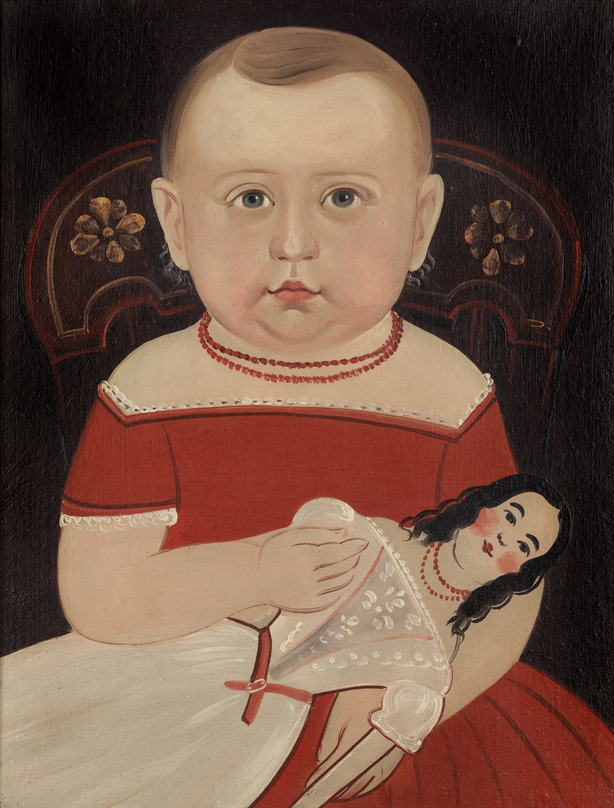
Little correctly attributed Rockefeller’s Baby with Doll to Hamblin in her descriptive catalogue of the Abby Aldrich Rockefeller Folk Art Collection in 1957, perhaps the first accurate published attribution to the artist.6 Still, the lack of published stylistic analysis hampered the development of a truer picture of the so-called Prior-Hamblin School and its members. In 1958, several unattributed Hamblin paintings were acquired by Stephen C. Clark and later bequeathed to the Fenimore Art Museum as part of the collection of Mr. and Mrs. William J. Gunn. The group of likenesses now attributed to Prior, Hamblin, and William W. Kennedy were all identified as “Manner of William Matthew Prior” in the 1960 catalogue of the collection, New-Found Folk Art of the Young Republic.7
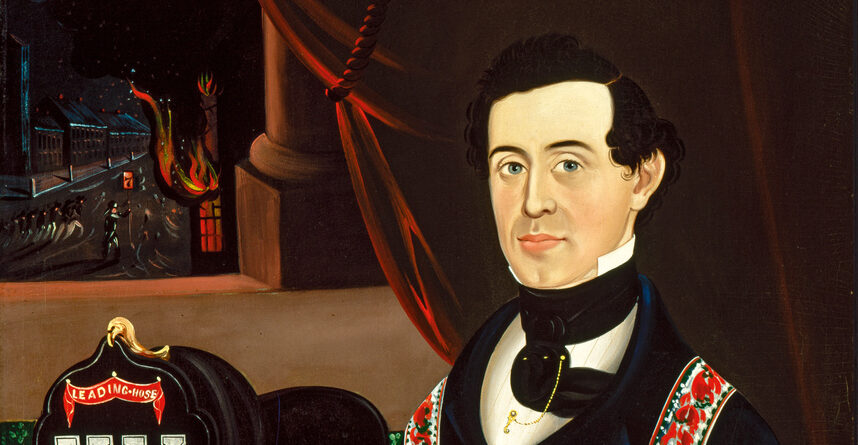
It was not until the early 1970s that larger numbers of Hamblin portraits were correctly attributed to the artist. The collection of Connecticut antiques dealer and collector Peter Tillou included six Hamblin portraits of the Gray Family and portraits of an unidentified sea captain and his wife, all attributed to Hamblin in his 1973 catalogue.8 Tillou seemed to know a Hamblin from a Prior, although he did not publish any description of the stylistic differences between the two. Consequently, when a major portrait by Hamblin—the Fenimore Art Museum’s The Fireman (now Charles C. Henry)—was included in Jean Lipman and Alice Winchester’s major 1974 Whitney Museum exhibition The Flowering of American Folk Art, 1750–1850, it was still identified as “Group of William Matthew Prior.”9
Appropriately, it was Rockefeller’s Baby with Doll that had a role in identifying the distinctive characteristics of Hamblin’s artistic style, along with those of Prior and William W. Kennedy, articulated for the first time by curator Donald Walters in the 1981 catalogue American Folk Portraits: Paintings and Drawings from the Abby Aldrich Rockefeller Folk Art Center. In his catalogue entries on Hamblin and the four works in the collection, Walters identified the hallmarks of Hamblin’s style that would form the basis of most future attributions: “the glistening quality achieved in the rendering of flesh modeling and highlights and the dark, cartoonlike outlining of hands.” He also pointed out “the backdrop format that combines drapery, a column, and a window view encompassing a bird perched on a barren tree.”10
As Hamblin’s work became better known, and more extant works attributable to him came to public awareness, other scholars and collectors began to elaborate upon his distinctive style (the traits now associated with Hamblin are summarized as they appeared in the literature in “Sturtevant J. Hamblin: A Style Guide” at the end of this essay). His life gained further context in Jacquelyn Oak and Gwendolyn Dubois Shaw’s landmark 2012 exhibition and catalogue Artist and Visionary: William Matthew Prior Revealed.
It was clear that by the second decade of the twenty-first century, more than two hundred years after his birth, Sturtevant J. Hamblin had achieved recognition as an important American artist whose growing body of work deserved greater scrutiny. Through all the literature on Hamblin, however, biographical data remained scant, his life story remained largely untold, and his artistic style had yet to be described comprehensively to facilitate reliable attributions. This essay aims to address these deficiencies and to compile all known information on Hamblin to establish a substantial knowledge base upon which future scholars can build.11
THE PAINTING HAMBLINS: EARLY YEARS IN MAINE
Sturtevant Hamblin had deep roots in New England. His ancestor James Hamlin I (also Hamelyn, Hamelin, Hamblin, and Haming) emigrated from London to Barnstable, Massachusetts Bay Colony, on Cape Cod, in about 1638 at the age of thirty-two. James established the Hamblin family in Barnstable by purchasing an eight-acre estate and an additional fifty-acre plot that came to be known as Hamlin’s Plains. When he died in 1690, Goodman Hamlin was remembered as a man “not much in public life. He was an honest man, a good neighbor and a sincere Christian. . . . industrious and prudent in his habits,” words that resonate with the largely quiet, steady nature of his descendant Sturtevant as implied by the historical record.12
According to an early history of Gorham, Maine, it was James’s son Bartholomew (1642–1704) who first acquired land on the Massachusetts frontier in what is now the state of Maine, by virtue of his having served in the Great Narragansett War of 1675–76. He was reportedly one of forty persons granted lots in a town that by 1745 had only about twenty families and a fort. Other members of the extended family settled in Gorham shortly thereafter, establishing a Hamlin foothold in what would become Sturtevant’s childhood home. Bartholomew and his son Ebenezer (1683–1736), however, maintained their residence in Barnstable.
Ebenezer’s son Gershom (1713–1756) was a shoemaker and fisherman in Barnstable who died, probably of smallpox, in 1756 at the age of forty-three. It was his widow, Hannah Almony Hamblin (1720–1797), “a woman of strong mind and great energy,” who brought Sturtevant’s branch of the family to Gorham to live. According to family history, Hannah packed up her family and sailed along the Massachusetts coast to the mouth of the Presumpscot River near present-day Portland, a distance of nearly two hundred miles. She then traveled up the river for several miles to Gorham. With Hannah was her eighteen-year-old son George (1745–1807), who had apprenticed in the painter and glazier’s trade in Barnstable and brought his skills to Gorham in addition to farming his hundred-acre lot. Thus it was that the Hamblin family came to be associated with artisan painting in Gorham and, later, Portland. George named one of his sons Almery, in honor of his mother.
Almery Hamblin was born on January 24, 1775, in Gorham, just a few months before the bombardment and burning of nearby Falmouth (a portion of which would become Portland) by the Royal Navy’s HMS Canceaux in October. It seems possible, even likely, that the extensive rebuilding of Falmouth and Portland (so named in 1786) after the Revolutionary War provided George and later his son Almery with plenty of work, and inspired Almery’s sons to learn the trade.13 Little of Almery’s life is documented, other than his marriage in 1797 to Sally (Sarah) Clark (1779–1822) and the births of their children Eli (1804–1839), Rosamond (1806–1849), Nathaniel (1810–1887), Joseph (1811–1890), and Sturtevant (1816–1884).14 The lives of Almery and Sarah in Gorham must have revolved around family, as he had ten siblings, at least one of whom, John (1781–1858), had twelve children of his own, in a town of about 2,500 people in 1800.
Sturtevant Joseph Hamblin was born in Gorham on March 18, 1816, and likely grew up surrounded by pigments, brushes, scrapers, chisels, and numerous cousins. As the youngest child, it was likely that he was most affected by his mother’s untimely death in May 1822, when he was just six years old. The Hamblins had already relocated from Gorham to Portland, as Sally Hamblin’s death and funeral occurred at the family home on Back Street. His father remarried in October of that same year, to Sarah Knox, a widow with three young children of her own. Although he may have been cared for by his older sister, Rosamond, Sturtevant’s closest family bond was likely to his brother Joseph, five years his senior.
By 1823, the Hamblins were firmly established in the painting trade in Portland, as both Almery and Eli appear in the city directory as painters residing at the corner of School and Congress Streets, probably in a larger home to accommodate an expanded family. They were located in the heart of a city that was recovering from severe economic downturns in the previous two decades, caused by the Embargo of 1807 and the War of 1812. In the 1820s, Maine became a state and Portland’s population grew by nearly 50 percent, undoubtedly creating plenty of opportunities for artisans like the Hamblins.15
It was two years later, in the spring of 1824, that an encounter would change the course of several of the Hamblins’ lives and careers. William Matthew Prior, an eighteen-year-old portrait painter from Bath, arrived in Portland and appears to have sought out Almery Hamblin soon upon arriving. The nature of this meeting is not documented, and we are left to speculate on what impression Prior may have made on the eight-year-old Sturtevant. We do know that Prior must have made an impression on Sturtevant’s sister, Rosamond, as he painted her likeness at that time and would marry her four years later.16
By 1825, Prior had improved dramatically as a portrait painter, executing a confident self-portrait and working to expand his business.17 About this time, he made connections to established Boston painter John Ritto Penniman and renowned portraitist Gilbert Stuart, probably through Portland landscape painter Charles Codman. If the adolescent Sturtevant had regular contact with Prior in the mid-1820s—which seems likely given the latter’s courtship of his sister and probable caretaker—he would have been exposed to an exciting world of artists who went far beyond the work for which the Hamblin family was known. Prior was also practicing his portrait trade “at Mr. Hamblin’s, Quincy Lane,” in Portland by 1827, further cementing his relationship with the family.18
The late 1820s and early 1830s must have again been difficult times for Sturtevant, then in his young teens. In 1828 Prior married Rosamond and moved to Bath, taking two important people out of his daily life.19 In about that same year, Nathaniel Hamblin built a house on Green Street (now Forest Avenue) in Portland, and it is possible that Sturtevant, then fourteen, lived with him there rather than with his father and stepmother.20 An even bigger blow occurred with the untimely death of his father, Almery, in 1830 at the age of fifty-five.21 Nevertheless, the Hamblin painting business continued, as both Eli and Nathaniel are listed as painters at the same shop on Union Street in the 1831 city directory. Their cousin William, a bricklayer, may have lived with them, and would have been useful as the Hamblins became builders and real estate developers in the mid-1830s.
Consequentially for Sturtevant, William Matthew and Rosamond Prior moved back to Portland in 1832. By 1834, they were living with Nathaniel Hamblin and his family at their house on Green Street, and it is likely that Sturtevant lived there as well. This must have been a formative time for Sturtevant, with Prior back in his life and expanding his portrait business. It is possible that Sturtevant met Charles Codman as well, owing to the presence of scenic landscape murals probably painted by Codman in Nathaniel’s house around this time.22
In 1835, Nathaniel, Eli, and Joseph Hamblin embarked on a major real estate project: the development of the “Hamblin Block” on Danforth Street in the sparsely inhabited west end of Portland. The development consisted of four Greek Revival brick buildings, including two double houses, a four-unit rowhouse, and a single dwelling. The Hamblins appear to have financed the project themselves, and the homes sold for the most part within a year for between $3,000 and $3,800 each.23
By 1836, Sturtevant had come of age, and records indicate that he married Harriet Newhall York in Portland on October 13 of that year. The following year, the twenty-one-year-old Sturtevant is listed in the business directory for the first time, with the occupation of “painter” and, along with Joseph, residing “at Wm. M. Prior’s” in one of the Danforth Street buildings.24 There is no evidence that Sturtevant was painting portraits at this time, although his appearance in the directory and close proximity to Prior led a generation of scholars to list his active dates as 1837 to 1856. It is more likely that he was simply following the family trade and working as a house painter. It was also in 1837 that Joseph Hamblin married Elizabeth Hartwell, whose brother George would become a fellow portrait painter working in the Prior-Hamblin style. Sturtevant and Harriet had their first child, Elizabeth Pearson Hamblin, in September 1839.25
For reasons that are not documented, Nathaniel, Eli, and Joseph Hamblin bought a large farm in Scarborough, just south of Portland, in 1838.26 It is possible they had some real estate project in mind, but Eli’s death in 1839 may have scuttled their plans. Joseph may have moved there, as he and Elizabeth had a son, Howard Malcolm Hamblin, born there in October 1840.27 By that time, Sturtevant and Prior had already left Maine and were seeking new lives in the bustling metropolis of Boston.
THE ELEGANT BRUSH:
THE PORTRAIT YEARS IN BOSTON AND EAST BOSTON
The move from Portland to Boston occurred over several months, with Prior leading the way in 1840 between May 8 (the date of the birth of daughter Jane in Portland) and July 31 (when son William Jr. was born in Boston). The reason for the move was largely to seek business opportunities, as Prior’s new home at 12 Chambers Street was centrally located in the West End near Beacon Hill, the Massachusetts State House, and the Boston Athenaeum—an area already populated by artists, engravers, and lithographers. For Prior, an added benefit of the move may have been to be closer to the center of the Millerite movement, with which he was already profoundly influenced.
While there is no documentation for when Nathaniel and Joseph may have moved, it is clear that Sturtevant was in Boston by October, as he and Harriet joined William and Rosamond Prior at the largest Millerite events held to date in Boston.28 The event was a two-day extravaganza held on October 14 and 15, 1840, at the Chardon Street Chapel, where one of Miller’s most prominent followers, Joshua Himes, was pastor. More than two hundred people attended the lengthy discussions of Millerism and its history. William Miller was supposed to attend but sent a letter of regrets to the attendees owing to illness. The list of attendees, published in the Millerite paper Signs of the Times, indicates that Prior and his wife, Rosamond, paid $6 to attend and ordered eleven copies of the conference report. Sturtevant and Harriet each paid $1 admission and ordered one copy of the report. While there is no direct evidence as to what the Hamblins thought of the conference, their paying the minimum to attend and then leaving no other known record of any further involvement with Millerism suggests that they attended out of respect for Prior. While Prior was obviously Sturtevant’s friend and mentor, he appears not to have been his spiritual guide.29
Hamblin listed himself as a portrait painter for the first time in the 1841 Boston city directory, indicating that he had by this time received some instruction from Prior. He and his brother, Nathaniel, are listed as living at 12 Chambers Street, along with Prior, so it is likely that he was able to observe the latter’s portrait making firsthand.30 This arrangement calls to mind Prior’s own purported observations of Gilbert Stuart working in his studio in the 1820s.31 Either Hamblin must have begun painting likenesses earlier or he caught on quickly, as he executed five beautiful portraits of the Jewett family at some point in 1841, around the time he and Harriet had their second child, daughter Sarah C. Hamblin.32
The atmosphere in which Hamblin launched his portrait painting career is widely documented, as the introduction of the daguerreotype to the United States caused profound shifts in the market for portraits. Daguerreotype studios flourished in cities such as Boston in the 1840s, and the number of portrait painters—especially those with no formal training, like Prior and Hamblin—sharply diminished.33 Those who continued to paint had to compete with a process that was an inexpensive, quick, and accurate way to obtain a likeness. Hamblin was indeed fortunate to have an older brother-in-law who was one of the country’s most accomplished and popular portrait painters, one who had developed an appealing and inexpensive style to attract middle-class customers who still saw value in painting. Hamblin’s early efforts as a portrait painter, to the extent that we know, predominantly emulate the Prior “flat” style. Later in the decade he, like Prior, painted ever more elaborate and decorative portraits to appeal to a more affluent clientele for whom a painted portrait signaled a measure of sophistication.
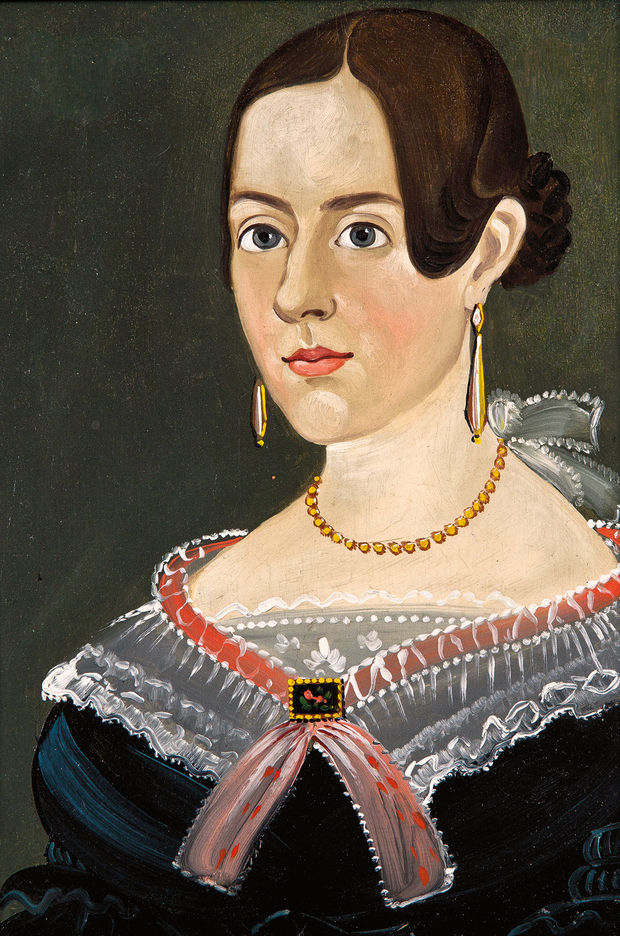
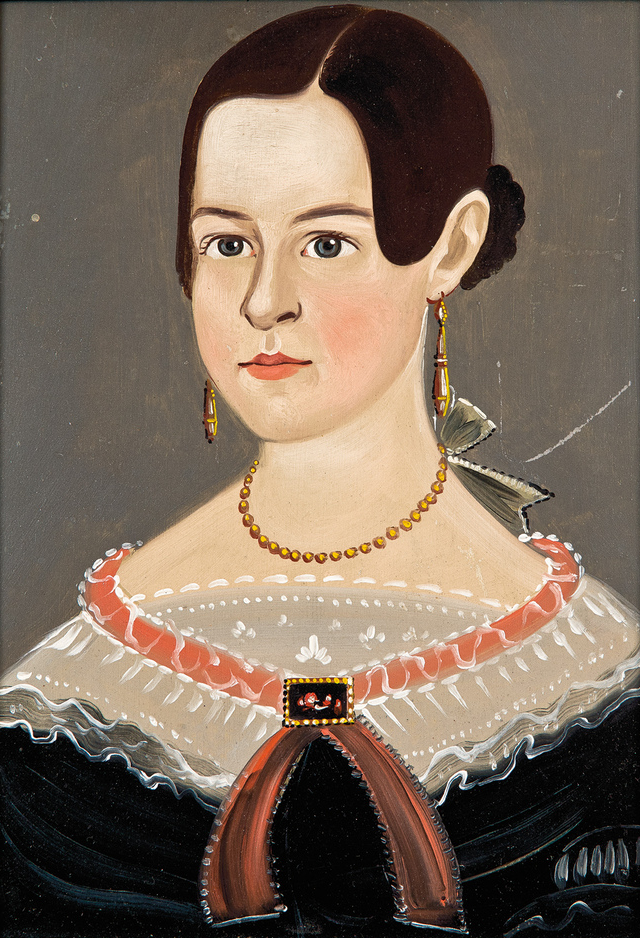
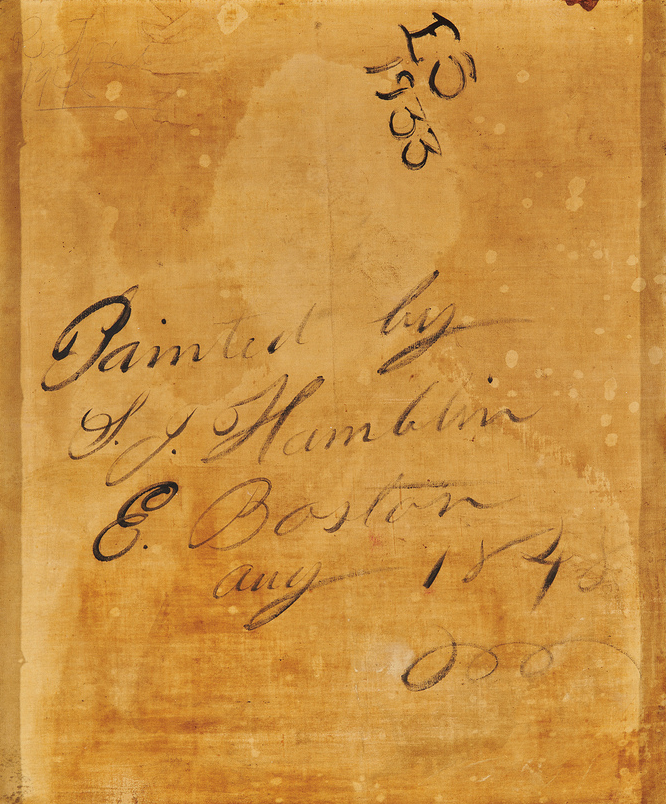
Hamblin’s early work is difficult to document owing to his practice of not signing his portraits. The likenesses of Aaron and Hannah Jewett, and their daughters Phoebe and Hannah, are rare exceptions (see figs. 1, 2). These works are inscribed, presumably by one of the sitters or a relative, with Hamblin’s name and 12 Chambers Street address, along with the sitters’ names, ages, and even relationship to other family members. Aaron was a cabinetmaker who likely lived in Bristol, New Hampshire, some one hundred miles to the north of Boston.34 The presence of Hamblin’s address in the inscriptions indicates that the Jewetts must have traveled to Boston and, while there, had their likenesses rendered by Hamblin, then a young artist just starting out in his trade. It is entirely plausible that they sought out Prior, who referred them to Hamblin either as a way of helping launch his career or to keep the business going while absent following William Miller.35
The Jewett portraits strongly reflect the influence of Prior’s so-called flat style. They are small-scale (each 14 by 10 inches), bust-length likenesses without much extraneous detail. They are, however, highly competent likenesses with considerable personality and charm. Phoebe and Hannah’s portraits, in particular, have a lot of visual energy in the manner in which Hamblin rendered their lace, ribbons, and jewelry. The main difference from Prior’s work is the surface texture in the faces: Prior painted with visible brushstrokes to highlight facial contours and animate his portraits, while Hamblin painted with a smooth, elegant style that left a more even surface and serene expressions.36 It is obvious from these portraits that, from the start of his career, Hamblin had a real talent for portraiture and, probably with Prior’s help, would become an appealing and possibly less expensive alternative to the better-known artist.
At some point in 1842, Prior and the Hamblins moved to the thriving, working-class neighborhood of East Boston. Established in 1836, the neighborhood was created by using landfill to join five islands in Boston Harbor. East Boston was connected to the city only by ferry at this time, which gave it a distinct character. It was also a center for shipbuilding and the maritime trade, which would provide opportunities for portraitists such as Prior and Hamblin, but mostly offered a more robust clientele for the portraits at the lower end of their price scale. The 1842 and 1843 Boston city directories indicate that Prior and Sturtevant, Joseph, and Nathaniel Hamblin were all living on Marion Street in East Boston, with Nathaniel and Joseph listed as painters and Prior and Sturtevant as portrait painters.37
The first few years that the group spent in East Boston were transformative in several ways. Prior became very active in Millerism and may have been traveling and painting in service to the cause for long stretches of time. The year 1843 saw intense anticipation of the Millerite Second Advent, predicted between March 21, 1843, and March 21, 1844, which likely preoccupied Prior for most of the year. He became less active in Millerism after the “Great Disappointment” of 1844, when the last of Miller’s revised predictions failed to come true.38
Evidence suggests that at some point in 1842 George G. Hartwell (1815–1901), brother-in-law to Joseph Hamblin, was in Boston and learned the portrait business from either Prior or Hamblin. Hartwell was in East Boston at least through 1845 or 1846, after which he moved to Lowell, Massachusetts. Meanwhile, William W. Kennedy was in Massachusetts and Rhode Island in 1844 and 1845. Lastly, Jacob Bailey Moore is listed in the Boston city directory as a portrait painter living on Atkinson Street in 1843. The nature and extent of their interactions in this relatively short period of time have yet to be determined. Sturtevant continued to live with the Priors until 1844, when he and Joseph moved to Sumner Street in East Boston, and he opened his own studio at 79 Broad Street in Boston, which he kept for several years.39 The portrait business must have been booming for Hamblin in the mid-1840s.
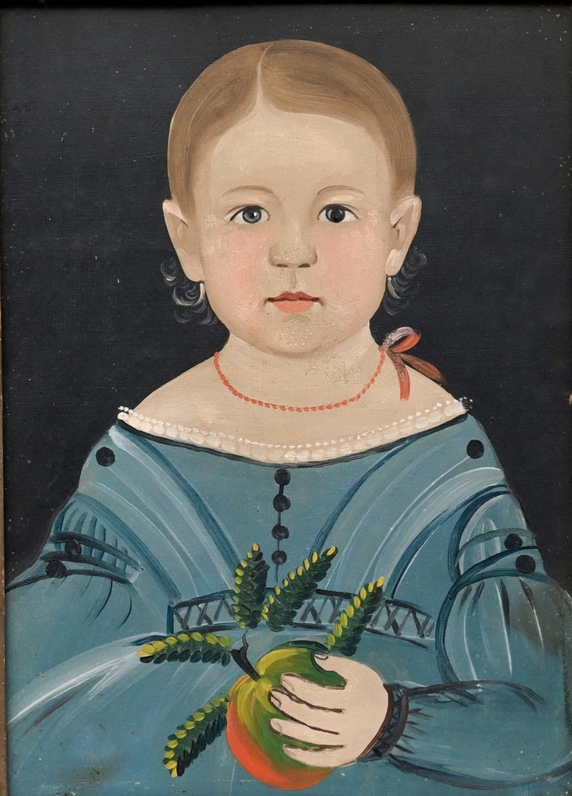
There are few Hamblin portraits with documentation indicating they were done in the early or mid-1840s, and yet it seems clear that he rapidly expanded his repertoire of poses, props, and settings. In the portrait of Mary Caroline Haynes, done about 1842, Hamblin adopted a frontal pose that would mark some of his most endearing children’s portraits for years to come (fig. 4).40 While this likeness is the same size as those of the Jewetts and likewise executed on academy board, Hamblin painted the young sitter in a frontal pose and three-quarters-length view, emphasizing the face while elaborating on costume details and a handheld prop, an apple and sprig. Works such as this may reflect the beginning of Hamblin’s hallmark compositional symmetry, as well as other distinctive traits such as the use of salmon pink alongside a grayish white for coloration of the lips and cheeks. These subtle highlights, along with the smooth, even brushwork, are evident in the works most confidently attributable to Hamblin.
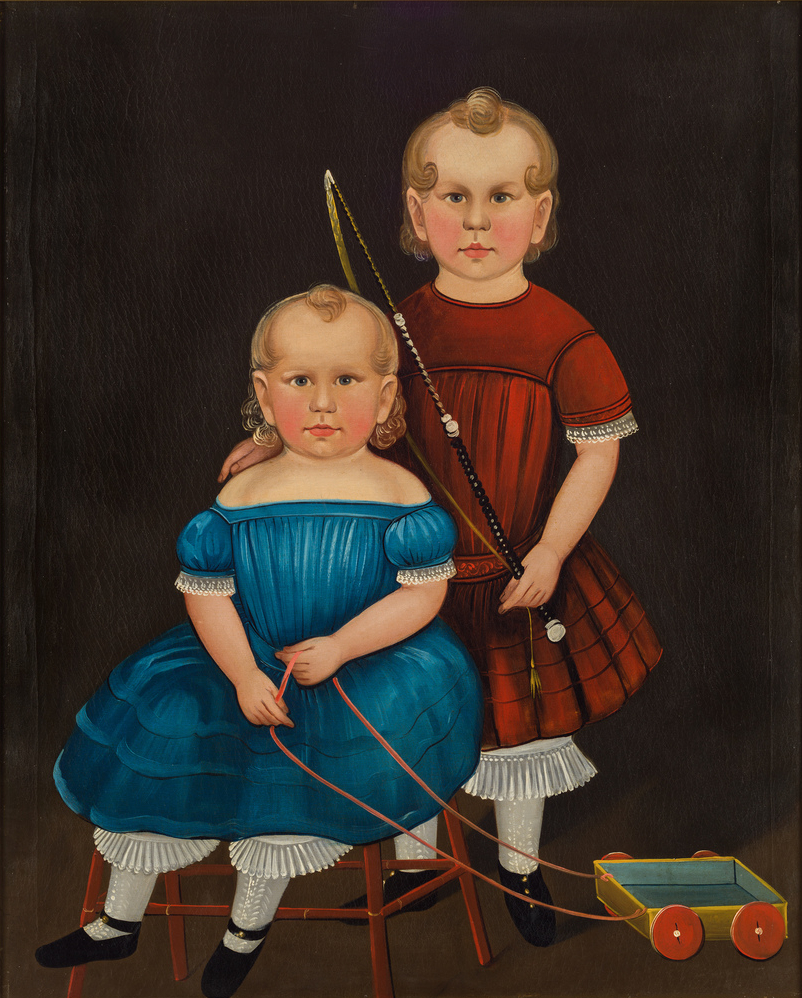
Other Hamblin portraits of children done in this format probably date to the mid-1840s. Of particular note is the artist’s iconic Baby with Doll, where all the aforementioned stylistic traits are present, along with Hamblin’s distinctive hands outlined in dark brown lines and tapering to the index finger (see fig. 3).41 The miniature Boston rocker appears in a number of Hamblin’s portraits and may have been a studio prop, along with the milliner’s doll, which was a frequent accessory of mid-nineteenth-century folk portraits. In this likeness, Hamblin playfully mimics the child’s necklace by painting an identical one on the doll. The child’s bright red dress is a startling change from the subtle blues and blacks of the previous works.
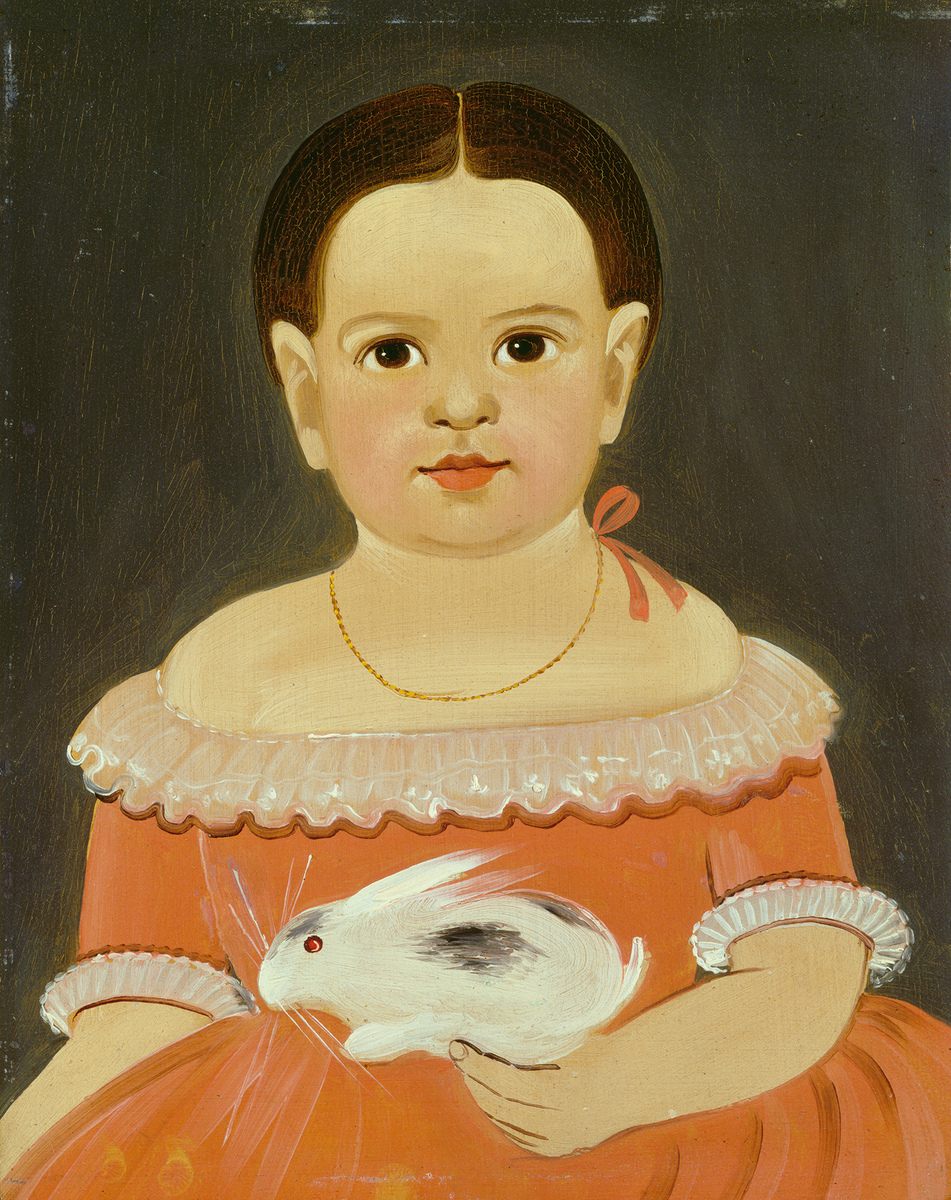
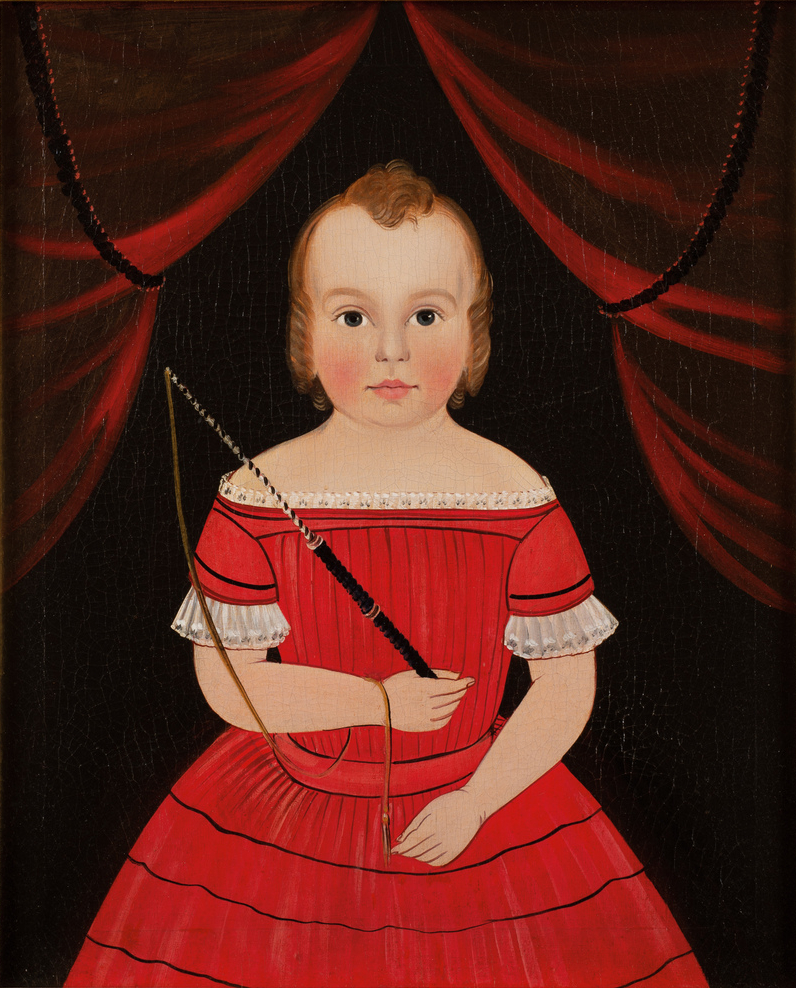
Perhaps the most striking trait of Hamblin’s portraits of children in works from the mid-1840s is the frontal view where a wide-eyed child directly engages the viewer with considerable charm and innocence. Hamblin repeated this format in numerous works through the decade, which attests to its popularity among his clients. It is a simple format, probably inexpensive, and seems to have appealed to parents in Boston and East Boston who knew too well the variety of diseases that took youngsters at an alarming rate at this time. The inclusion of age- and gender-specific props and interior details such as drapery created a highly effective formula for Hamblin’s clientele. Little Girl with Pet Rabbit is a prime example of this body of work, as it shows a rosy-cheeked child at about three years of age, with large brown eyes and holding a small pet rabbit in one hand (fig. 5). Child in Red with Whip includes a toy whip—a common prop—along with subtle drapery swags that pick up the red in the child’s dress (fig. 6). Hamblin would experiment with and expand upon this format in the coming years, to great effect.42
By 1846, Sturtevant and Harriet had six-year-old Elizabeth, five-year-old Sarah, and a new baby boy, Sturtevant Joseph Hamblin Jr., born at some point during the year. The arrival of their third child may have prompted Sturtevant to relinquish his Boston studio and work out of their home, as the 1847 city directory records the Hamblins living on Havre Street near Maverick in East Boston, with no mention of the Broad Street location.43 It was a bustling part of town, like Sumner Street, very near the East Boston Wharf, Hotel Square, and the Eastern Railroad depot, all of which were prime points of entry for potential sitters.
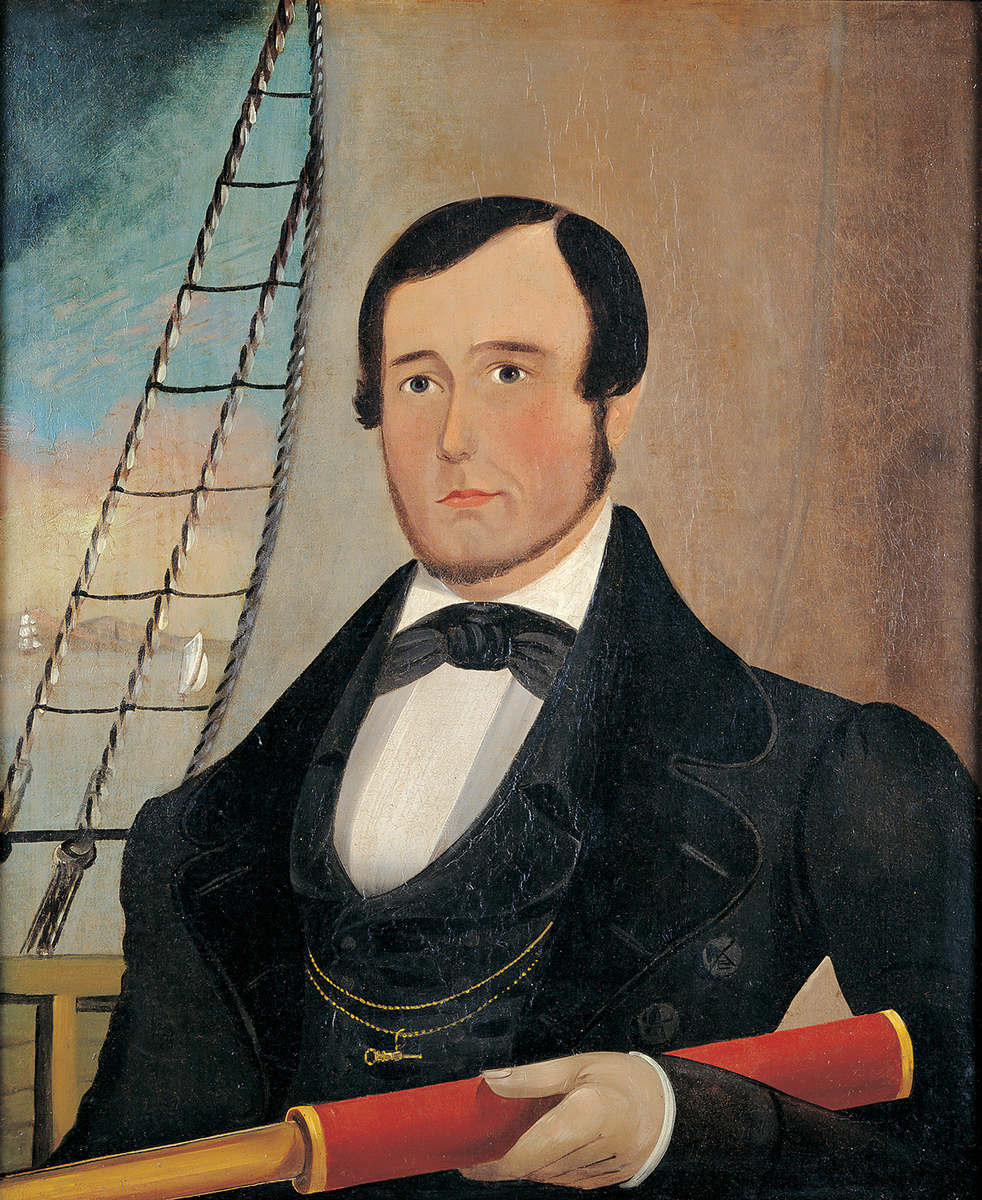
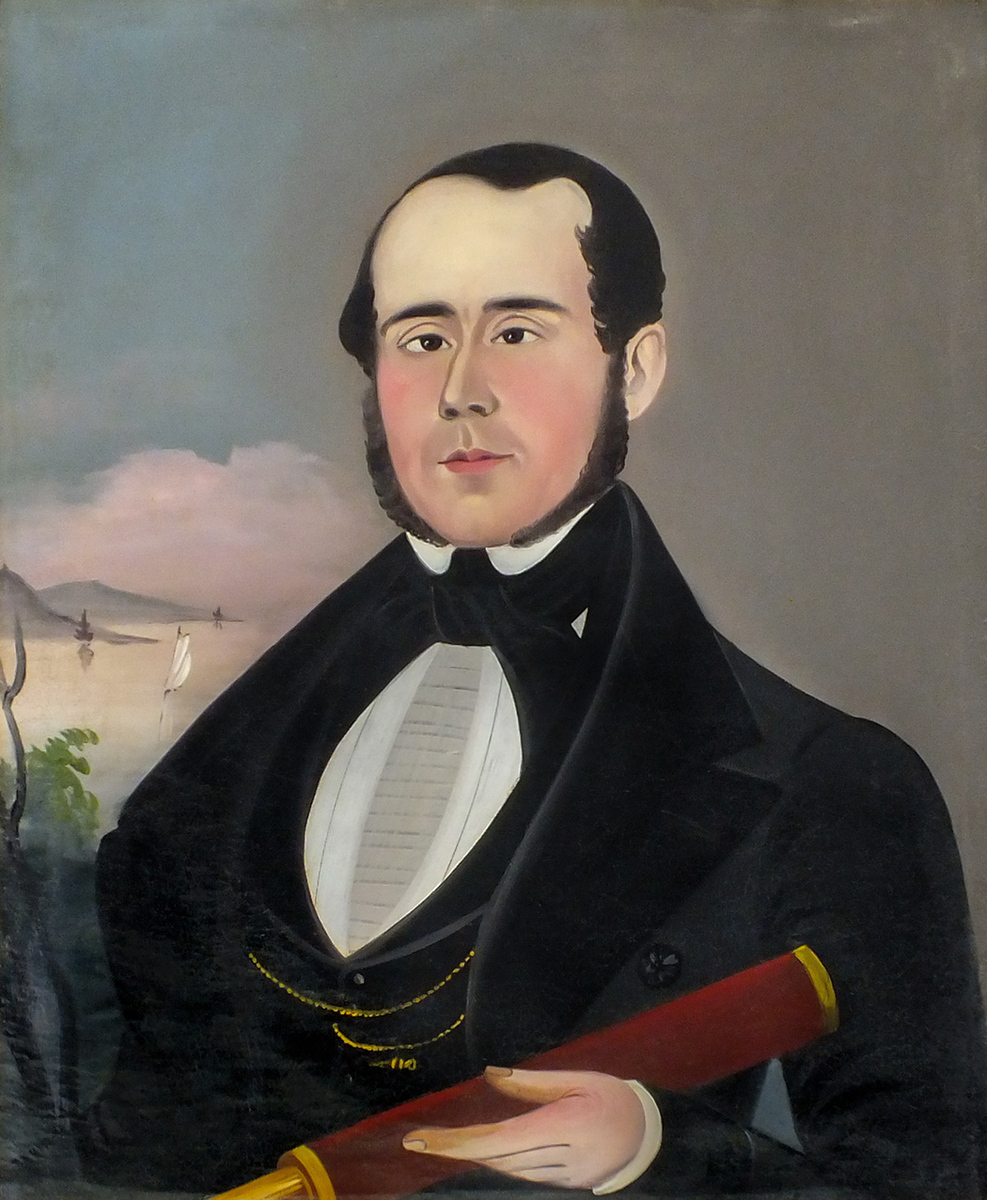
Hamblin’s prime location likely made him an obvious choice among ships’ captains who were seeking a likeness during a brief stopover in Boston or East Boston. He appears to have adopted an oft-used formula for these portraits that included a half-length seated pose with a landscape background and a spyglass held by the sitter. The best-known of these is Sea Captain at the American Folk Art Museum, which features a young gentleman in a stylish black suit, his pose accentuated by an exaggerated collar and shoulders, tapered jacket, and stylized arm firmly holding a spyglass (fig. 7).44 The man’s profession is further identified by the sailcloth placed as a foil for his face, the rigging on the left, and the distant seascape with sailing vessels beyond, elements probably derived from Prior. It is not known when Hamblin started including landscape backgrounds in his portraits, although a signed example from 1848 is extant, and it is likely that Prior started painting landscapes in the mid-1840s at his “Painting Garrett” on Trenton Street in East Boston.45 Hamblin’s portrait of Captain William B. Aiken at the Peabody Essex Museum features a similar stylized black suit, a spyglass lightly held in the sitter’s left arm, a neutral background on the right, and a serene rendering of a distant shoreline to the left (fig. 8).46
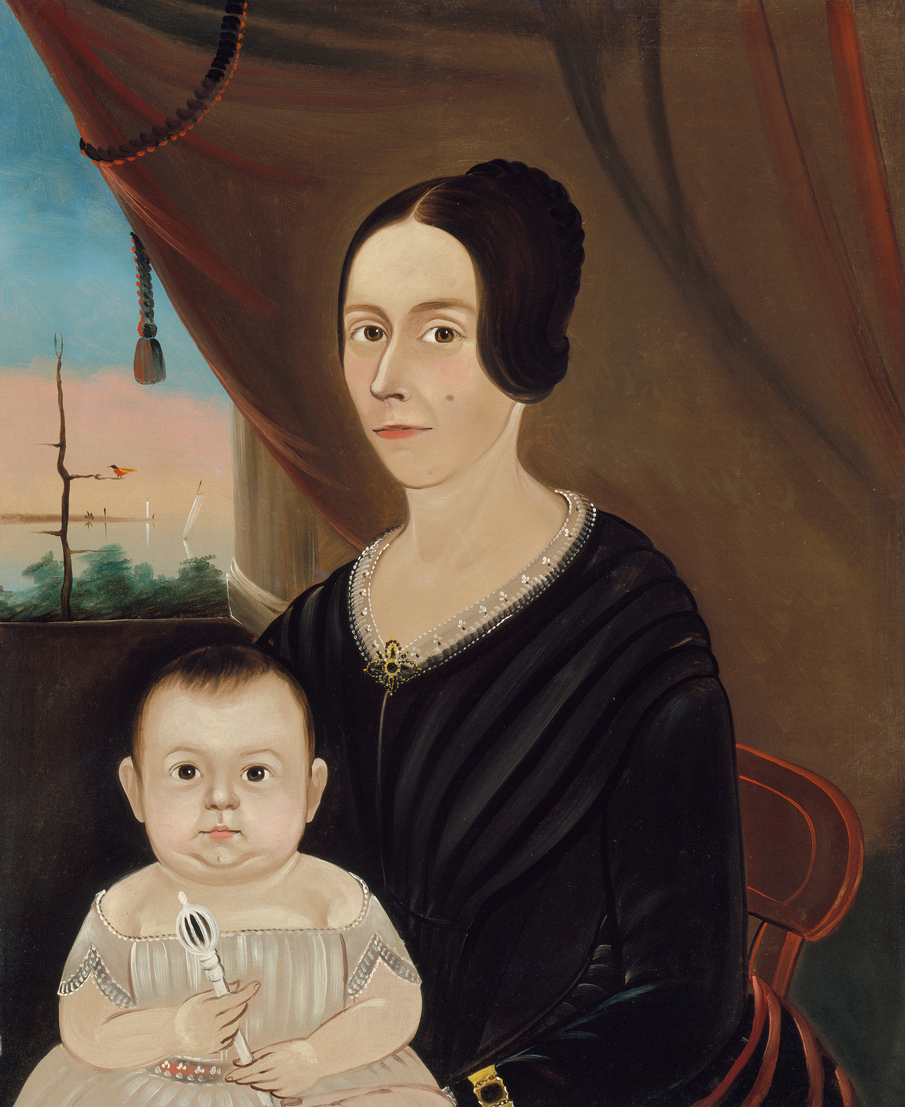
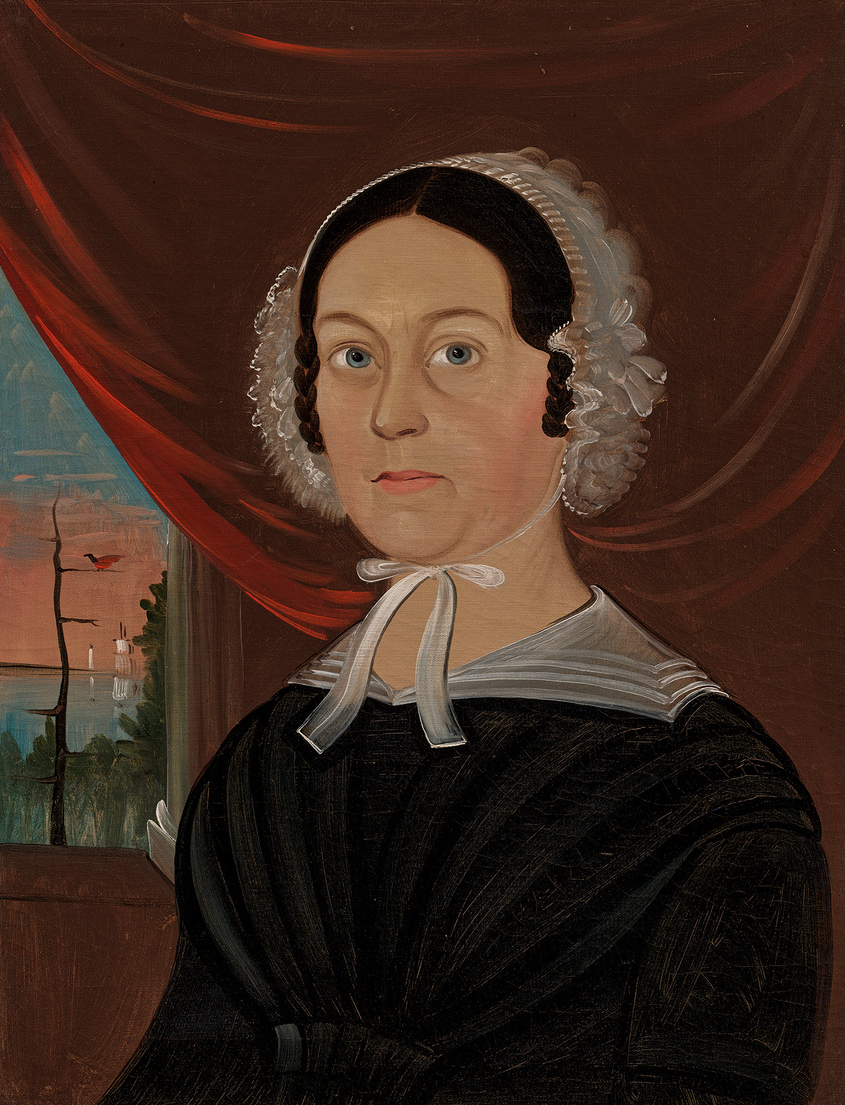
Unlike Hamblin’s landscapes painted for sea captains, however, his scenes for other sitters among this group are generalized and remarkably consistent. In Mother and Child at the Museum of Fine Arts, Boston, Hamblin places his unidentified sitters in front of a large drapery swag with a window view off the right shoulder of each. The view this time is framed by a white neoclassical column and features a tall dead tree on the near shore of a placid body of water with sailboats and a distant shore. Delicately perched on a branch of the tree is a red bird with a black head, possibly a northern cardinal, a symbol of good luck. This bird is a small point of interest that the artist repeated in numerous vistas in his signed or attributed portraits. Hamblin’s Lady with Black Hair also at the Museum of Fine Arts, Boston, signed but not dated, has a nearly identical landscape view with dead tree and bird and was likely painted at about this time.
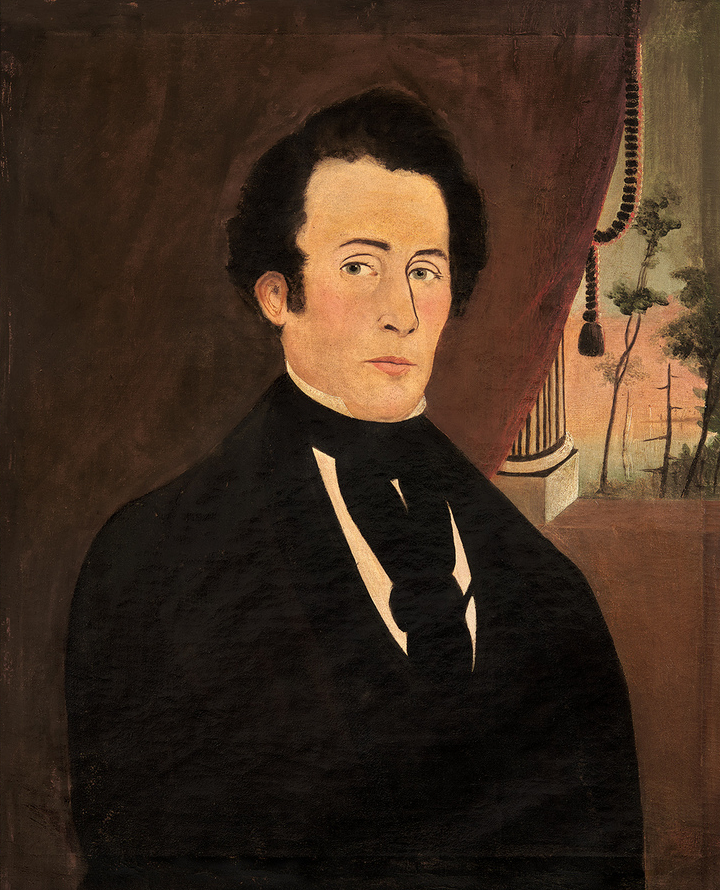
In August 1848, Hamblin signed and dated a portrait of New Hampshire mill owner and lumber dealer Asa Jewett, depicting him in a similar setting (figs. 11, 12). The confidently posed Jewett was probably in East Boston on business (lumber being a crucial component of the shipping business) when he had his portrait painted.48 Over the sitter’s left shoulder, Hamblin varied his landscape formula only slightly, opting for living trees to frame the view.
Although the portrait business appears to have been going well, as indicated by the number of signed, inscribed, or documented likeness from the late 1840s, the period was marked by a series of personal tragedies for Hamblin. He and Harriet lost two children from scarlet fever over a period of three days in December 1848: two-year-old Sturtevant Jr. and seven-year-old Sarah. Both were interred in the East Boston Cemetery. The following year, the Hamblins had a stillborn child in April, and in August forty-year-old Rosamond Prior and her four-year-old son, Joseph, died of cholera. In November 1850, the Hamblins had another son, again Sturtevant Joseph Hamblin Jr., only to lose him at nine months from “disease of the bowels” (probably dysentery).49
We will likely never know the effect these deaths had on the Hamblins, and how it must have felt for Sturtevant to paint the many young children of strangers who came to their house to have portraits taken. Nevertheless, it is noteworthy and poignant that Hamblin painted some of his most complex and beautiful portraits of children in about 1848 and 1849. One of those, in particular, must have evoked the emotional trauma of the loss of a child for the artist, the sitters, or both.
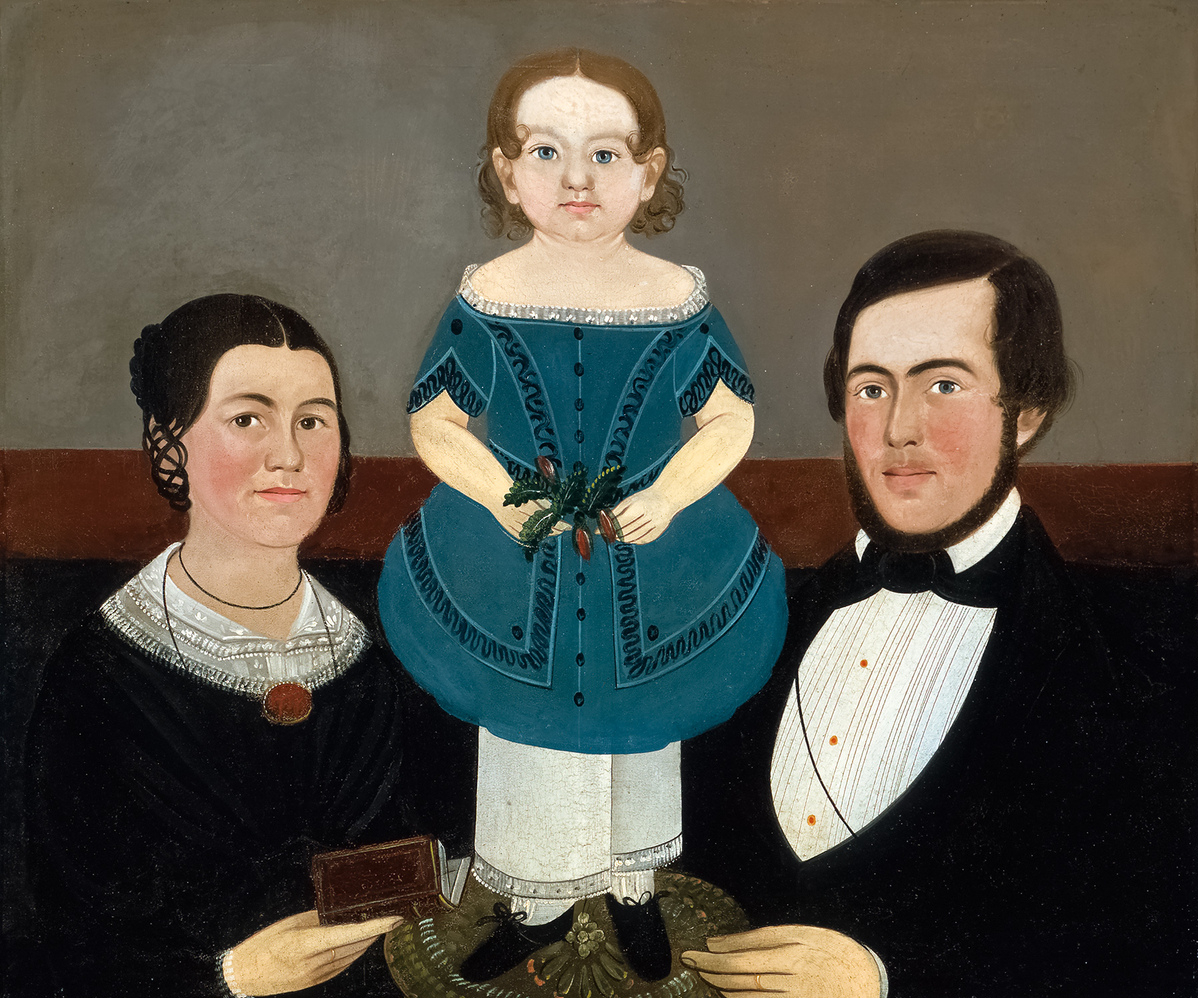
At some point in 1848 or 1849, Hamblin painted a triple portrait of stonemason Benjamin T. Rounds, his wife Sarah, and their son Benjamin Jr. (fig. 13). The composition is striking, owing to the placement of the young Benjamin at the center of the canvas standing atop a painted table where one would expect a still-life arrangement. In contrast to the half-length, three-quarters-view likenesses of the adults, the full-length frontal portrait of the child is startling and visually arresting in its forthright posture and placement at the apex of a triangular composition. The Roundses were married in 1840, and Hamblin must have known that they lost their first son, also Benjamin T. Rounds Jr., as a one-year-old in 1845. The Benjamin Jr. likely depicted in the portrait was born in 1846 and thus about two years old, identical in age to that of the first Sturtevant Jr., who would be dead within the year (if he had not already passed away when this portrait was painted).50 We are left to wonder if Hamblin ever painted a similar portrait of his wife Harriet and their children, or if he felt a keen regret at not having captured their likenesses as he did for the Roundses.
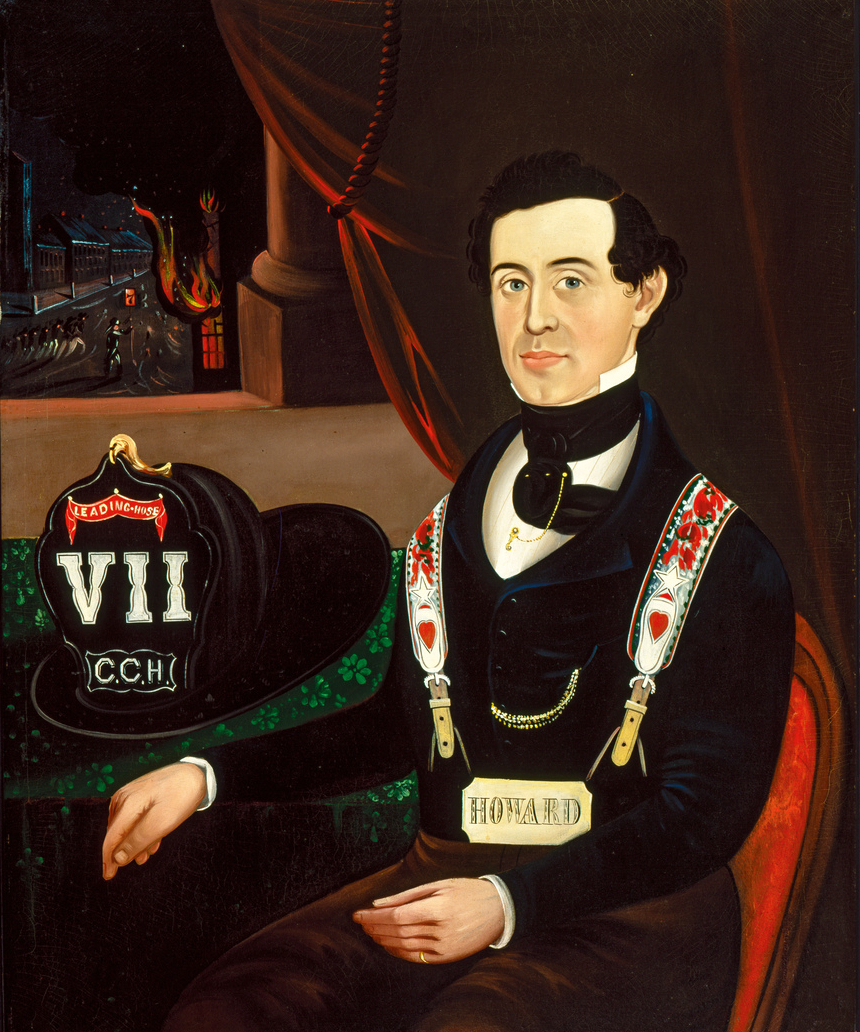
Judging from the resulting portrait, the company must have been generous with the commission. Not only is Henry painted with Hamblin’s enhanced modeling of facial features and hands, but the amount of decorative and informational detail goes far beyond any other known portrait by the artist. Hamblin takes great pains to identify his subject by placing Henry’s fire helmet with his initials, the engine number, and the position “Leading Hose” prominently on the table at the left. Henry also wears a belt buckle with the name of his company. His highly decorative suspenders complete the formal fire regalia with which he is depicted. Yet the most enthralling aspect of this portrait is the clear sense one has that it is a night scene, with Henry’s company responding to a fire in the window view at the upper left. Hamblin enhances the dramatic fire scene with the use of red tones on the drapery, helmet, suspenders, and chair to contrast with the liberal use of black in the painting.
The nighttime fire scene in the window is Hamblin’s only known streetscape and is reminiscent of the nocturnes painted by Prior at his “Painting Garrett” on Trenton Street in the 1850s.55 It provides evidence of Hamblin’s ability to depict buildings in receding perspective, dimly lit by the glow of the large conflagration. The row of seven firemen leans forward convincingly, as if pulling a fire hose. Hamblin was clearly called upon to celebrate the valor and dedication of his subject, who knew well the dangers of fighting fires. One must assume that Henry was pleased by his portrait and delighted to be so honored in front of his peers, as the meeting minutes of the company indicate that the Annual Ball, where the portrait was displayed, came off “to the entire satisfaction of all present.”56 Thus, the only known public display of Hamblin’s work during his lifetime was a resounding success.
The portrait of Charles C. Henry, fireman and bonnet presser, is not the only painting to foresee Hamblin’s eventual career change from portrait painter to haberdasher. A curious painting of a group of women ironing, with a gentleman overseeing their work, appeared in the Fenimore Art Museum collection in the late 1950s (fig. 19). It had been found in Rhode Island but lacked any other documentation. Titled The Ironers, it was the subject of much speculation, the consensus being that it depicted the interior of a commercial laundry. The painting can be safely attributed to Hamblin and is his only known interior genre scene.57
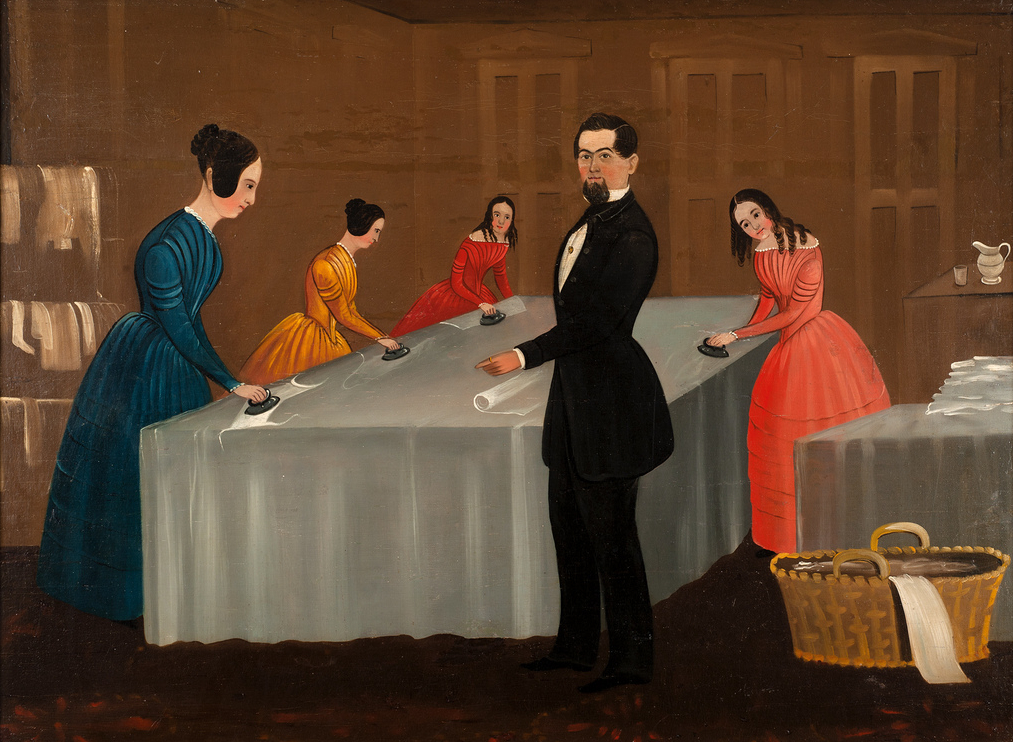
In The Ironers, Hamblin shows the four women and their employer in a large room with several closed doors. They stand around a large work table covered by a white tablecloth, the women busily using sadirons to press various articles of clothing while the man looks out at the viewer, scroll in hand, pointing to the work being done as if advertising a business. Additional articles of clothing can be seen on a table and in a basket at the right, and on drying racks at the left. The hairstyles of the women, two with hair pulled back into buns and two with hair down, seem to indicate an older and younger pair. The hair and clothing styles support a date range from the late 1840s to the early 1850s, about the time the portrait of Henry was completed. Considering that portrait painters at this time were not figure painters, Hamblin did a commendable job at creating a believable scene of daily life within a commercial business. Of particular note is his color harmony, with the women’s dresses being a rich blue and yellow along with two shades of his signature salmon, all standing out boldly against the white of the garments, the man’s stark black suit, and the brown interior.
The 1850s were increasingly challenging times for portrait painters, with the photography business becoming ever more attractive for those seeking likenesses, especially the tradespeople and merchants who had patronized folk artists for generations. When he did paint portraits, it seems likely that Hamblin noticed that his sitters were doing better economically than he was. Probably in an attempt to gain more business, Hamblin moved his studio back into Boston in about 1852, selecting a location on Commercial Street near the wharves while maintaining a residence near Maverick Square in East Boston.58 It was in 1853 that he painted two of his last documented portraits: a large triple portrait of the sons of Edwin and Sarah Hill; and a likeness of ship captain Thomas W. Lewis (figs. 20, 21).

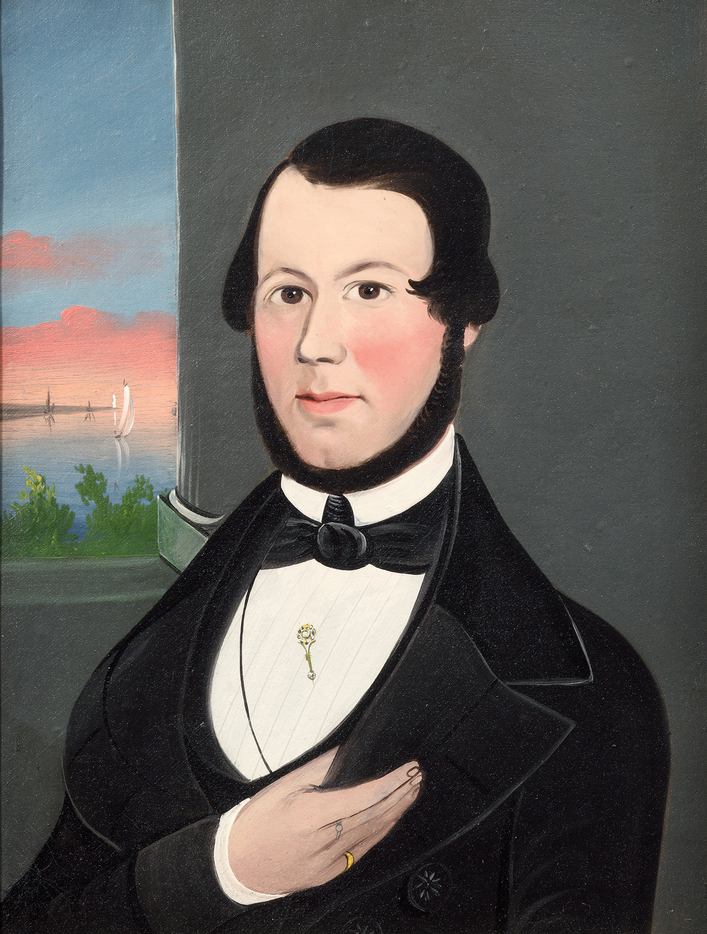
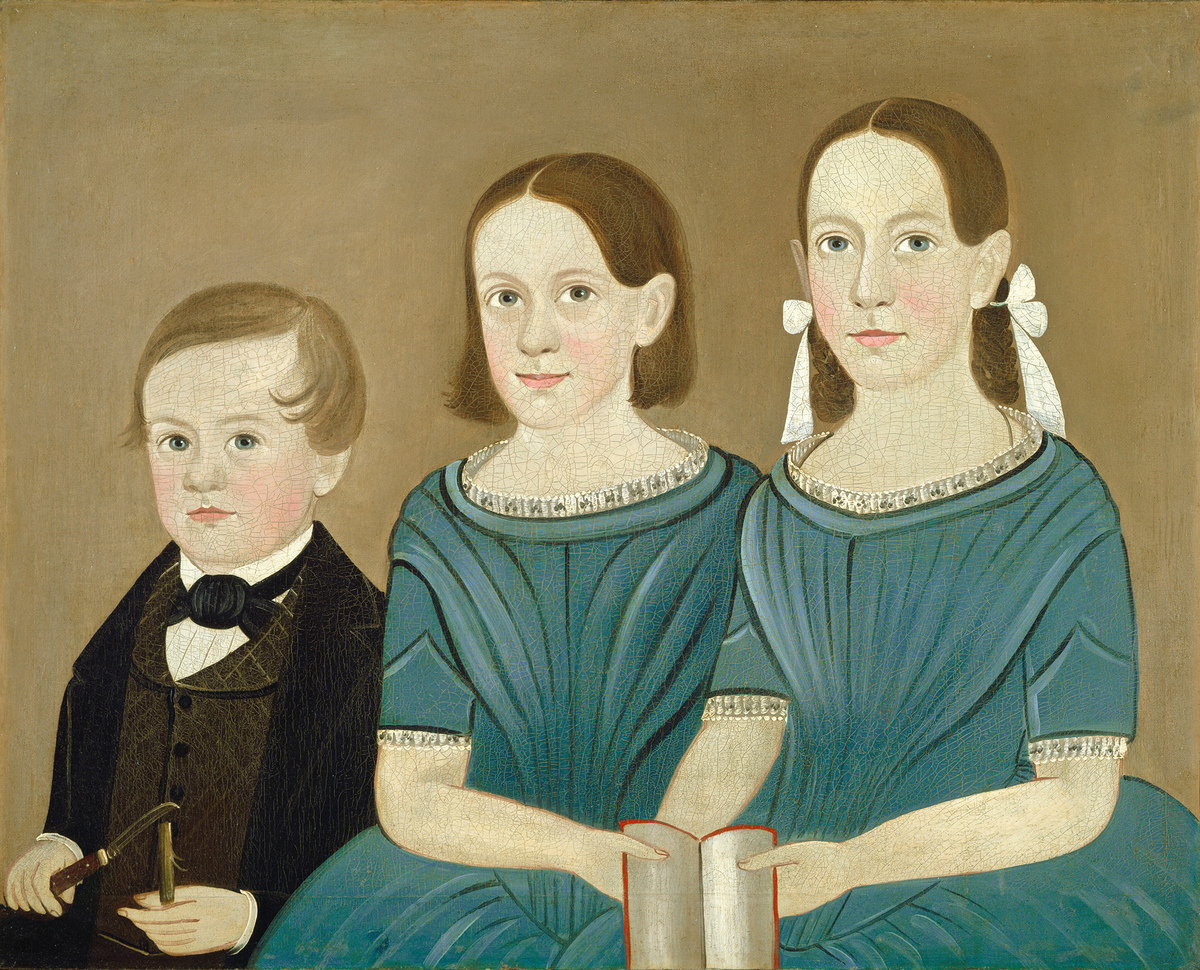
The portrait of the Hill children is one of Hamblin’s largest and most complex compositions. He posed the boys in a triangular format with the oldest, six-year-old Augustine Prentice Hill, standing at the center. Seated to the right with one leg draped over the arm of his chair is four-year-old John Pierce Hill, and seated in the high chair at left is one-year-old Edwin Lawton Hill. As in The Ironers, Hamblin’s neutral background effectively sets off the pink, green, and blue of the boys’ clothing as well as the red-painted high chair and miniature Boston rocker. While Edwin holds an apple and cherries as props, Augustine holds a book with the date 1853 on the cover. The boys’ father, Edwin A. Hill, was a stair builder who lived on Decatur Street in East Boston, very near Hamblin’s residence, in 1853. He must have been doing well financially to commission such a major work, and Hamblin’s ability to deliver such a large, beautiful group portrait shows that he was at the height of his artistic powers when his portrait business came to a close.59
According to documentation for the Captain Lewis portrait, which descended in the Lewis family, the captain arrived in Boston from Bath, Maine, on the bark Silver Cloud on June 12, 1853. The ship departed Boston for Cape Town on June 25, leaving Hamblin roughly two weeks to secure and complete the commission. In the resulting portrait, Hamblin returns to a simplified format from his early years, that of a small portrait (18 by 13 inches) on academy board. The exceptionally smooth, linear composition features Hamblin’s classic handling of facial features and hands, along with a columned window view onto a marine vista, this time with a salmon-pink sunset that mirrors the highlights in the sitter’s flesh tones and lips.60
THE ELEGANT LOOK: GENT'S FURNISHINGS
The sunset in Captain Lewis’s portrait proved symbolic for Hamblin, as his portrait career ended shortly after the Lewis portrait was painted. In 1854 he was still listed as a portrait painter on Commercial Street, but he may have been struggling financially, as he was now boarding with his brother Joseph on Webster Street in East Boston. Joseph had abandoned his own career as a house painter to open a “gent’s furnishings” business on Hanover Street. Sturtevant may well have joined him in the business by 1855, as he is listed as a “trader” in his daughter Florence’s birth record in November of that year. By 1856, the Hamblin brothers are listed together as the gent’s furnishings firm “Joseph G. Hamblin & Bro.” on Hanover Street while still living at the same address on Webster. By 1858, the firm was called J. G. and S. J. Hamblin, and Sturtevant had his own residence once again.61
In the gent’s furnishings business, Hamblin was very much involved with matters of presentation and comportment that had served him well for fifteen years as a portrait painter. While neither he nor Joseph placed advertisements for their firm in the city directories, its business was likely similar to other retail operations that offered a wide range of goods and services to gentlemen seeking to upgrade their appearance. Gent’s furnishings stores carried items such as clothing made to order and uniforms for military or fraternal society use. One such Boston store offered “Shirts, Collars, and Stocks of every variety, the largest assortment in the United States, at the lowest prices, wholesale and retail.”62 In 1856, there were forty-eight such establishments listed in the Boston city directory, some quite large, and some catering specifically to the wholesale market, which the Hamblins did not. In the same year, there were only forty-five portrait painters, one of whom was William Matthew Prior.63
It is quite possible that Hamblin simply traded one competitive market for another, but the clothing business was a better living for him than portrait painting. In the 1860 federal census, he is listed as being in the furnishing goods business with real estate holdings valued at $12,000 and a personal estate worth $2,000. His brother Joseph, now listed as a master builder, had real estate worth $30,000. Prior, still listed as a portrait painter, had property valued at only $2,000. Sturtevant remained in partnership with Joseph only until 1862, when he appears to have taken over the Hanover Street business and Joseph moved on to other occupations, including that of a US government assessor. By this time, the business had two locations, with a second one on Washington Street, and it appears that Joseph and Sturtevant had a relatively thriving enterprise.64
The 1860s appear to have been a period of relative stability in Sturtevant’s life, as he ran the gent’s furnishings business at both locations and saw his eldest daughter, Elizabeth Pearson Hamblin, marry bookkeeper Nathaniel Sexton in 1864. In 1865, he and Harriet were in their late forties, with only their nine-year-old daughter, Florence (Effie), living at home. Early that year they had their first grandchild, as Elizabeth gave birth to a daughter, Mabel. After the loss of two sons and the stress of a career change in the 1850s, it must have seemed that life was once again in order for the Hamblins.65
The years following the end of the Civil War brought more change, however, in what must have an increasingly competitive clothing business. By 1867, Joseph Hamblin’s son, Joseph Jr., was running his own gent’s furnishings shop out of the Washington Street location, and Sturtevant had entered into a partnership with Warren A. Farr and Francis Bacon to operate Hamblin, Farr & Co. on Hanover Street. The 1870 federal census shows Hamblin in sound financial condition, with real estate valued at $10,000 and a personal estate worth $4,000. He and Farr ran the business together in two locations until 1872, when Hamblin left and the business became known as Warren Farr & Co. Hamblin appears to have left the business at an opportune time, as the gent’s furnishings shop was among the 776 buildings destroyed in November in the Great Fire of 1872, and Warren Farr & Co. reappears as a shirt manufacturer in a different location in 1874. For reasons unknown, Hamblin lists no occupation in the city directory for the next eight years. Now in his mid-fifties, Hamblin appears to have “retired.”66
Despite the nearly decades-long closeness between the Priors and the Hamblins, there was some drama in the generation that succeeded Sturtevant Hamblin and William Matthew Prior. In May 1872, Gilbert Stuart Prior (age twenty-one), the son of William Matthew Prior, was arrested along with Howard M. Hamblin (age thirty-two), the son of Sturtevant’s brother Joseph, for conspiring to burn down Howard’s theater building in Hyde Park for the insurance money. Gilbert had tried to engage a third party, who informed his own father, who in turn informed police before the incident took place. Gilbert Prior was arrested, and in turning in Howard, referred to him as the “one in this who has been the bane of my life.” Howard was bailed out by Joseph for the whopping sum of $7,000, and Gilbert was held on $6,000 bail. It is not certain who paid to have Gilbert released.67 Several months later, in January 1873, Sturtevant’s lifelong friend and mentor, William Matthew Prior, passed away of typhoid fever at the age of sixty-six.68
In 1878, six years after leaving the gent’s furnishings business and living without employment, Sturtevant was forced to declare bankruptcy. He filed a voluntary petition to the US District Court in Massachusetts in November 1877, and the court conducted a hearing of his creditors in July 1878. There is no known record of his creditors’ names or how the hearing played out, but it does appear that the Hamblins kept their house on Terrace Place in East Boston, where they had been living since 1860.69
S.J. HAMBLIN, ARTIST: LAST YEARS
Perhaps motivated by the need for an income, Hamblin returned to painting about 1880, nearly a quarter century after he left portraiture for the gent’s furnishings business. The Boston city directories from 1880 through 1884 list him as an “artist” with a business location on Hanover Street, not far from Joseph’s place of business. It seems clear that he was painting portraits, as indicated by both the 1880 federal census and the 1881 business directory, but it is not clear how he secured any commissions from a market that had largely disappeared decades before.70 The key to understanding Hamblin’s late artistic career may well lie in terminology, specifically the distinction between “portrait painter” and “artist.”
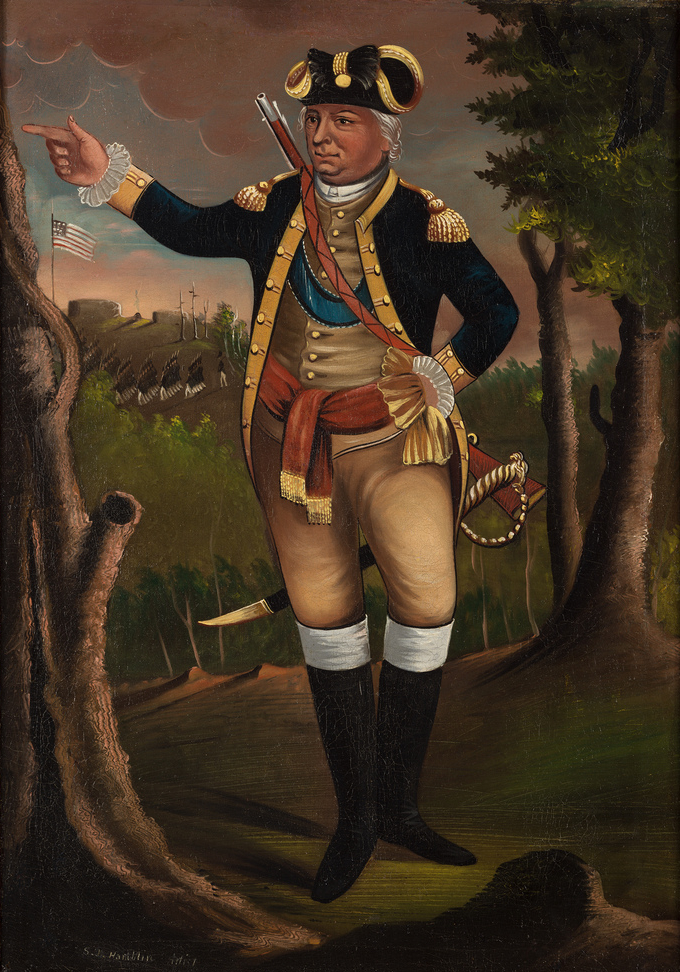
There is one outlier in Hamblin’s known body of work: a full-length portrait of General Israel Putnam (fig. 22).71 While the painting can safely be attributed to Hamblin, it is his only known image of a historical figure, in contrast to Prior, who is well-known for his images of the Washingtons, Daniel Webster, and Abraham Lincoln. There are other unusual features as well, namely, the addition of surface texture to the tree trunks with a graining comb (which Hamblin had never used in any of his known landscape backgrounds), and his signing the painting on the front (which he did only once before, on his Portrait of Ellen). Most interestingly, Hamblin signed the work “S. J. Hamblin, Artist.” Why would someone who so rarely signed his work at all add this reference to a signature on the front of a painting that has no comparable example in his painting career during the 1840s and 1850s? The answer may lie in the artist’s mysterious last years in the early 1880s, when he referred to himself as “artist.” Was Hamblin trying to capitalize on the interest in American history in the aftermath of the centennial of both the nation and the Battle of Bunker Hill, where Putnam distinguished himself in 1775, about a mile from Hamblin’s eventual home in East Boston? Could the portrait of Israel Putnam be the only known painting from Hamblin’s final years?
There are no other known clues to Hamblin’s painting activities in the last years of his life. After five years of identifying himself once again as an artist, Sturtevant Joseph Hamblin died at the age of sixty-eight of “pulmonary phthisis,” or tuberculosis, on June 20, 1884. His death record indicates that he had suffered his last illness for about a year. He was buried in Woodlawn Cemetery in Everett, not far from his friend, brother-in-law, and mentor, William Matthew Prior. Harriet continued to live in East Boston, listed simply as “widow” until 1901, when she was listed as “widow of Sturtevant J.” In addition to declining health, she had to endure the loss of her forty-six-year-old daughter Effie, who died in 1902 of accidental burns suffered five days earlier. When Harriet died at age eighty-seven in 1903, she honored her husband’s memory in her obituary, where she specifically identified herself as the “widow of the late Sturtevant J. Hamblin.”72 It would be another thirty years before Hamblin’s artistic legacy began its slow and steady rise to prominence as part of the artistic and cultural heritage of the United States, prompted by Abby Aldrich Rockefeller’s Baby with Doll, an anonymous portrait probably done in one sitting for a few dollars some ninety years earlier.
Sturtevant Hamblin left an indelible mark on American art with his elegant renderings of ordinary Americans, and was a major force in the democratization of American portraiture led by William Matthew Prior. He was the first member of the Prior-Hamblin group of artists, and the only one of those artists who had a close, long-term association with Prior. The sheer number of attributable works is evidence of Hamblin’s popularity and success as an artist, if only for the relatively brief fifteen years in which he actively produced likenesses. His serene, innocent paintings of children, in particular, speak to the profound emotions that defined family life in an era of high mortality. Lastly, Hamblin’s sublime sense of composition, color, and linear design is matched by very few artists of his generation and undoubtedly brought beauty—as well as meaning—into the lives of working people who had limited resources with which to find it elsewhere. That these works also found resonance in the eyes of artists, collectors, dealers, and museums who, in the twentieth century and beyond, have sought to define and preserve an ever-evolving national identity, shows how Hamblin created a lasting legacy one face at a time.

Acknowledgments
About the Author
STURTEVANT J. HAMBLIN: A STYLE GUIDE
The distinguishing features of Sturtevant J. Hamblin’s artistic style have been described by scholars, dealers, and collectors over the course of several decades. The following Style Guide is a summary of past descriptions along with this author’s own observations. It is meant solely as a guide, rather than a definitive method of attribution.
Donald Walters, in American Folk Portraits: Paintings and Drawings from the Abby Aldrich Rockefeller Folk Art Center, ed. Beatrix T. Rumford (Boston: New York Graphic Society, 1981), 112.
- “the glistening quality achieved in the rendering of flesh modeling and highlights”
- “the dark, cartoonlike outlining of hands”
- “the backdrop format that combines drapery, a column, and a window view encompassing a bird perched on a barren tree”
Marna Anderson, A Loving Likeness: American Folk Portraits of the Nineteenth Century, exh. cat. (Princeton, NJ: Bristol-Myers Squibb, 1992), 24.
- Clear, bold strokes.
- A developed sense of balance and symmetry.
- Outlined hands with tapered fingers pointing to a outstretched index finger.
- Intensive use of primary colors.
- Use of background props, including columns, draperies, and windows open to an exterior scene.
- Salmon-colored faces with white highlights under the brows and large eyes.
Stacy C. Hollander, American Anthem: Masterworks from the American Folk Art Museum, by Hollander and Brooke Davis Anderson (New York: Harry N. Abrams, 2001), 334, cat. no. 87 (Sea Captain).
- Heavy white highlights underneath brows and on the bridge of the nose.
- Prominent “rabbit” ears.
- Outlined hands that taper to a point at the index finger.
- A smudge of paint to define the chin.
- A trailing line at the corners of the mouth.
- Background views often show a rosy, sunset-like hue, and elements such as curtains, clothes, and ropes feature heavy white specular highlights.
- Children are usually portrayed from the front, while adults are typically shown in three-quarters view.
David Krashes, “Understanding the Prior-Hamblen School of Artists a Little Bit Better,” Maine Antique Digest, July 2011.
- Hamblin pointed hand: fourth finger is the longest, the next three are progressively shorter down to the pinky.
- Vertical centerline: down through the top of the head to the waist in many portraits. Symmetry on left and right. In some cases the symmetry is partial, excluding the hair or only going part way down the painting.
- Hamblin chin: an almost imaginary circle with its top an inverted arc visible beneath the lower lip.
Paul D’Ambrosio, additional notes on Hamblin.
- Brushwork is smooth and his surfaces are even.
- Landscape backgrounds are distinctive, and include foregrounds framed by trees (sometimes a single barren tree) leading to a placid expanse of water and a distant shore. Thin sweeps of white paint suggest sailing vessels. In several of his landscape views, Hamblin includes a little red bird with a black head perched on a limb of a barren tree. These landscape views were likely influenced by Prior, who had an association with landscape painter Charles Codman in Portland in the 1820s.
- Often included a fluted white column at the right of his window views, as did Prior, but Hamblin’s columns are considerably more abstracted.
- A sinuous, or serpentine, flare in Hamblin’s lines, particularly in the rendering of the tapered hands. Was Hamblin influenced by developments in “whole arm” handwriting such as Spencerian script, or perhaps calligraphic drawing?
- In his more developed—and likely more expensive—portraits, Hamblin adds shading to hands, arms, and faces to suggest three-dimensional modeling.
- Compared with other Prior-Hamblin School artists, Hamblin’s style is more graceful and refined, with sure lines suggesting a strong draftsman.
- His work is forthright, direct, linear, simple in form and composition. He is a master of both stark and subtle color contrasts, and his works were undeniably charming—all qualities sought by modernist artists and collectors of modern art in the 1920s and 1930s.
- Likenesses have a calm sweetness that is different from that of his contemporaries in the Prior-Hamblin group.There are more similarities between Hamblin’s work and that of George Hartwell than between either of them and William Matthew Prior. It is possible that Hamblin, not Prior, taught Hartwell. One also cannot rule out the possibility that they collaborated on some portraits, especially given the business mindset of Prior.
1 The artist spelled his name “Hamblin” in the signed portraits. “Hamblen” appears just as often in inscriptions or entries by others, such as listings in city directories or census records.
2 To date, the twelve known signed or inscribed Hamblin portrait paintings are: Five portraits of the Jewett family, including portrait of Aaron Jewett, inscribed, possibly by a relative of the sitter, “A. J., aged 44 years. Painted by L. [sic] J. Hamblin No. 12 Chamber St., Boston 1841” (location unknown); portrait of Phoebe Jewett, inscribed (on verso) by a relative of the sitter “P. L. J., Aged 21, painted by S. J. Hamblin, Chamber St., Boston, 1841,” and “Phoebe Lor[illegible] Jewett, Aged 21 years / Painted in 1841 by L. [sic] J. Hamblin / 12 Chamber St. Boston / Mother of Eugene F. Coburn”; portrait of Hannah Jewett, inscribed (on verso) by a relative of the sitter “H. M. J. AGED 16 yrs / Painted by/ S. J. Hamblin / 1841” and, in a later hand, “Hannah M. Jewett Aged 16 years / Painted by L J Hamblin [sic] 1841 / 12 Chamber St Boston / Aunt of Eugene F. Coburn,” private collection, illus. in Sotheby’s, New York, The American Folk Art Collection of Howard and Catherine Feldman, June 23, 1988, sale 5744, lot 18; Franklin M. Jewett, inscribed (on verso) “M. F. J. Age 13, painted S. J. Hamblin No. 12 Chamber St. Boston 1841,” private collection; Mother and Child, inscribed “Hamblin / East Boston / 1848,” Museum of Fine Arts, Boston, 1981.113; Lady with Black Hair, inscribed “S. J. Hamblin / East Boston,” Museum of Fine Arts, Boston, 1980.430; Asa Jewett, inscribed (on verso) “Painted by / S. J. Hamblin/ E. Boston / Aug 1848,” New Hampshire Historical Society, Concord, 2020.019; Portrait of Ellen, inscribed (on left foot) “S. J. Hamblen,” private collection, illus. in Nina Fletcher Little, Little by Little: Six Decades of Collecting American Decorative Arts (New York, E. P. Dutton, 1984), 115, fig. 149; Dr. J. Smith and Mrs. J. Smith, at least one of which is signed on verso “Painted by / S. J. Hamblin / E. Boston / Sept. 1848,” locations unknown, illus. in an advertisement for Paul McInnis, Inc., Abby Aldrich Rockefeller Folk Art Museum research files; and General Israel Putnam, inscribed (lower left) “S. J. Hamblin Artist,” Abby Aldrich Rockefeller Folk Art Museum, 1978.100.2.
3 For Baby with Doll, see American Folk Art: The Art of the Common Man in America, 1750–1900, exh. cat. (New York: Museum of Modern Art, 1932), 30, fig. 12. For an extended study of folk art collecting by American modernist artists, see Elizabeth Stillinger, A Kind of Archeology: Collecting American Folk Art, 1876–1976 (Amherst: University of Massachusetts Press, 2011), 145–253. A lesser-known Hamblin, Child with Hat and Cane, was also in the public eye at this time. According to a label on the stretcher, this painting was exhibited at the National Committee of Folk Arts’ Folk Arts Center on Fifth Avenue in New York City in late 1935. As the center was known to have relied upon the folk art collection of pioneering dealer and collector Isabel Carlton Wilde, it is possible, even likely, that Hamblin had been included in her well-known collection at this early date. Child with Hat and Cane joined Baby with Doll in Halpert’s 1937 exhibition Children in American Folk Art, 1725–1865. Child with Hat and Cane sold at New England Auctions–Fred Giampietro, “Antiques from Estates and Collectors,” October 29, 2018, lot 0096, illus. at liveauctioneers.com. For Wilde, see Stillinger, A Kind of Archeology, 153–59.
4 See Jean Lipman, American Primitive Painting (1942; repr., New York: Dover, 1969), fig. 14.
5 See Nina Fletcher Little, “William M. Prior, Traveling Artist, and His In-Laws, the Painting Hamblens,” The Magazine Antiques 53 (January 1948): 44–48.
6 See Nina Fletcher Little, The Abby Aldrich Rockefeller Folk Art Collection (Williamsburg, VA: Colonial Williamsburg, 1957), 14–15, cat. no. 5.
7 Agnes Halsey Jones and Louis C. Jones, New-Found Folk Art of the Young Republic (Cooperstown: New York State Historical Association, 1960), cats. 24–29, 36.
8 Peter Tillou, Nineteenth-Century Folk Painting: Our Spirited National Heritage (Storrs, CT: William Benton Museum of Art, 1973), 107–12, figs. 95, 96.
9 Jean Lipman and Alice Winchester, The Flowering of American Folk Art (1776–1876) (New York: Viking, 1974), 36, fig. 32.
10 Beatrix T. Rumford, ed., American Folk Portraits: Paintings and Drawings from the Abby Aldrich Rockefeller Folk Art Center (Boston: New York Graphic Society, 1981), 117. Baby with Doll appears as fig. 85 on pp. 114–15.
11 I am grateful to Jacquelyn Oak for her groundbreaking research into the life and works of William Matthew Prior, which provides much-needed context to this essay. See Jacquelyn Oak and Gwendolyn Dubois Shaw, Artist and Visionary: William Matthew Prior Revealed (Cooperstown, NY: Fenimore Art Museum, 2012).
12 Information on the Hamblin family comes from H. Franklin Andrews, The Hamlin Family: A Genealogy of James Hamlin of Barnstable, Massachusetts (Exira, IA: printed by the author, 1902) (archive.org); Hugh D. McLellan, History of Gorham, Me., comp. and ed. Katharine B. Lewis (Portland, ME: Smith & Sale, 1903); and H. Franklin Andrews, History of the Hamlin Family . . . Part One (Exira, IA: George W. Guernsey, 1894) (archive.org), which relies on the work of David Hamblen of Boston, 1845–55.
13 Almery’s name also appears as Almary. His birth is documented in Maine Births and Christenings, 1739–1900; and his marriage to Sally Clark in Maine Vital Records, 1670–1921; familysearch.org.
14 Sturtevant’s date of birth is often incorrectly listed as 1817, owing to an estimate gleaned from the federal census records. His birth record with the correct 1816 date appears in Massachusetts Births and Christenings, 1639–1915. Sally Hamblin’s death is noted in the Portland Gazette, May 21, 1822. Almery’s second marriage is documented in Maine Marriages, 1771–1907, familysearch.org.
15 Nathaniel G. Jewett, The Portland Directory and Register (Portland, ME: Todd and Smith, 1823), 25.
16 See Woman of 1824, Probably Rosamond Clark Hamblin in Oak and Shaw, Artist and Visionary, 12, fig. 7.
17 The Artist as a Young Man: Self-Portrait is in the collection of the Fenimore Art Museum, N0008.2010.
18 See Oak and Shaw, 14; Prior’s self-portrait appears on p. 14 as fig. 10.
19 See Oak and Shaw, 15.
20 The Nathaniel Hamblin House in Portland is located at 87 Forest Avenue (previously Green Street). It is well documented in an unpublished 1981 paper by Arthur J. Gerrier in the files of Greater Portland Landmarks. The Hamblins (spelled Hamblens) appear on p. 28 of the 1831 Portland city directory (Todd & Holden, printers, 2 Union St.).
21 Almery Hamblin’s death is recorded on his tombstone in Hamblin Cemetery, Cumberland County, Maine; memorial no. 149619760, findagrave.com.
22 See Arthur Shirley, The Portland Directory, containing the names of the inhabitants, their occupations, places of business, and dwelling houses, and the city register, with lists of the streets, courts and wharves (1834), 71, 95. The murals in the Nathaniel Hamblin House (now covered) are discussed and described in the Gerrier report (see n. 20 above) and attributed to the Hamblins. Jacquelyn Oak and I do not see a stylistic basis for this attribution and believe that Codman, whose murals in Portland are well documented, is the likely artist. Gerrier describes the murals as being in the living room, above the (now removed) chair rail, as including the depiction of a church flanked by trees and a brick house flying a Union Jack, and with figures including a man fishing and a man on horseback. There are also a wharf scene and numerous trees with figures interspersed. Remaining stretches of wall are painted in an allover landscape pattern with trees. Some clue as to what these murals looked like (they now lack even a photographic record) lies in a 1993 National Register registration form for the Nathan Harris House at 425 Main Street in Westbrook, Maine, near Portland (dated September 3, 1993, and prepared by Thomas B. Johnson). According to the application, “The attribution of the murals to the hand of either Sturtevant J. Hamblen or William Matthew Prior lies in photographic records [now lost] of murals in the Nathaniel Hamblen House at 87 Forest Avenue in Portland (much damaged and now covered) which Arthur J. Gerrier attributed to the Hamblens in 1981.” See nps.gov
23 The Hamblin block, located at 188–194 Danforth Street in Portland, is well documented in two National Park Service forms: a 1992 National Register of Historic Places Registration form (see n. 21 above), and a 1993 National Register Nomination form, dated May 20, 1993, and prepared by George C. Clancy. See nps.gov
24 Sturtevant’s marriage record is in Maine Marriages, 1771–1907. See also the Portland city directory for 1837, p. 34, Maine State Archives, Augusta.
25 Joseph Hamblin’s marriage to Elizabeth Hartwell is documented in Maine Vital Records, 1670–1921. Elizabeth Pearson Hamblin’s birth date is documented on her tombstone in Loudon Park Cemetery, Baltimore, Maryland; memorial no. 115500849, findagrave.com.
26 The Scarborough farm purchase is mentioned in Little, “William M. Prior, Traveling Artist,” 45.
27 Howard Hamblin’s 1912 death record lists his place of birth as Scarborough, Maine; familysearch.org.
28 See Oak and Shaw, Artist and Visionary, 18–20.
29 The conference was covered extensively in Signs of the Times 1, no. 15 (November 1, 1840). The list of attendees is on p. 120. Prior quickly became close to Miller and Himes, and by the end of 1840 he was corresponding with the “prophet” and painting his likeness for lithographic reproduction in Himes’s book Views and Prophecies and Prophetic Chronology Selected from the Transcripts of William Miller (Boston: Moses A. Dow, 1841). See Oak and Shaw, Artist and Visionary, 20–23.
30 Stimpson’s Boston Directory (Boston: Charles Stimpson, 1841), 226 (cited hereafter as Stimpson’s Boston directory). Nathaniel is listed as being a partner with C. H. Knox in the house painting business.
31 For Prior and Stuart, see Oak and Shaw, Artist and Visionary, 14.
32 Sarah’s birth year is documented in her 1848 death record in Massachusetts, U.S., Town and Vital Records, 1620–1988, Ancestry.com.
33 According to Oak, Boston alone had more than 125 daguerreotypists serving a city of about 100,000 people by 1850. Oak and Shaw, Artist and Visionary, 26.
34 See note 2 for inscriptions. Aaron and Hannah’s 1819 marriage in Wentworth, New Hampshire, is documented in New Hampshire Marriage Records, 1637–1947, familysearch.org. Aaron’s second marriage, in 1852, lists his residence as Bristol, as does his death record in 1882. See Massachusetts State Vital Records, 1841–1920; and New Hampshire Death Records, 1654–1947, familysearch.org.
35 The notion of Hamblin filling in for an absent Prior is discussed in Oak and Shaw, Artist and Visionary, 24.
36 See the portraits of Mr. and Mrs. Gardner Brightman in the collection of the Fenimore Art Museum. Illus. in Oak and Shaw, 48, cats. 22, 23.
37 For Prior’s move to East Boston, see Oak and Shaw, 19; and Stimpson’s Boston directories 1841, 226, and 1842, 248. Variations in the spelling of Hamblin continued through Sturtevant’s life. In Stimpson’s Boston directories, he is alternately “Hamblin” and “Hamblen,” and at times his last name is spelled differently from that of his brothers.
38 Prior’s increased involvement in Millerism in the early 1840s is discussed in Oak and Shaw, Artist and Visionary, 23–25.
39 George Hartwell’s son George Jr. was born in Massachusetts in 1842, according to the 1850 federal census. When George married Laura Tyler in Lowell in 1845, the record listed him as a portrait painter living in Boston. See Massachusetts State Vital Records, 1841–1920. For Kennedy in New England, see Rumford, American Folk Portraits, 136. For Moore, see Stimpson’s Boston directory 1843, 360. Hamblin’s moves in 1844 are documented in Stimpson’s Boston directory 1844, 264.
40 The portrait of Mary Caroline Haynes was sold on June 9, 2021, at Devin Moisan Auctioneers, Epping, New Hampshire, lot 100. See W. A. Demers, “Hamblin Portrait of ‘Miss Mary’ Leads at Devin Moisan Auction,” Antiques and the Arts Weekly, June 29, 2021. According to handwritten information on paper attached to the reverse of the portrait, Mary Caroline Haynes (Jackson) was born December 6, 1838, and died December 29, 1911. For the painting’s verso, see invaluable.com
41 Baby with Doll was originally given by Mrs. Rockefeller to the Museum of Modern Art in 1937 and then transferred to Colonial Williamsburg in 1954.
42 For Little Girl with Pet Rabbit, see Deborah Chotner et al., American Naïve Paintings (Washington, DC: National Gallery of Art; Cambridge: Cambridge University Press, 1992), 170–71. For Child in Red with Whip, see Paul D’Ambrosio and Charlotte Emans, Folk Art’s Many Faces: Portraits in the New York State Historical Association (Cooperstown, NY: NYSHA, 1987), 95–96.
43 East Boston Directory (1847), 22. Sturtevant Jr.’s birth is undocumented but determined by his death record in 1848. See n. 49, below.
44 See Stacy C. Hollander, Sea Captain, in American Anthem: Masterworks from the American Folk Art Museum (New York: Harry N. Abrams in association with the American Folk Art Museum, 2001), 333, cat. no. 87.
45 Prior’s landscapes are discussed in Oak and Shaw, Artist and Visionary, 27–29.
46 For an image of Captain William B. Aiken (1814–84), see npg.si.edu. A portrait of a sea captain was offered for sale at Thomaston Place Auction Gallery, July 8, 2023, lot 2053.
47 See also Portrait of Ellen (see n. 2); and Dr. J. Smith, location unknown.
48 Asa Jewett (1815–1883) belonged to a family of woodworking mill owners in Milton Mills, New Hampshire. His grandfather Paul Jewett (1744–1835) owned an early sawmill known as the Jewett Mill, which was operated by Asa; his father, Gilman Jewett; and his uncle, Nathaniel Jewett. They incorporated the Milton Mills Manufacturing Company in 1837, transforming the mill into a lathe-and-turning mill where they produced wood products. Around the date his portrait was painted, Asa was listed as a lumber dealer in the federal census.
49 Sarah and Sturtevant Jr.’s deaths are documented in Massachusetts, U.S., Town and Vital Records, 1620–1988. For Rosamond Prior’s death, see Oak and Shaw, Artist and Visionary, 27. For the second Sturtevant Jr.’s death, see Massachusetts State Vital Records, 1841–1920.
50 Information on the Rounds family is from curatorial files at the Museum of Fine Arts, Boston; and Stimpson’s Boston directories 1846, 469, and 1851, 215. For documentation of the first Benjamin Jr. see “Benjamin T Rounds,” familysearch.org. The Benjamin Jr. depicted in the Rounds family portrait is documented in his death record at New Hampshire Death Records, 1654–1947.
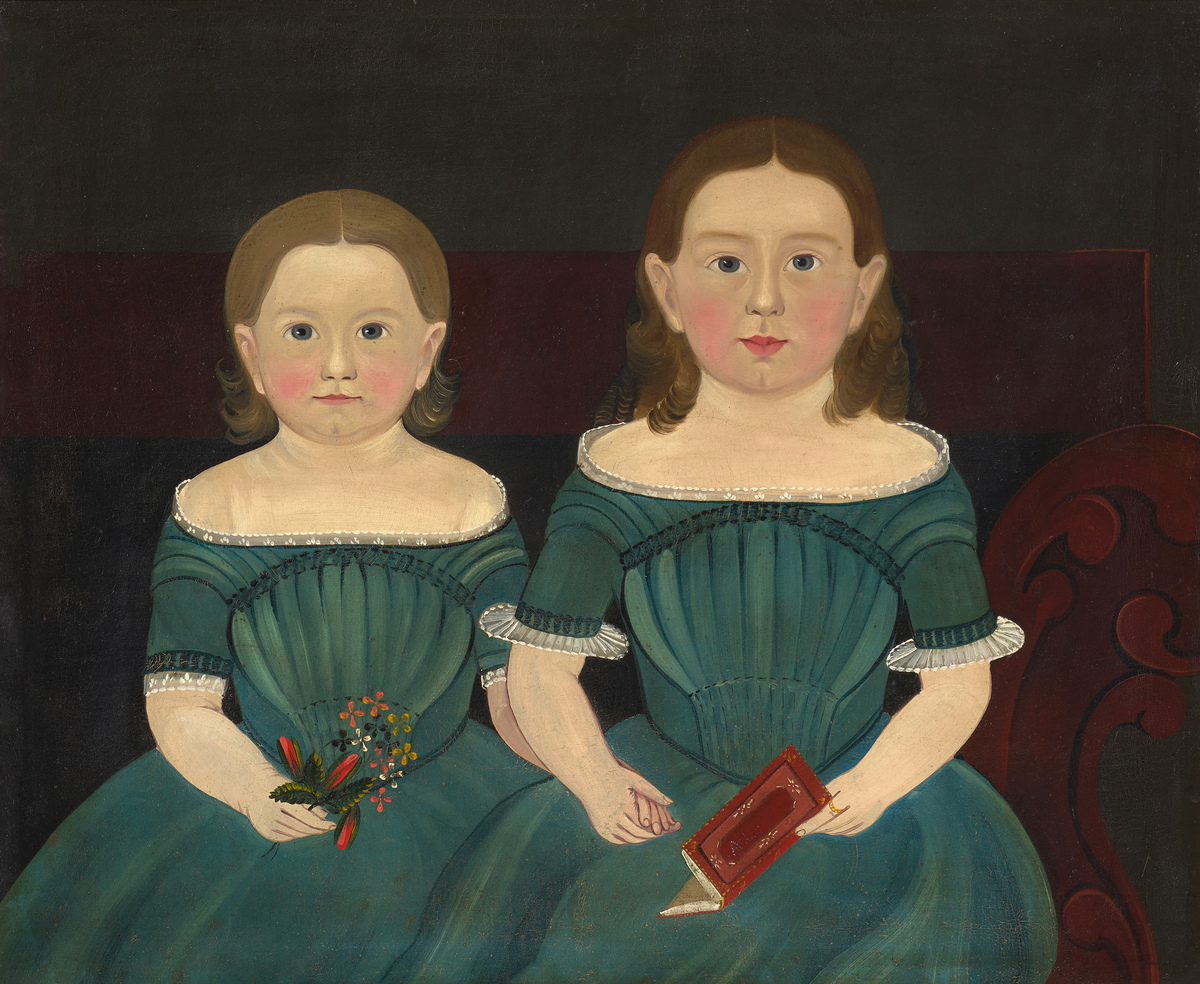
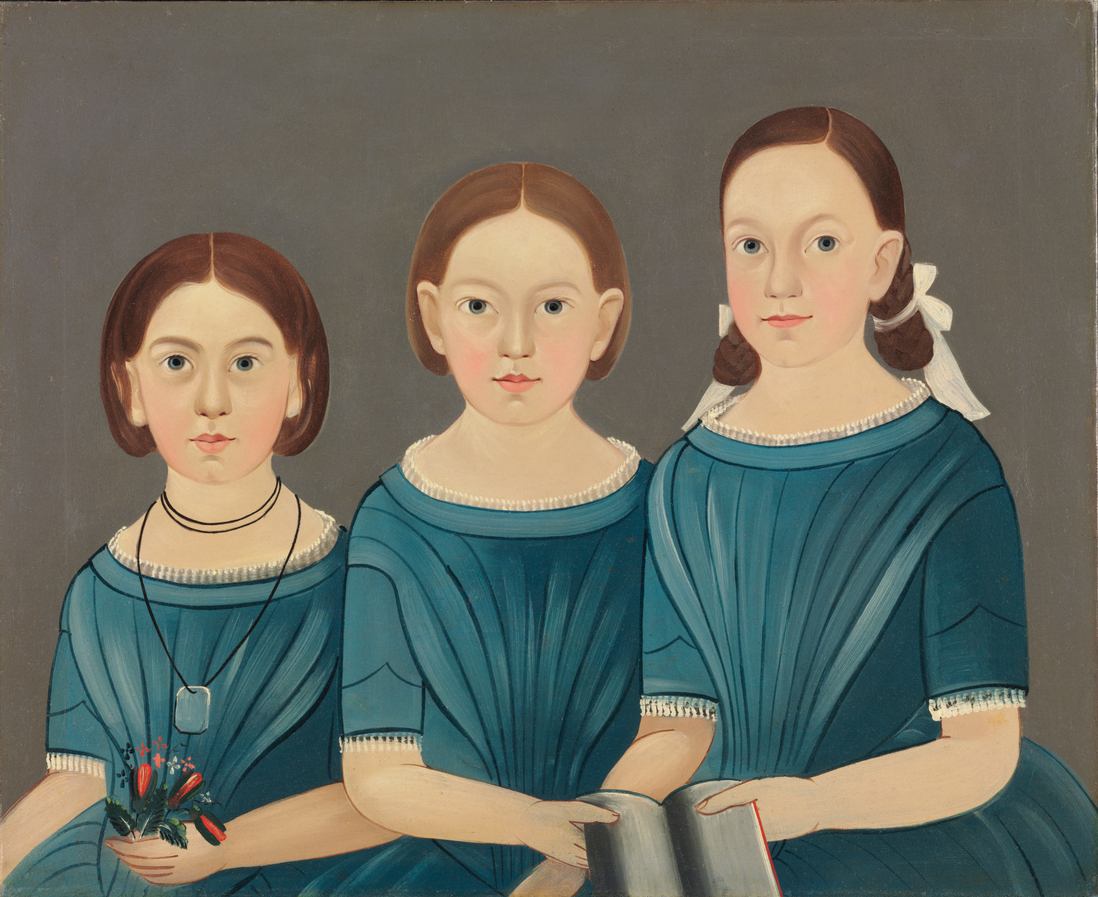
51 The portrait of Mary and Elizabeth Hathaway sold at Christie’s, New York, Important Americana, January 20, 2023, sale 21026, lot 469. The notes in the auction catalogue entry indicate that the sitters, previously identified by their first and last names, were Mary Lucetta (1846–1920) and Elizabeth Alice (1841–1908), daughters of Elihu C. (1818–1887) and Angeline Brown Hathaway (1818–1854) of Fall River, Massachusetts. The book held by Elizabeth appears to bear the partial inscription “AL . . .,” a possible reference to her middle name. For a similar likeness, see the Portrait of Three Children in the collection of the Fenimore Art Museum, N0235.1961.
52 Prior’s obituary appeared on page 1 of the Fall River Daily News, January 24, 1873, and stated that he “was a former resident of this city, and was favorably known here as a portrait painter.” It is not known how long Prior resided in Fall River, or if he simply traveled there to paint portraits.
53 Children with Toys was found in Concord, Massachusetts, and purchased by Mrs. Rockefeller from Halpert’s Downtown Gallery in New York. For a similar red, white, and blue color scheme, see Prior’s portrait The Sweetster Children, 1853, in Oak and Shaw, Artist and Visionary, 29, fig. 31.
54 The identity of Charles C. Henry was first established through research by Suzan Friedlander and can be established by comparing addresses in the listing for Fire Engineers in the Boston almanac of 1864 with the Stimpson’s Boston directory. Henry is listed in both places as living at 30 Hawley Street. On Henry’s work as a firefighter, see historian James Feeney to Suzan Friedlander, April 2, 1993, curatorial research files, Fenimore Art Museum. The minutes from the Howard Engine Company’s meetings are in the collection of the Bostonian Society. See also Stimpson’s Boston directory 1851, 121, 193.
55 For an example of Prior’s night scenes, see Mount Vernon and Washington’s Tomb by Moonlight, Fenimore Art Museum, N0376.1961.
56 Transcripts of the Howard Engine Company meeting minutes are in the curatorial research files at the Fenimore Art Museum. Three years after this portrait was painted, Henry was badly injured fighting a fire at the Old Pemberton House, as reported by the Boston Evening Transcript on February 16, 1854: “Charles C. Henry, a hoseman of Engine Co. No. 7, was completely buried under the mass of lumber and bricks, and when taken out was found to have a leg broken and his spine injured, besides being badly bruised. He was taken to the General Hospital and will probably recover.” He did recover and went on to run his own hat-and-bonnet bleachery in Boston at least until 1863.
57 The Ironers came to the Fenimore Art Museum from the collection of Mr. and Mrs. William J. Gunn of Newtonville, Massachusetts, with the history of having been found in Rhode Island. See Louis C. and Agnes Halsey Jones, New-Found Folk Art of the Young Republic (Cooperstown: New York State Historical Association, 1960), 18, fig. 24. There were several commercial laundries operating in Boston in the early 1850s, according to Stimpson’s Boston directory. The attribution to Hamblin rests on several characteristics of this painting, including the appearance of the younger women, who look very much like the milliner’s model doll held by the child in Baby with Doll, the salmon-pink colors in the faces and two of the dresses, and the tapered hand of the gentleman.
58 Stimpson’s Boston directory 1852, 115.
59 Information on the family comes from Fruitlands Museum curatorial files and from the entry for Edwin A. Hill in the 1860 federal census. For Hill’s residence, see Stimpson’s Boston directory 1853, 142.
60 The portrait Captain Thomas W. Lewis appears on the website for Austin T. Miller American Antiques, Inc., accessed March 4, 2024, usfolkart.com. It is listed alongside a painting of Lewis’s ship, Silver Cloud, bearing a Boston canvas maker’s stamp and presumably painted at the same time as the Lewis portrait, though clearly not by Hamblin.
61 Stimpson’s Boston directories 1854–58. For Florence’s birth record, see Massachusetts, U.S., Town and Vital Records, 1620–1988.
62 The quotation is from an ad for Locke’s Shirt Depot, Washington Street, in Stimpson’s Boston directory 1862, advertising section, 36.
63 See Stimpson’s Boston directory 1856, 384, for a list of gent’s furnishings stores. Prior is listed with other portrait painters on p. 395.
64 Stimpson’s Boston directory 1862, 184.
65 See Stimpson’s Boston directories 1862–67. For Elizabeth’s marriage record and Mabel Sexton’s birth record, see Massachusetts, Town Clerk, Vital and Town Records, 1626-2001, FamilySearch; Mabel Blanchard Sexton Cunningham; Burial, Baltimore, Baltimore City, Maryland, United States of America, Loudon Park Cemetery; memorial no. 115502208, findagrave.com.
66 For the “Great Boston Fire of 1872,” see the website of the Boston Fire Historical Society (including a link to a map of the fire): bostonfirehistory.org. See also Stimpson’s Boston directories, 1867–74, and 1870 federal census. The last location of Hamblin, Farr & Co. was at 25 Otis Street, within the burnt district.
67 The incident with Gilbert Stuart Prior and Howard Hamblin is described in the Boston Evening Transcript, May 8, 1872, p. 1. I am grateful to Jacquelyn Oak for finding and sharing this information.
68 For William Matthew Prior’s death, see Oak and Shaw, Artist and Visionary, 31.
69 See notice of petition in Boston Evening Transcript, November 9, 1877, p. 8. The notice of hearing appears in the Boston Globe, July 9, 1878, p. 3, and reads: “Bankruptcy notice: District Court of the United States, District of Massachusetts. Upon a petition presented to the court, by Sturdivant J. Hamblin of Boston, praying that he may be decreed to have a full discharge from all his debts provable under the bankrupt act; it is ordered that a hearing be had upon the same on the twelfth day of July, A. D. 1878, before the court in Boston, in said district, at 10 o’clock A. M., and that the second and third meetings of creditors be held before S. Lothrop Thorndike, Esq., Register, on the tenth day of July, A. D. 1878 at 11 o’clock A. M., at the office of said register, No. 2 Pemberton Square, in Boston, and that all persons in interest may appear at said time and place and show cause, if any they have, why the prayer of the said petition should not be granted. Edward Dexter, Clerk of said Court.”
70 The 1880 federal census lists Hamblin as a sixty-three-year-old “portrait painter” living in Boston with his wife Harriet (sixty-four), “keeping house,” and daughter Effie F. (twenty-four), “at home.” The 1881 business directory in Stimpson’s Boston directory lists Hamblin among “Portrait and Landscape” painters.
71 The portrait of General Israel Putnam is discussed and illustrated in Rumford, American Folk Portraits, 115–17, fig. 87. It is thought to be based on an eighteenth-century mezzotint by Benjamin or Samuel Blyth of Salem, Massachusetts. The painting was owned by Robert Fridenberg, a dealer in American prints in New York, and also by the Winterthur Museum, which sold it at auction in 1978.
72 For Hamblin’s death record, see Massachusetts, U.S., Death Records, 1841–1915, Ancestry.com. Harriet’s obituary appears in the Boston Globe, December 20, 1903, p. 25. Hamblin’s other daughter, Elizabeth Pearson Sexton (1839–1912), moved to Baltimore with her husband in 1867 and died there in 1912.