Charles C. Hofmann’s Paintings Along the Schuylkill River: Landscapes of Peace, Prosperity, and Despair
Taking his last breaths in the men’s ward of the Berks County Almshouse, Charles C. Hofmann (1821–1882) may have been thinking about the pain in his body or the poor living conditions he had endured during the latter portion of his life. Or perhaps the artist dwelled on the grass, trees, hills, and farms of the bucolic Schuylkill River along which he had wandered and painted for nearly twenty years. Hofmann, like many itinerant artists in the nineteenth-century United States, died penniless and destitute. And while he was the most prolific almshouse painter of the century, his contributions to American art were entirely unrecognized at his death. Today, much of Hofmann’s biography and even his remains are lost to time, yet the artist’s scattered works are viewed by thousands each day in major metropolitan museums, regional collections in Pennsylvania, and private holdings.
Hofmann’s paintings frequently revolve around southeastern Pennsylvania’s Schuylkill, Berks, and Montgomery County Almshouses, public institutions tasked with housing and rehabilitating the poor, ill, and injured. The artist, whose twenty-two short years in the United States were marred by chronic alcohol addiction and vagrancy, was himself a frequent resident of these almshouses. Yet through his itinerancy and many stays in Pennsylvania’s almshouses, Hofmann visited more of Pennsylvania than many of its earliest settlers, and his paintings document the lives of both anonymous almshouse residents and rural Pennsylvanians, revealing an idealized and utopian vision of life after the Civil War (fig. 1).1 These almshouse paintings are not only a visual representation of the welfare system in the early United States but also a record of Hofmann’s life. Tracing the artist’s career through these paintings reveals both the best and worst of Pennsylvania’s almshouses.
Charles Christian Hofmann was born in the German Confederation and immigrated to the United States in 1860, arriving at the port of New York City. Virtually nothing is known of his life in Europe, but he evidently trained as a lithographer: in the United States, he occasionally signed paintings as “C. C. Hofmann, Lithograph.”2 Visual analysis of Hofmann’s almshouse paintings, particularly his fine linework, acute sense of proportion, and architectural precision further hint at his background in lithography. The first four years of Hofmann’s life in the United States remain entirely undocumented. Over one million German-speaking immigrants arrived in the decade prior to the Civil War, and many of those arriving after 1860 joined the Union Army to fight for a country they barely knew.3 It is possible that Hofmann too enlisted in the war effort; the name “Charles Hofmann” appears several times in New York and Pennsylvania war records, possibly supporting this conclusion. A “Christian Hofmann” is listed on the rolls of the 75th Regiment, Pennsylvania Infantry Company D, which primarily consisted of German-speaking residents of Philadelphia and newly arrived German immigrants.4 Further research might determine Hofmann’s activities during these early years in the United States.
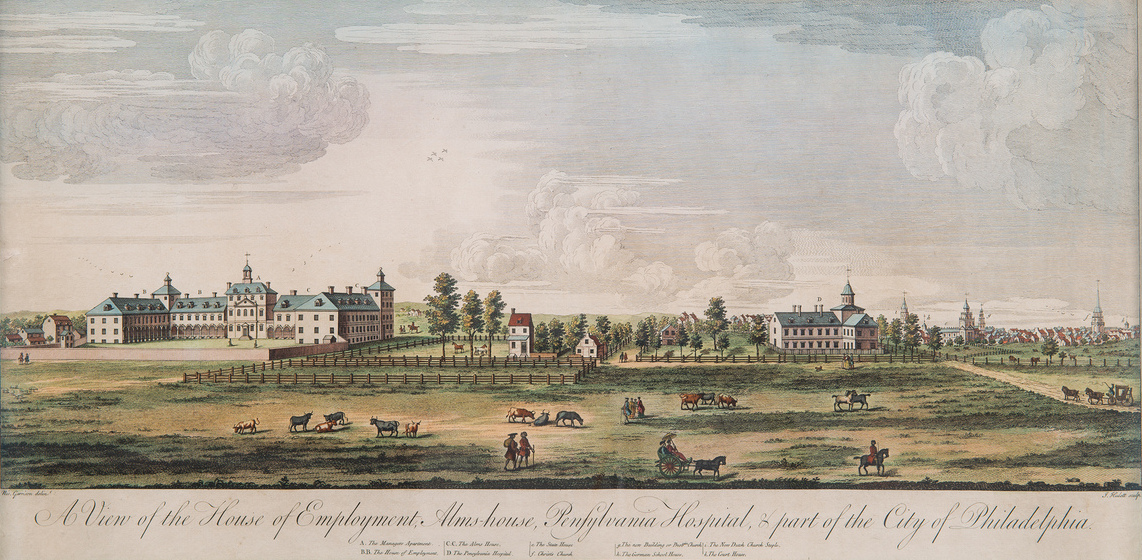
By 1864 Charles C. Hofmann was traveling as an itinerant painter throughout southeastern Pennsylvania, committing himself to almshouses for intemperance every few months. It is unknown whether Hofmann’s addiction to alcohol predated his immigration, but the affliction was among the few constants during the artist’s life in the United States. While the hallways and sparse rooms of these institutions served as Hofmann’s only form of residence, Pennsylvania’s almshouses were not wholly benevolent entities—their administrators frequently provided Hofmann with whiskey and other spirits to pay for the paintings that the artist executed privately for them.5 Yet these institutions sought, at least in theory, to support unhoused individuals who were poor, ill, or disabled. Almshouses had long existed in England, and Philadelphia’s first almshouse was erected in 1732 to “provide shelter, support, and employment for the poor and indigent, a hospital for the sick, and an asylum for the idiotic, the insane, and the orphan” (fig. 2).6 Early nineteenth-century political movements inspired by the Second Great Awakening incorporated the almshouse model within their platforms, and in 1826 Pennsylvania state law required that each county provide a hospital, asylum, or almshouse to care for the poor, creating one of the earliest forms of legislated social welfare in the United States.7
Such institutions became especially necessary in this period. After the American Revolution, immigration to the new nation greatly increased. Alongside this demographic growth, both commercial agriculture and urban manufacturing expanded throughout southeastern Pennsylvania due to a growing international demand for American goods.8 The subsequent development of mining and agriculture along the Delaware and Schuylkill Rivers drew people from Philadelphia to coal and iron mines in the countryside, and the expanding canal system connected all aspects of this rising economy.9 Yet during the War of 1812, the US economy significantly declined due to economic blockades and embargoes, stifling shipping and manufacturing.10 Employment shrank in New York City and Philadelphia, and immigrants arriving after the economic downturn of 1817 left cities to find scarce jobs in the countryside. Organizations such as Philadelphia’s Guardians of the Poor cared for unemployed laborers and tradesmen, and by 1820 forty-eight people for every one thousand relied on poor relief assistance.11
Centralized homes for the poor soon emerged as a worthy collective endeavor and prudent public expense.12 As such, public almshouses became places where destitute, ill, or injured men, women, and children could recuperate and receive medical treatment. Yet to proponents of the almshouse system, such care also had the strategic goal of relocating such individuals to institutions outside of towns, where they could not wander or beg. Care was also not freely given, as in the nineteenth century the poor were expected to work for the amenities and accommodations provided by almshouses. Public sentiment classified poor relief into two categories: that of the “deserving poor” and the “undeserving poor.”13 The first category included those who could not work due to circumstances outside their control, such as low wages for women, sickness and disease, disabilities, and job loss from the War of 1812.14 The second included, among others, individuals termed “intemperate” paupers, or those suffering from alcoholism. Initially the almshouses primarily cared for the “deserving” population of aged, sick, orphaned, disabled, or injured persons, but critics argued that unwed mothers and the “undeserving” became their primary users.15 As such, the institutions gained a reputation as a revolving door for those unable to remain employed or sober. Though many of the same people were frequently readmitted, most did not stay for long. Very few residents stayed for over four weeks, while most stayed for two weeks or less.16 Due to his intemperance, Charles C. Hofmann fell into the category of the “undeserving poor,” and this marker plagued the artist for his entire life. In reality, people such as Hofmann who lived in rural locations depended on almshouses less frequently than those in cities.17
Hofmann first journeyed to Northampton County, Pennsylvania, less than one hundred miles from New York City. There he admitted himself to the county’s almshouse in 1864, where he resided for the next two years. Use of the almshouse property by Europeans dated to 1745, when a group of Moravian farmers settled outside of nearby Nazareth. The community was called Gnadenthal (Dale of Grace) and became a part of the “Upper Places”—satellite villages that provided produce and other necessities for the largest community of Moravians, living in Bethlehem, just south of Nazareth. In 1837 Northampton County purchased over 200 acres from the Moravians to build what they called the “Poorhouse and Lunatick Asylum.” Only a year after it was built, the almshouse served 171 residents.18 By the time that Hofmann arrived, the facility had operated for twenty-seven years.
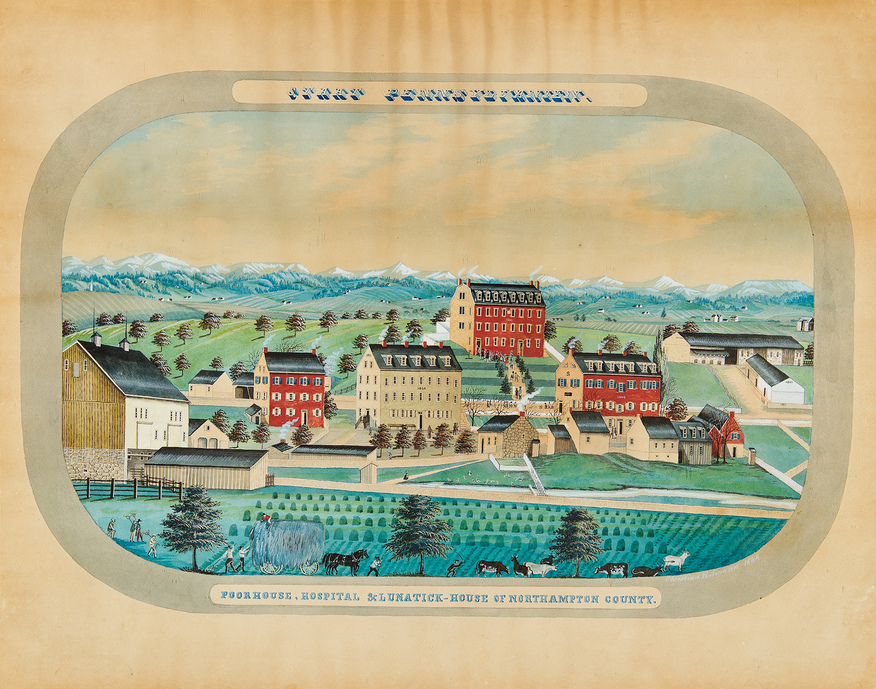
During his two years at the Northampton County Almshouse, Hofmann executed his first identified paintings, four views of the almshouse site dated to 1864 and 1865 that likely paid for his residence at the facility (fig. 3). These early examples are useful in introducing the artist’s materials, style, and remarkable pace of work. Hofmann painted each almshouse multiple times, sometimes in the same month, using multiple media including watercolor on paper, oil on canvas, and oil on metal, likely zinc, or another non-ferrous metal. Hofmann’s early Northampton County Almshouse paintings are consistent with the style employed throughout his career. From the bird’s-eye perspective to painted faux frames surrounding the almshouse and farm scenes, Hofmann’s style combined elements from lithography with watercolor and, later, oil painting. Throughout his extensive travels, his paintings also became increasingly formulaic, akin to the way in which period itinerant portraitists often recycled the same compositions of bodies or heads within their paintings. Similar techniques quickened Hofmann’s pace of work, and he may also have developed a process to copy details from his previous paintings of the same almshouse.19
The directors of the Northampton County Almshouse had good reason to commission Hofmann to paint their institution. As public approval of almshouses diminished throughout the nineteenth century, Hofmann’s paintings likely counteracted negative opinions by depicting the sites as symbols of order, beauty, and rehabilitation. This appeal to public sentiment explains later impressions of his almshouse paintings as “cheerful” and “orderly”—conspicuously devoid of the despair within their walls.20 Hofmann’s attention to the Northampton almshouse’s exterior architecture also reflected well on the communities funding the institution. The facades of the almshouses instilled pride in the public as their grand architecture represented the community’s moral and financial contributions to the poor. At the Chester County Almshouse, for example, administrators sought to convince taxpayers to fund new buildings and renovations so that residents’ overall quality of life might improve. An outside committee inspecting the almshouse agreed, suggesting that additional buildings would further sequester more dangerous inmates from productive working residents.21
Hofmann’s watercolor paintings of the Northampton County Almshouse depict four-story stone and brick buildings. Their gambrel roofs and dormer windows reflect the Germanic vernacular architecture that the Moravians had built in Nazareth, such as the stately Nazareth Hall School for Boys, the Single Sisters residence, and the Whitefield House, home to the community’s nursery. In his 1864 watercolor of the almshouse, Hofmann painted a lively scene with groups of visitors entering the large building in the background (fig. 4). Most almshouses arranged public tours, which likely included visits to preselected rooms within each structure. Hofmann also details within the foreground a frieze-like composition of figures harvesting hay and herding cattle, and four of the painting’s primary buildings feature date stones. Both the depiction of daily labor and an acute attention to detail would characterize Hofmann’s paintings over the next eighteen years. Hofmann painted the Northampton County Almshouse two additional times in 1864, including an oil on canvas, and another watercolor in 1865, which is less detailed than the other views.
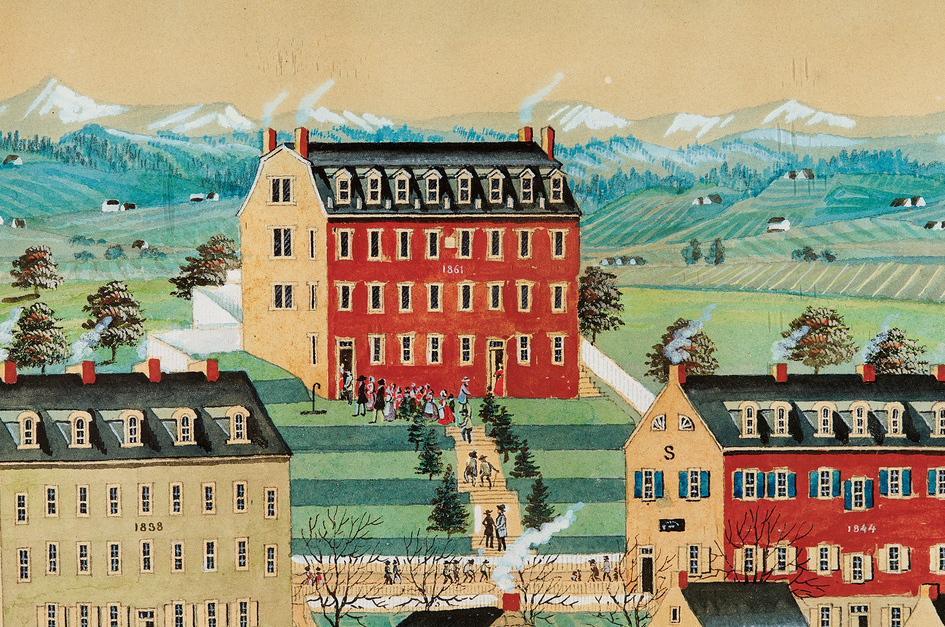
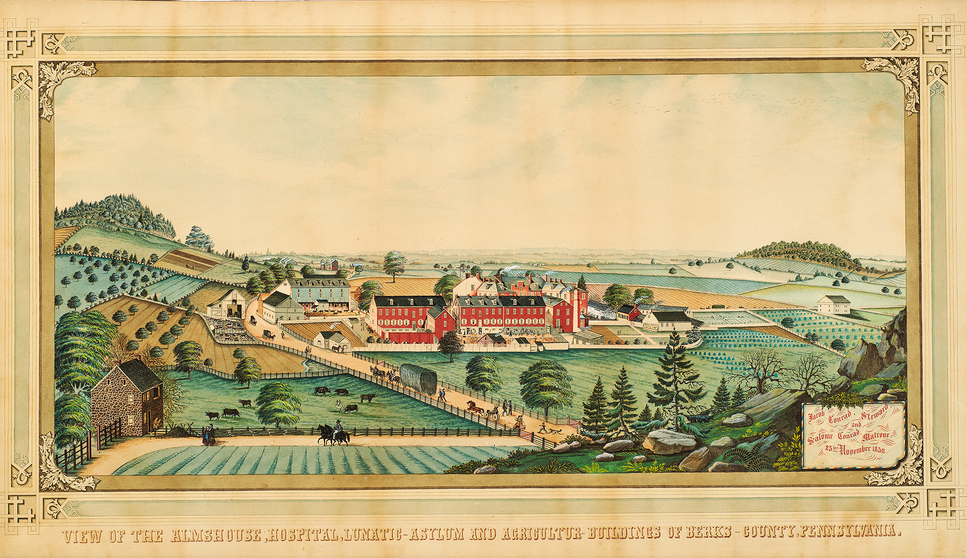
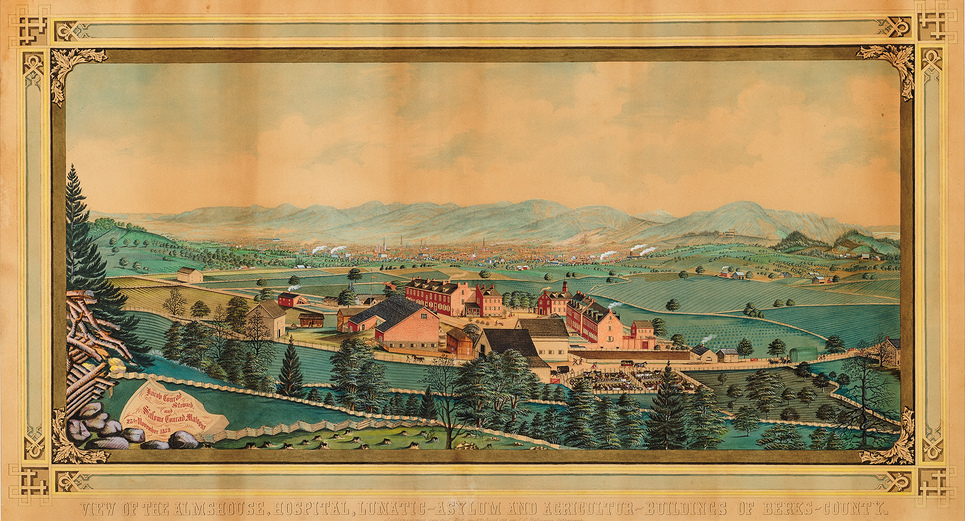
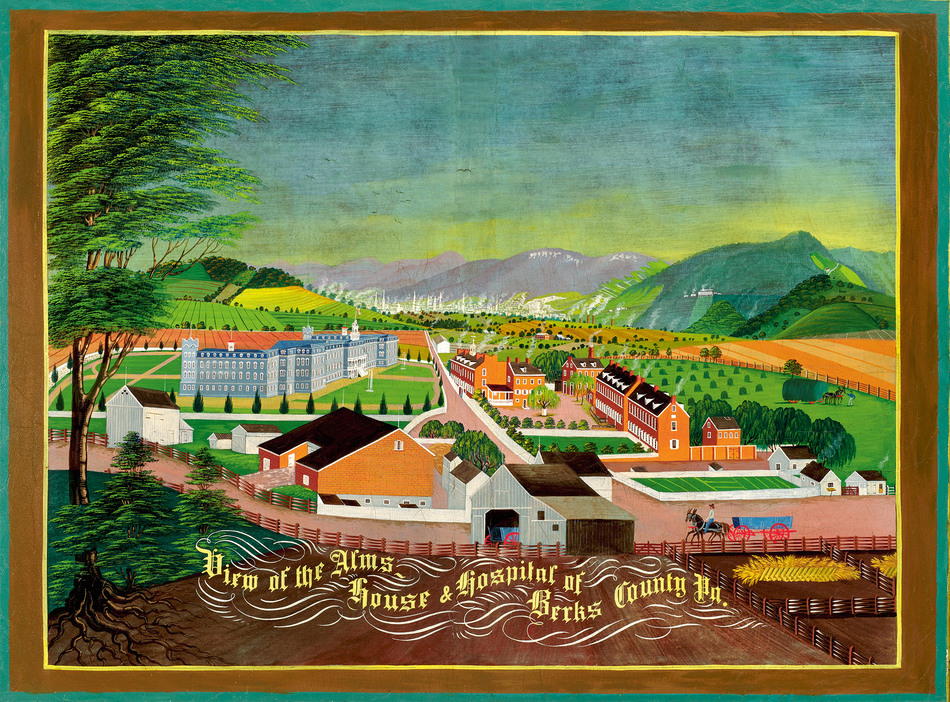
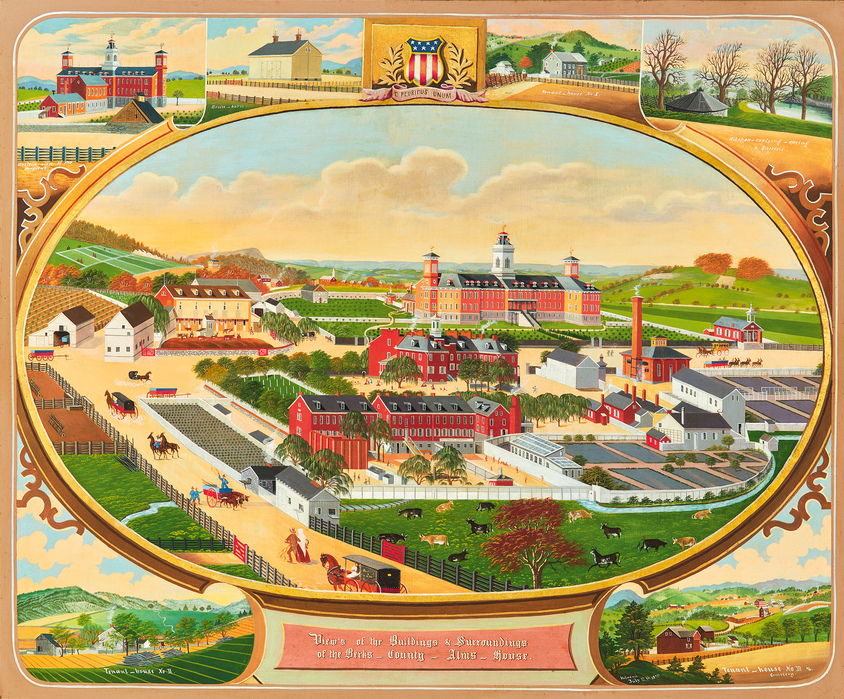
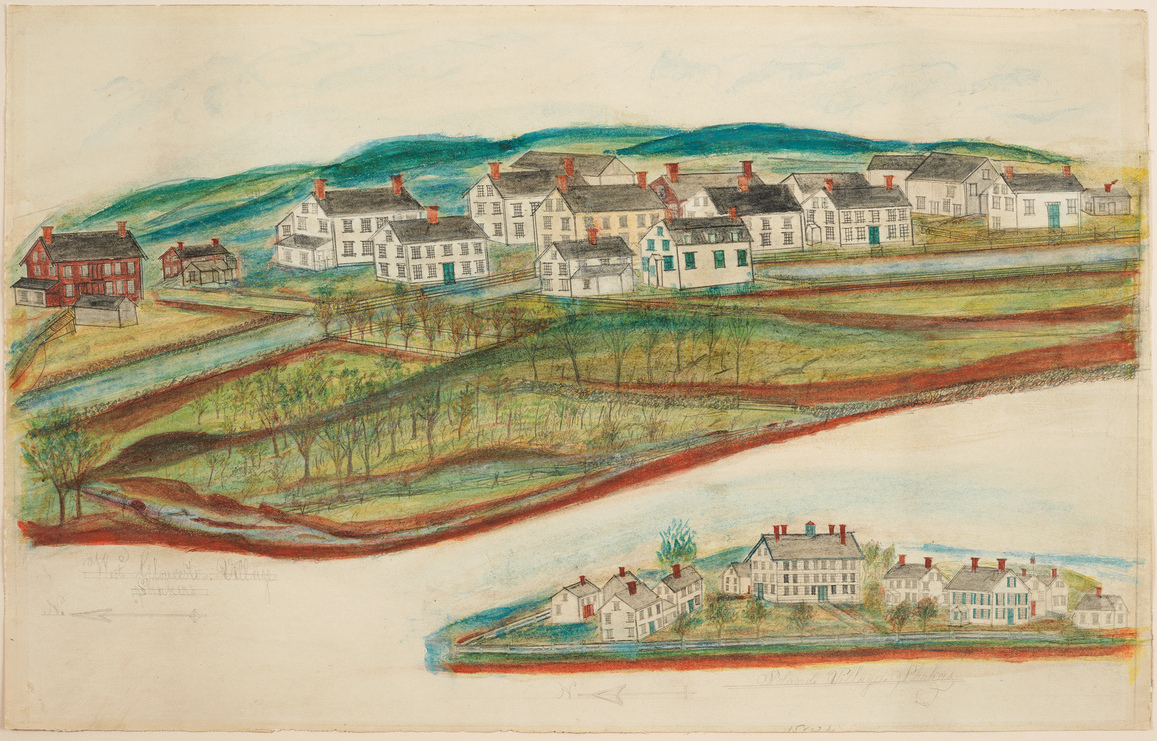
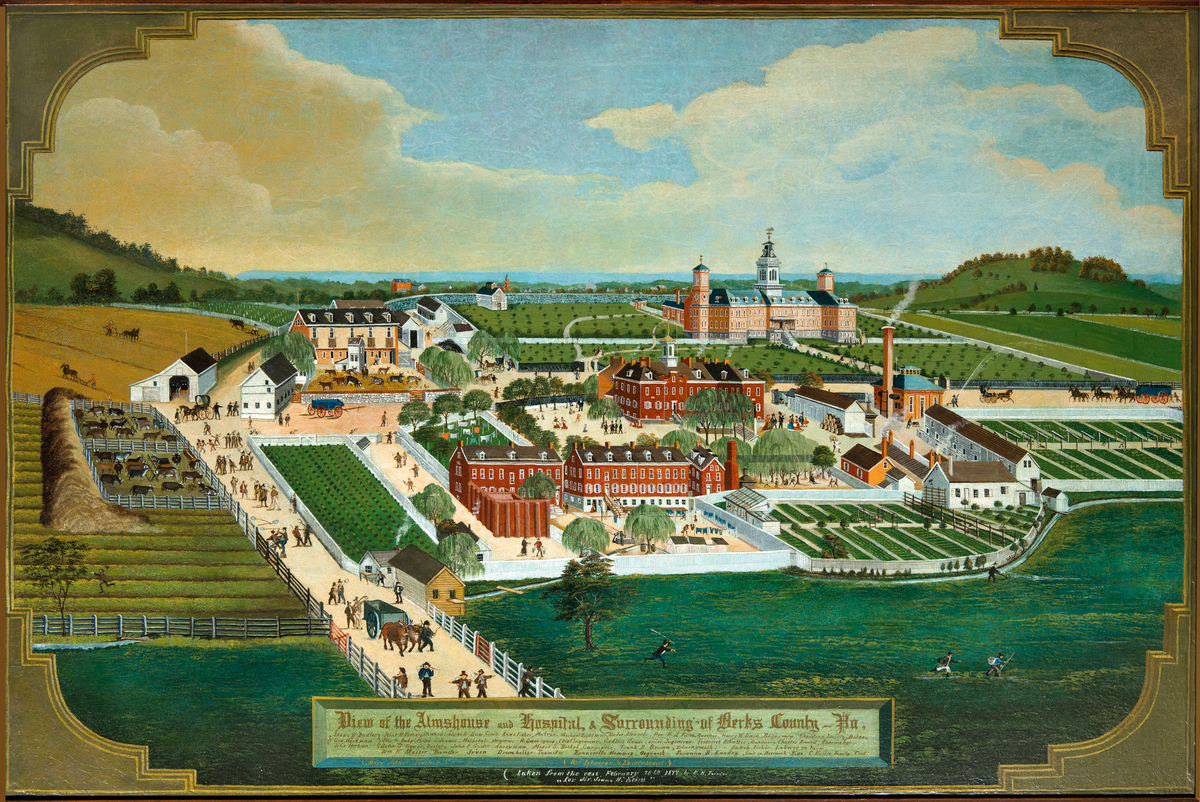
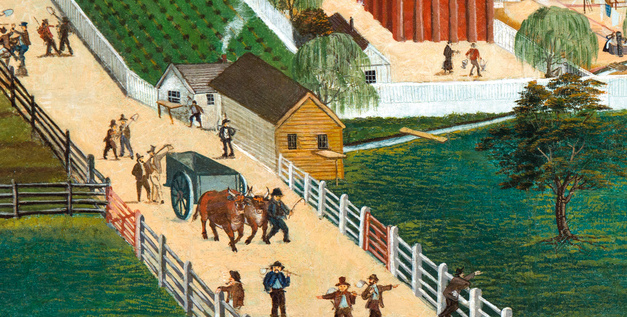
Hofmann’s contribution to this seemingly harmonious environment was painting each almshouse as a well-oiled machine. Many of the jobs inside and outside the almshouses were physically intensive, but Hofmann’s ability to paint may have substituted for such employment, as these artworks paid for his stays. To acquire his painting supplies, Hofmann may have utilized the trade networks through which almshouse stewards supplied their institutions, perhaps receiving his materials as part of his commissions.26 Hofmann repeatedly returned to the Berks County Almshouse after years of intermittent residence at the Montgomery and Schuylkill County Almshouses.27 Over the many years during which Hofmann painted the site, the Berks County Almshouse evolved from a property of rolling hills, farms, animals, and frolicking people to a company town whose figures and buildings were numerous, impressive, and efficient.
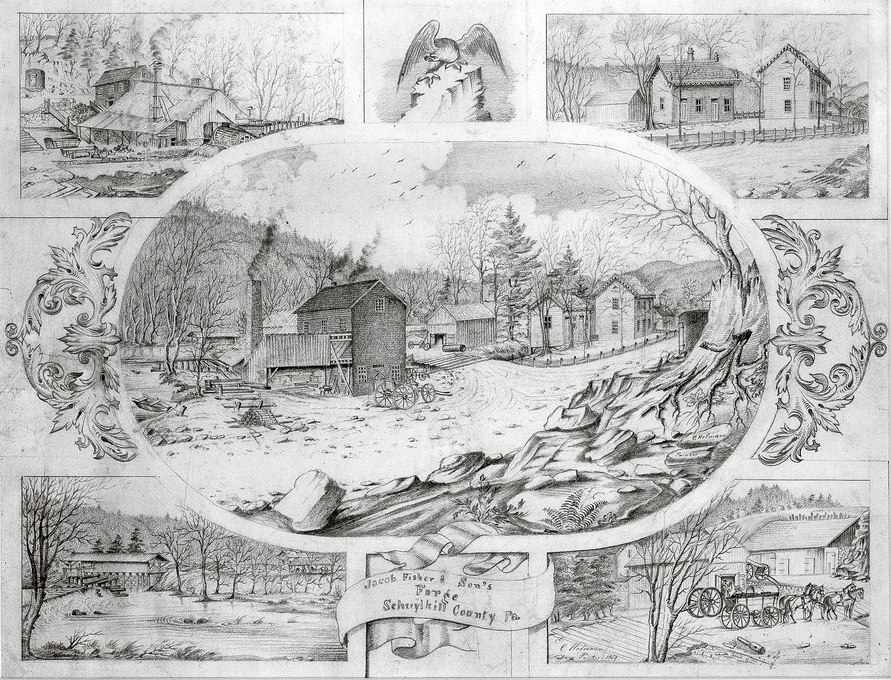
In 1869 Hofmann traveled north from Berks to Schuylkill County. There he produced his only known graphite drawing, a sketch depicting the blacksmith forge of Jacob Fisher & Son (fig. 12). This work features composite images bordered by acanthus leaves and an eagle above the central image containing the Fisher forge and home. The drawing uses motifs commonly employed by Hofmann throughout his career including patriotic images, composite vignettes of the same subject or series of buildings, and scrolls, banners, or banderoles incorporating the work’s title. Like his watercolors of the Northampton and Berks County almshouses, this graphite drawing draws on Hofmann’s earlier training as a lithographer in its precise execution of buildings, roads, and fences in the axonometric style common in nineteenth-century maps, atlases, and other way-finding prints. It was not until Hofmann shifted to painting in oil that his style loosened and became more painterly.
Hofmann invariably depicted his almshouse exteriors as impressive, but taxpayers occasionally saw the interiors of these spaces on tours, with special committees, or when visiting interned relatives. In such situations, almshouse stewards and matrons likely put on a show of order and cleanliness, and almshouse records are often untrustworthy as they included adjusted admissions numbers, discharge information, and even finances.30 In fact, eyewitnesses recorded that almshouses were far from comfortable. Residents frequently lost sleep from incessant screaming throughout the halls, and bedbugs were common. According to Dorothea Dix, an advocate for the poor and individuals with mental illnesses, almshouses in Pennsylvania were sparsely furnished and their interiors were whitewashed.31 Administrators employed these stark interiors both for sanitation and to keep residents from becoming overly comfortable and thus less likely to stay or return. As an artist, Hofmann must have found the lack of color and pattern drab indeed.
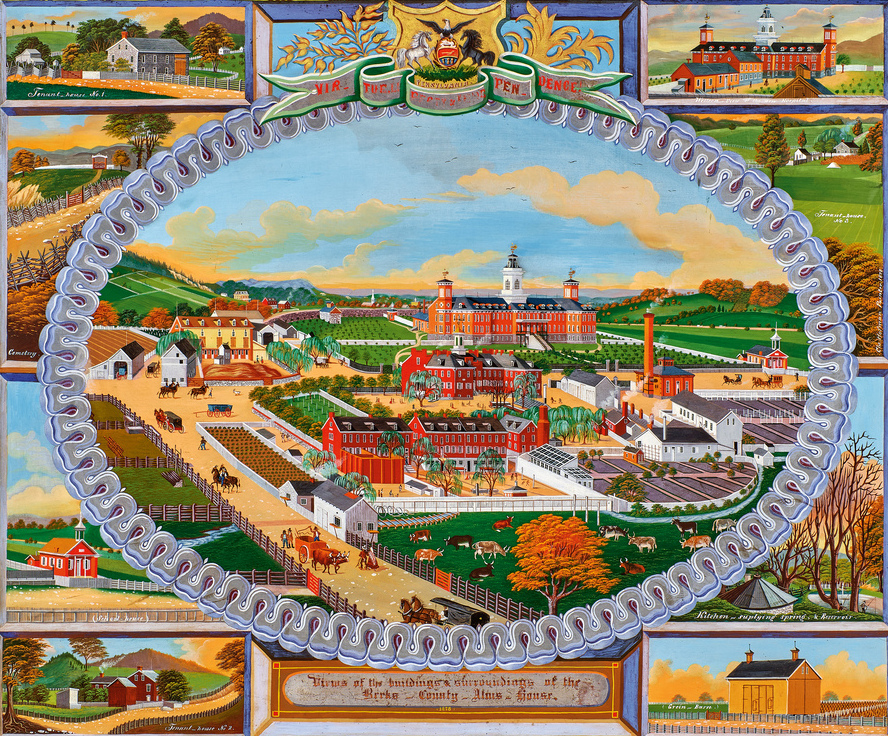
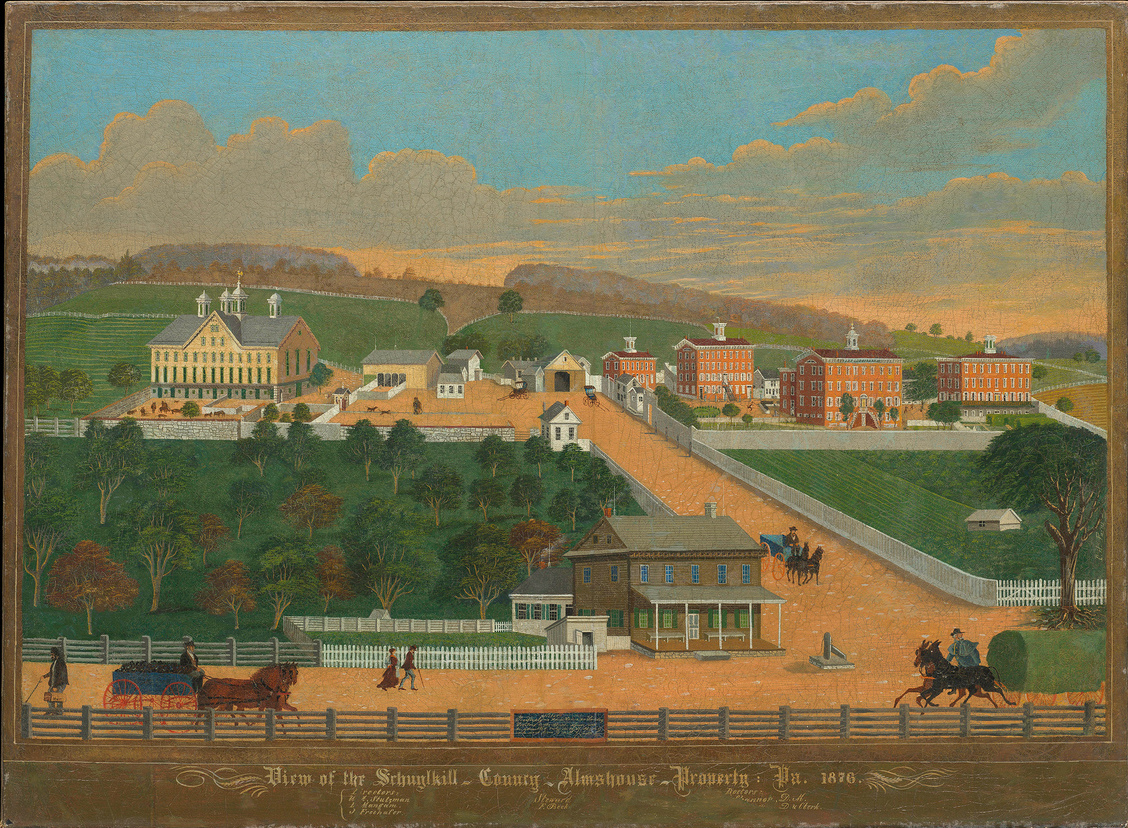
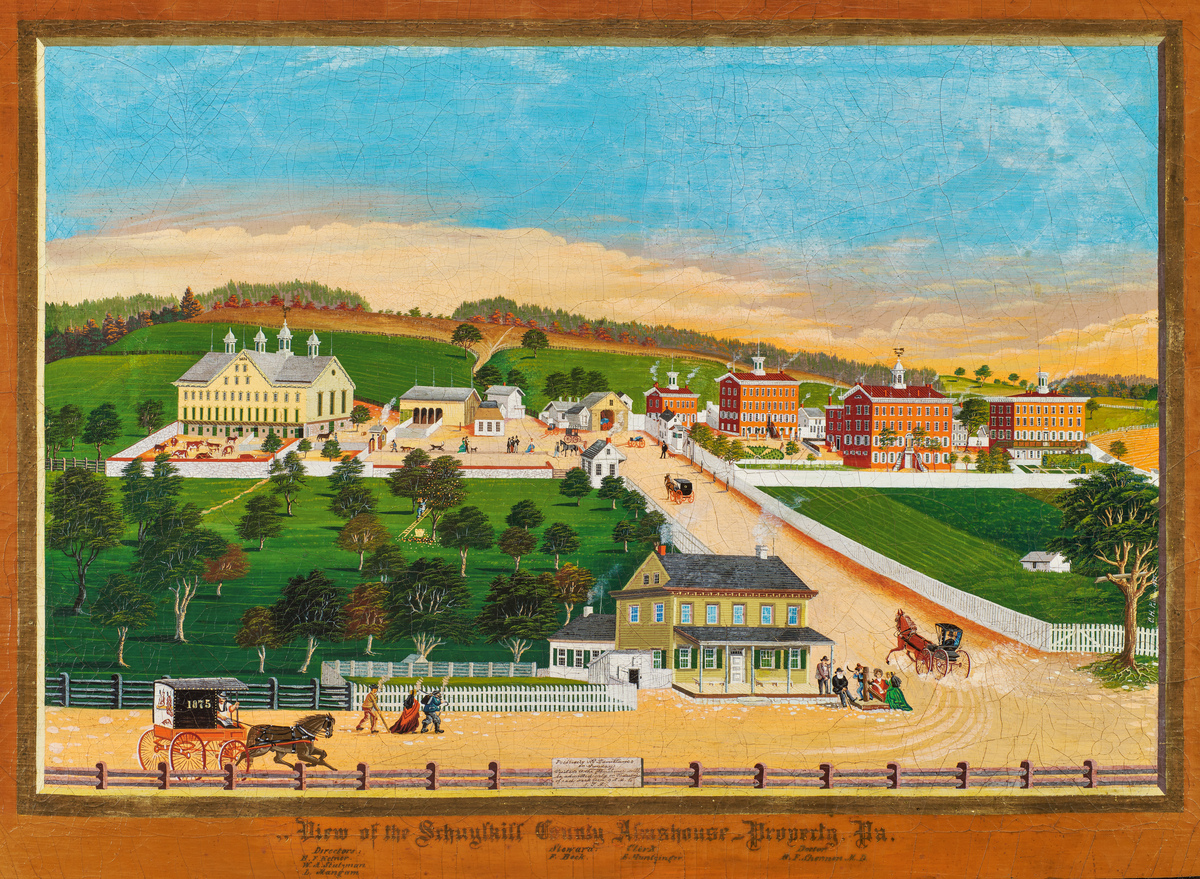
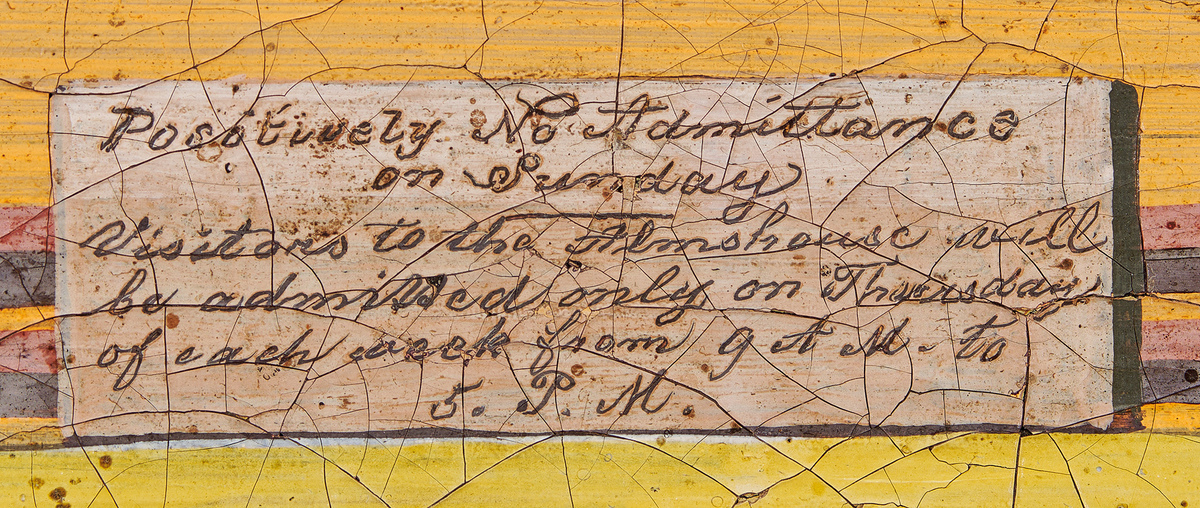
Hofmann populated his Schuylkill County Almshouse paintings differently within each rendition. Some have numerous figures, while in others they are scarce (fig. 14). It is possible that he painted the almshouse both on days when it was closed and on days when it was open to visitors. Hofmann inscribed on one view from 1881, “The Union forever and notice: Positively no admittance on Sunday. Vistors to the almshouse will be admitted only on Thursday of each week from 9 AM to 5. P. M.” (fig. 15). Within these views, Hofmann’s application of paint for the residents was thinner than that for the public, implying a material difference between the two. His residents were frequently translucent, ethereal, and almost featureless; figures occupying the foreground have greater depth and detail, and their formal attire suggests that they are members of the public or administrators (see fig. 13). Later paintings partly reversed this trend (fig. 16). In 1878 Hofmann again painted the Berks County Almshouse, this time as a composite of eight vignettes surrounding a central depiction of the institution (see fig. 1). In this later view of the almshouse, the residents inhabiting the barnyards and common spaces are depicted with a range of abilities and disabilities, and their numbers far surpass those of the visitors. Consistent, however, are Hofmann’s vibrant colors, bucolic landscape, and the grand and extensive property. Over the six-year period that Hofmann painted the Schuylkill County Almshouse, the site changed little. Among the few alterations, most notable are the number of trees or the types of crops grown in the fields in a particular year.32
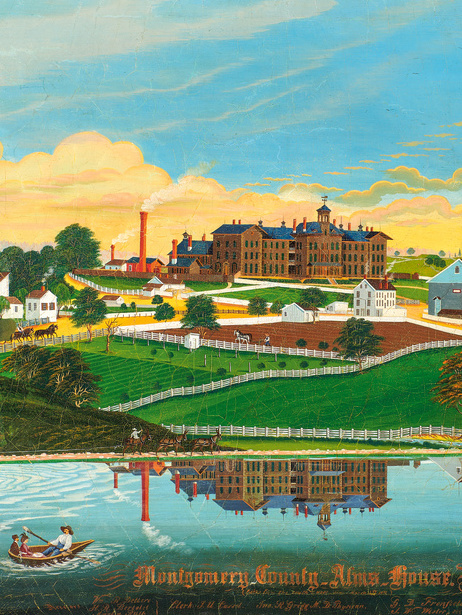
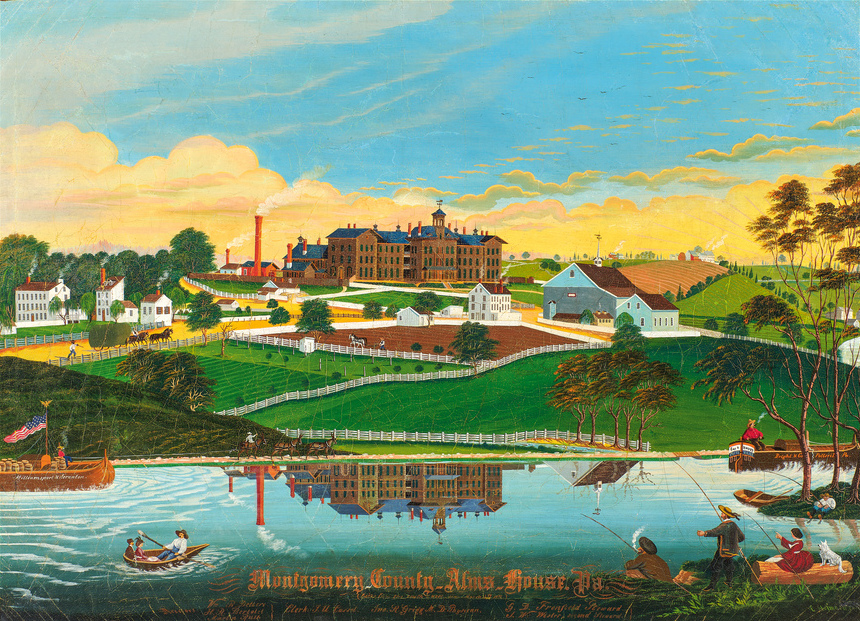
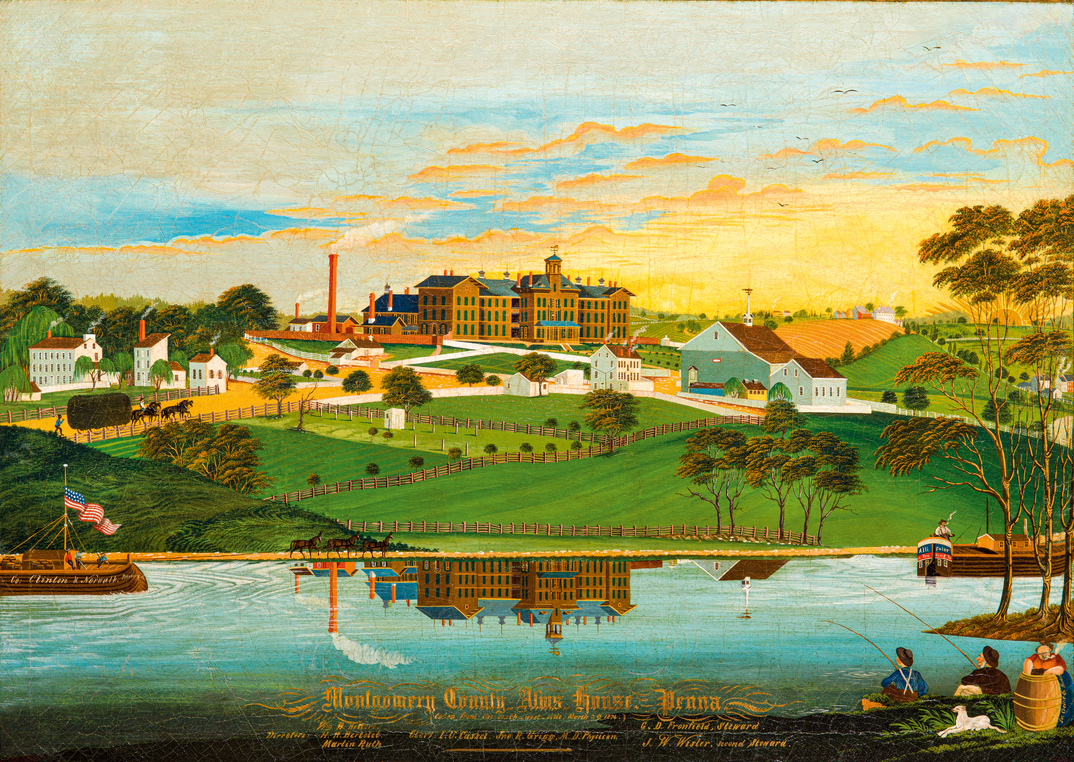
In 1874 Hofmann appeared for the first time in Montgomery County, admitting himself to its almshouse that same year. For the previous ten years, Hofmann had lived and traveled north of Montgomery County between the Delaware and Schuylkill Rivers. Although he would spend the least amount of time in this almshouse, the institution provided the artist with a subject different from those depicted in his previous paintings. The Montgomery County Almshouse sat directly upon the Schuylkill River, providing Hofmann with a waterway to paint. Immediately north of the almshouse the Schuylkill Canal, which began operating in 1825, emptied directly into the river, which explains Hofmann’s inclusion of a small island within the right foreground of the artist’s identified paintings of the site. Thus, all four of Hofmann’s extant views of the Montgomery County Almshouse include canal boats, shipping barges, and vignettes of daily life along the Schuylkill River. These paintings are also Hofmann’s only works to include the names of local businesses. The Montgomery County Almshouse was founded in 1808 and built upon 265 acres of land purchased from Abraham Gotwalt of Upper Providence Township.39 The institution’s new residential stone building was completed in 1872, just two years before Hofmann admitted himself to the almshouse. By then fires had already devastated the almshouse three times, but despite this, residents filled its rooms each time it was rebuilt.
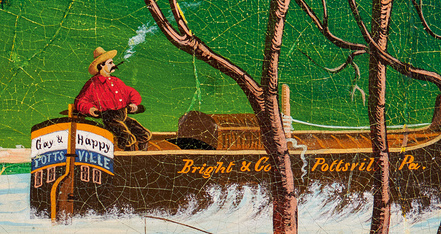
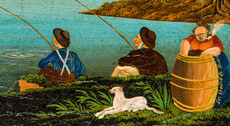
Hofmann’s view from the southwest side of the Schuylkill River shows the almshouse’s three-story brown stone building at the center surrounded by outbuildings, farmland, dirt roads, and tenant houses (fig. 20). People fish along the banks of the Schuylkill River as two boats travel south, pulled by a team of mules along the canal towpath. The narrow boat to the left carries barrels and flies a large American flag topped by an eagle. On the side of the boat, Hofmann painted “Williamsport & Scranton,” stops along northern divisions of the Pennsylvania canal system. The second vessel is a typical canal boat with a manual tiller; on its rear Hofmann painted “Gay & Happy” and “Pottsville,” and on its right side “Bright & Co[.]” and “Pottsvil[le,] Pa.” (fig. 21).40 In a similar painting of the almshouse created only ten days later, Hofmann included many of the same motifs, such as the American flag, this time reversed, and people sitting along the river (fig. 22). The same boats are present, but with different names painted on their sides. On the narrow boat, Hofmann painted “To: Clinton & Norwalk. Pittsburg Pa”; the rear of canal boat reads “Alli Gator at Reading Pa”; and a woman packing fish into a barrel is accompanied by the text: “For Chester Co. Market” (fig. 23). Hofmann’s views of the Montgomery County Almshouse thus also document the industrial history of the Pennsylvania canal system and the Schuylkill River waterway.41
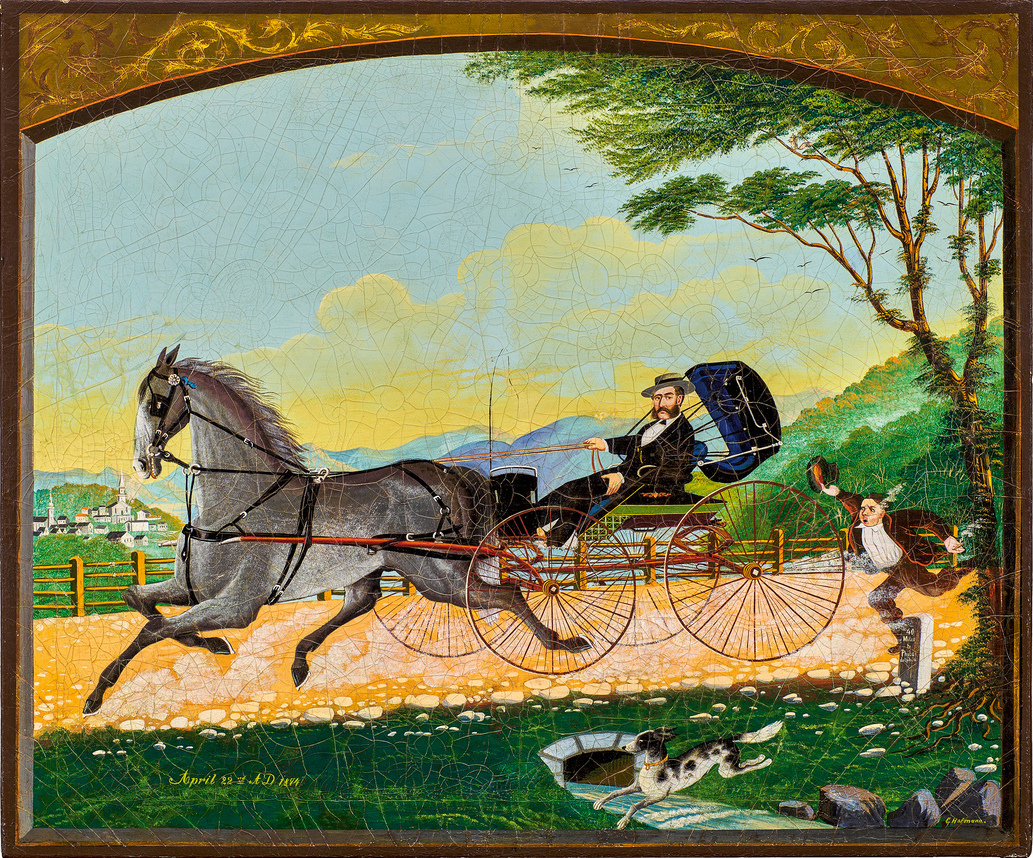
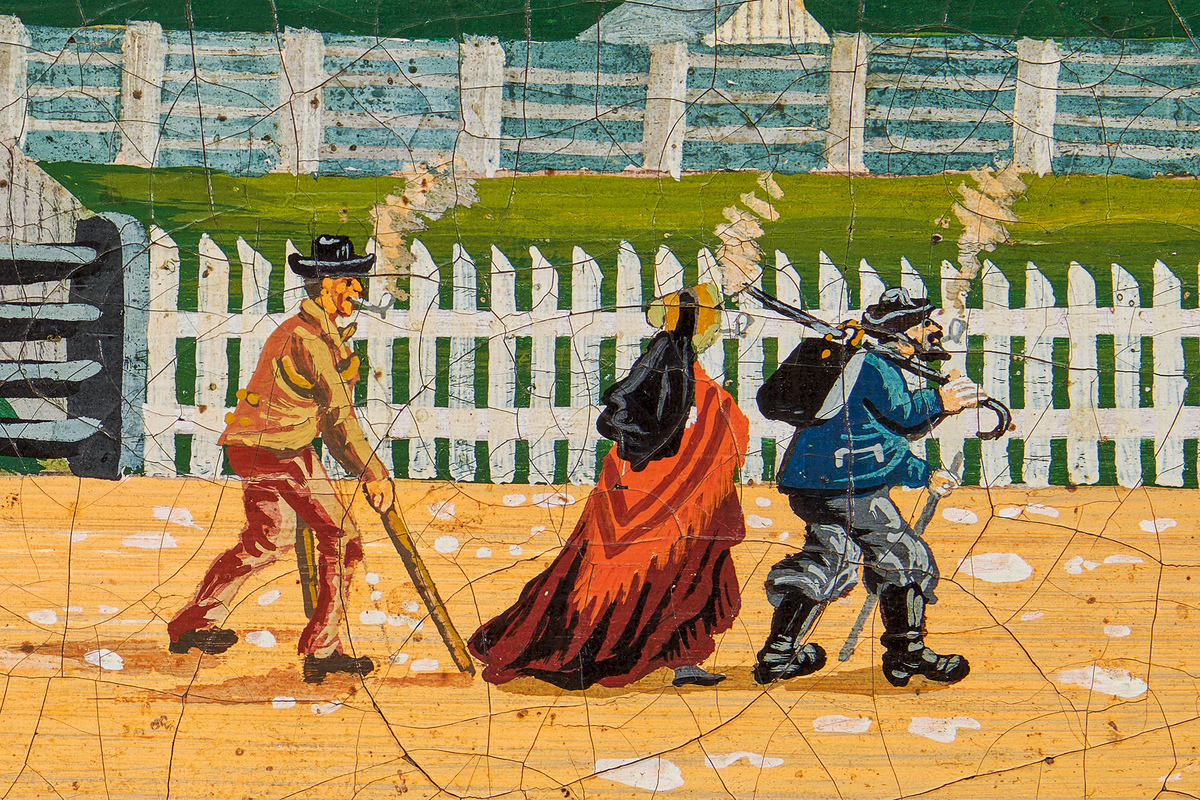
Hofmann’s painting, although detailed, does not allow definitive identification of the buggy. Several similar models were in production after the Civil War, and Hofmann, who probably executed the painting from memory, likely fabricated some details. It is possible that the vehicle is a Goddard Buggy, named after designer Thomas Goddard of Boston, or a so-called Coal-Box Buggy, referring to the shape of the body and seat.43 Regardless of the buggy’s model, the eventful scene invites speculation. As nearly all of Hofmann’s paintings were commissioned by almshouse administrators or farmers living near the almshouses, who might have commissioned this unusual painting? Hofmann completed the work in April 1874 after admitting himself to the Montgomery County almshouse, and by 1875, he was painting again in Schuylkill County. Did this colorful carriage scene depict an event witnessed on his previous travels, or was the scene fabricated? The painting’s expressive figures raise more questions. Dressed in a brown coat, baggy pants, and a button-down shirt, the individual chasing the carriage presents as a laborer while the man in the carriage, wearing a jacket, cravat, and hat, is doubtlessly a wealthier individual, perhaps even an administrator of the Montgomery County Almshouse. Hofmann may also have painted this scene to flaunt his painting skills, or perhaps the painting funded his transportation to Schuylkill County.
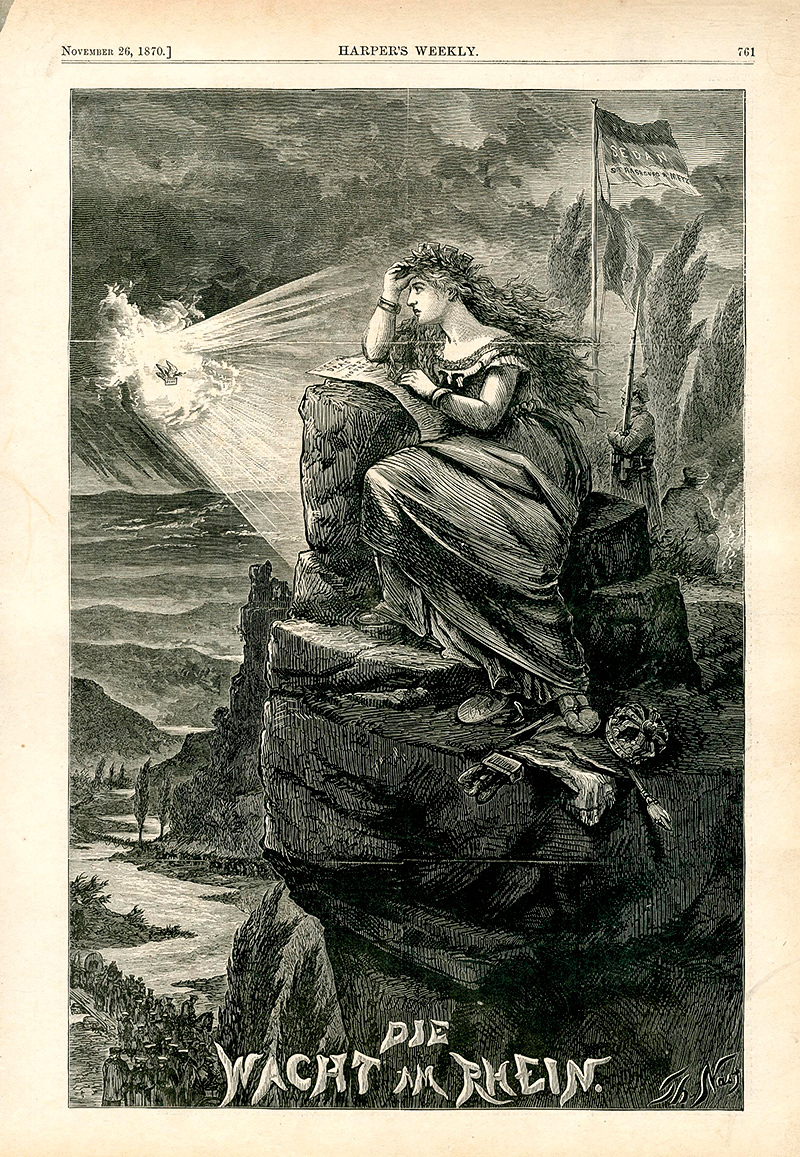
In 1877 Hofmann produced another painting unrelated to his almshouse commissions. This painting, titled Die Wacht am Rhein (The Watch on the Rhine), is a visual representation of an eponymous German patriotic anthem (fig. 25).44 The lyrics were based on an 1840 poem composed by Swabian merchant Max Schneckenberger (1819–1849) and set to music in 1854 by Karl Wilhelm (1815–1873) of Krefeld. The anthem became popular during the Franco-Prussian War (1870–71), a conflict between the Second French Empire and the North German Confederation led by the Kingdom of Prussia.45 The song was later a second national anthem of unified Germany that evoked deep feeling, especially among Germans who had defended the Rhine during the war.46 In this painting, Hofmann depicts Germania sitting atop a rocky outcropping outside of Rüdesheim, high above the Rhine River. Depictions of Germania—or a deific female personification of Germany—emerged in antiquity and later represented the “Mother of the Nation” after the German states unified in 1871. Like other period representations of Germania, Hofmann painted the figure wielding the Reichsschwert (imperial sword) and clothed in a Roman-style dress. She also holds a shield with the coat of arms of Germany: a black eagle against a field of gold. Along the edges of the mountainside, Hofmann wrote: “Und! sie sollen ihm nicht haben, Den freien deutschen Rhein” (They shall not have him, the free, German Rhine), a quote that Hofmann attributed to Otto von Bismarck. Yet the words actually originated in an 1840 poem by Nikolaus Becker called “Rheinlied” (Rhine song).47 Rising behind the windswept hair of Germania is Hohenzollern Castle, home to the Prussian dynasty that ruled imperial Germany between 1871 and 1918. An abundance of laurel leaves cascade down the mountainside, surrounding German soldiers and weapons of war. Hofmann’s pride in his homeland is also hinted in his depiction of German industry, including the train from Berlin to Paris and steamships charging through the Rhine. Like the painting of the well-dressed man seated in the carriage, this work marks another departure for Hofmann from farms and almshouses. The commissioner of this painting remains unknown, but Hofmann was likely familiar with period visualizations of Schneckenberger’s 1840 poem. In the November 26, 1870, issue of Harper’s Weekly, political artist and cartoonist Thomas Nast (1840–1902) produced a similar image of Germania sitting along a mountainside with the Rhine River below her feet (fig. 26). Similar images appeared over the course of Germany’s unification and were so popular that Nast, who was born in Bavaria, used it for more than one illustration in Harper’s Weekly. The political magazine was widely circulated and could easily have inspired Hofmann’s painting seven years later.
![Charles C. Hofmann, Die Wacht am Rhein [The Watch on the Rhine]](https://americanainsights.org/wp-content/uploads/2026/03/ai-essay-08-hofmann-25-rev.jpg)
Between 1878 and 1882, Hofmann traveled between the Schuylkill, Berks, and Montgomery County almshouses, painting each location multiple times. His work evidently remained popular to the administrators who repeatedly commissioned new views of their institutions, with each subsequent painting recording the sites’ latest additions and improvements to the property. The paintings, therefore, had many uses, standing in for maps that allowed visitors to view the institutions all at once or to navigate when the institutions were open to the public. Hofmann’s composite style, incorporating framed vignettes flanking the central bird’s-eye view of each institution, supports the idea that these works had more than purely aesthetic value. Hofmann’s skills in lithography helped the administrators to produce accurate views of the almshouses both pleasing to the eye and as advertisements, creating the perception that the properties were orderly and clean and that their residents engaged in “restorative” physical tasks such as farming.
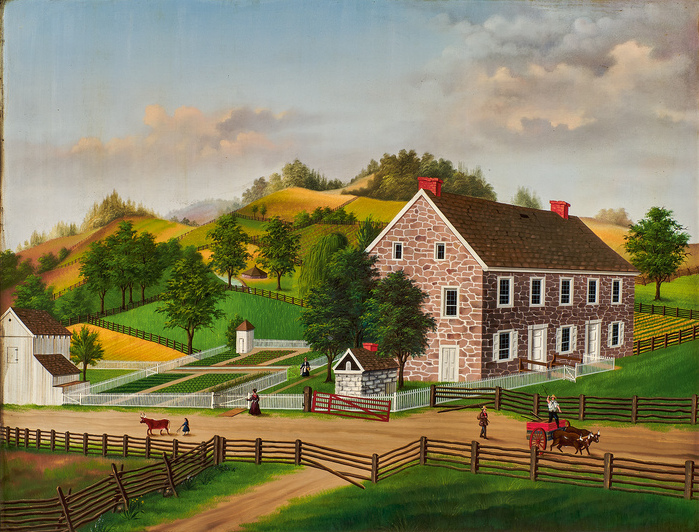
Building on his successful paintings for Daniel B. Lorah earlier in the decade, Hofmann worked privately for another almshouse administrator in 1879. John B. Knorr, an undertaker and cabinetmaker by trade, was also the clerk of the Berks County Almshouse.48 He commissioned Hofmann to paint his home in Wernersville, a village about eight miles west of the almshouse and near Lorah’s farm. Knorr also asked Hofmann to paint the church he attended, Hain’s Church, and a view of Wernersville (figs. 27, 28).49 Hofmann’s painting of the Knorr home features several people in the foreground including a horse, carriage, rider, and running dog reminiscent of the scene painted in Montgomery County (see fig. 24). However, in the work for Knorr, a spectator admires the carriage rather than chases after it. Typical of Pennsylvania German homes in the mid-to-late-nineteenth century, the Knorr house has two front entrances with a covered porch and a detached summer kitchen. As in his painting of the Reber farm, Hofmann documented the way that Pennsylvania German domestic architecture blended multiple styles from the early eighteenth century until after the American Civil War.
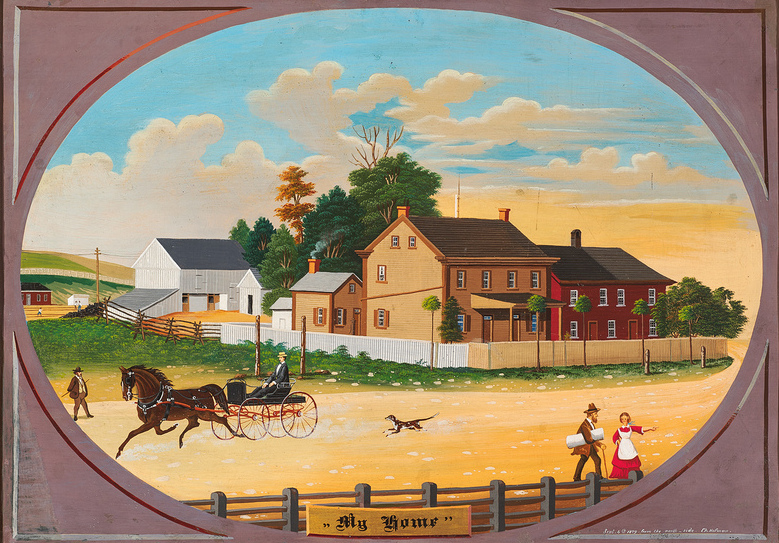
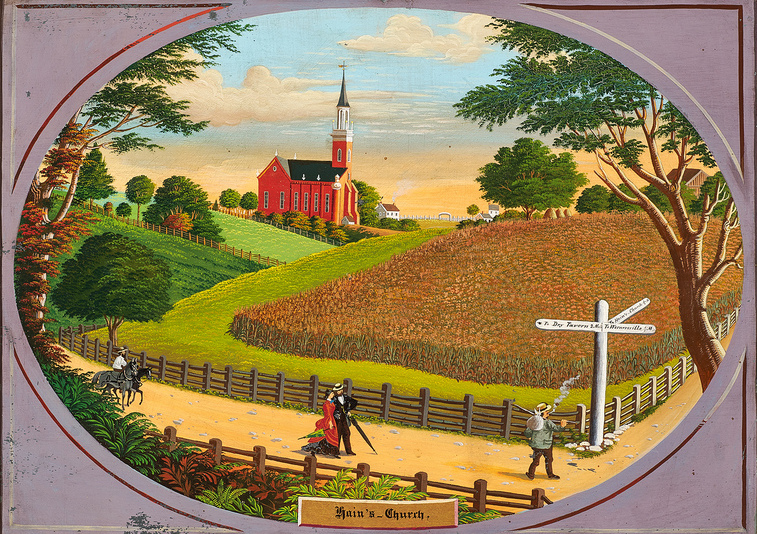
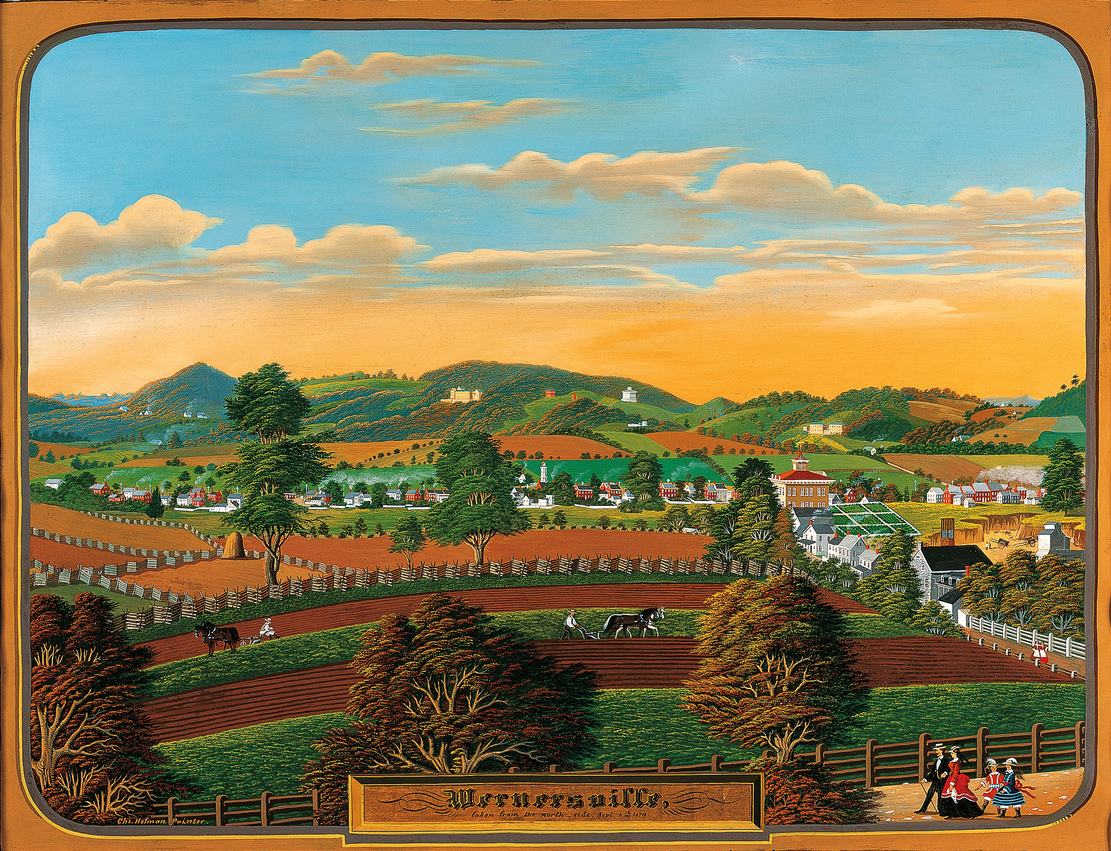
By the time that Hofmann completed Knorr’s three paintings in September 1879, his days roaming the countryside and staying at almshouses had nearly drawn to a close. In 1880 the artist admitted himself to the Berks County Almshouse and painted the site for the last time. The following year, he traveled to the Schuylkill County Almshouse and similarly painted it for the final time. In 1881 Hofmann made his last trip south, from the Blue Mountains and into the rolling hills of Berks County. By then he was likely experiencing painful symptoms of the edema that took his life a year later; one can only imagine the physical strains of long-term addiction and itinerancy. In 1882 Hofmann passed away at the Berks County Almshouse, a site that he had painted so many times over the past two decades.
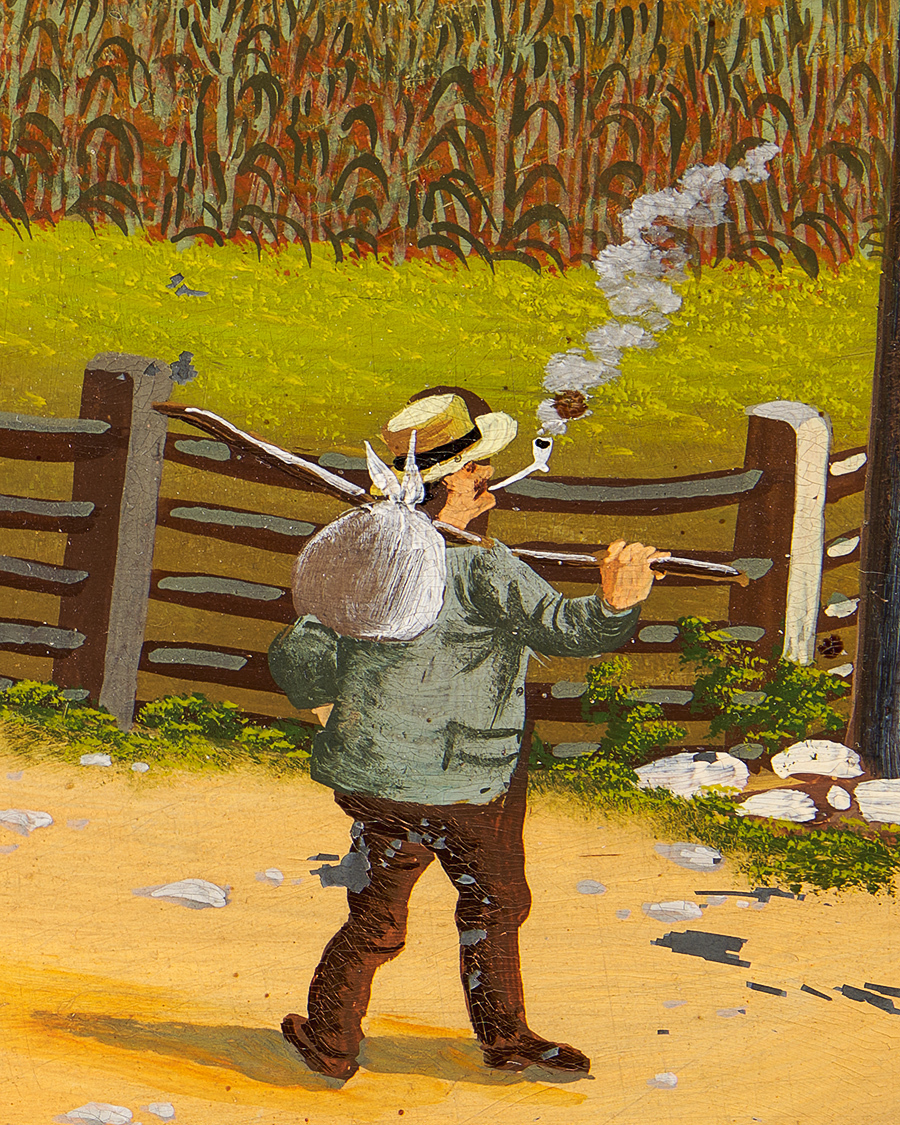
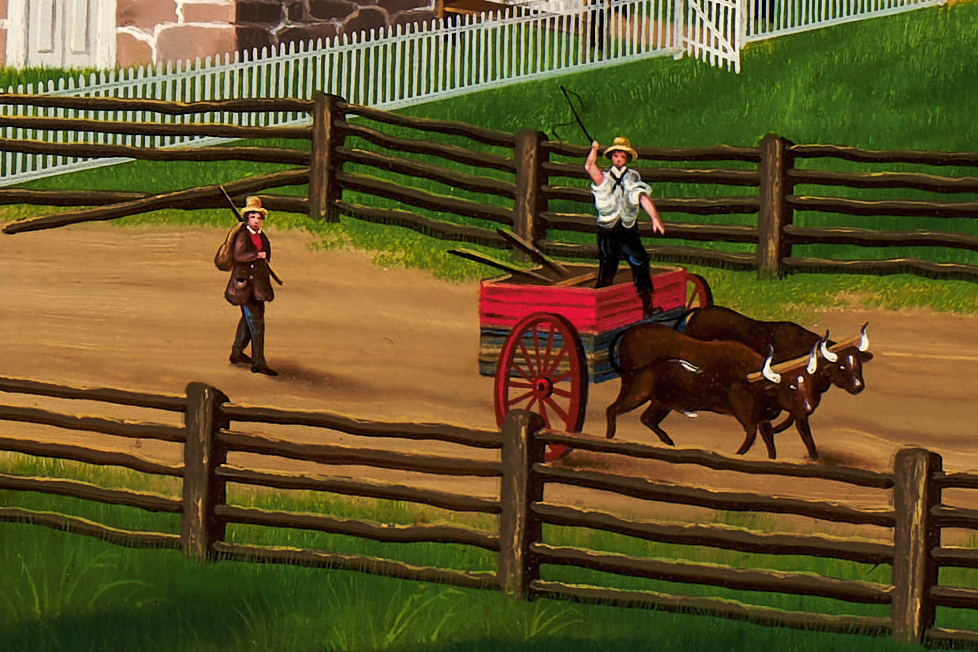
Bereft of documentary records or firsthand accounts of Hofmann’s life, we are left only with the artist’s surviving paintings with which to better understand him. Indeed, within a select few paintings it is likely that viewers encounter the artist himself. Scholars have noted the appearance of a distinctive figure within several of Hofmann’s paintings. Wearing a humble straw hat, jacket, and trousers and carrying a pipe and bindle, this itinerant figure appears in at least eight of Hofmann’s paintings and is likely the closest that we will come to knowing the artist first-hand (figs. 28, 29, 31, 32).55 Outside of this elusive self-portrait, Hofmann’s thirty-plus known works stand as rich testaments to his capabilities and wandering spirit. While almshouse administrators doubtless asked Hofmann to depict their properties as stately institutions worthy of praise, we might also speculate that he depicted such bucolic scenes, grand buildings, well-dressed people, and clean roads for his own mental health. For Hofmann painting offered escape from a difficult life. Yet his itinerancy enabled him to experience more of Pennsylvania than did most people of his class in the nineteenth century. Additional paintings by Hofmann will inevitably surface over the next several decades, and scholars will continue to identify connections between Hofmann and other period almshouse painters. It is clear that Hofmann influenced John Rasmussen (1828–1895) and Louis C. Mader (1842–c. 1899. Rasmussen, also intemperate, lived at the Berks County Almshouse at the same time as Hofmann and painted that almshouse in a style similar to Hofmann’s, including the use of bird’s-eye perspective and composite vignettes. Perhaps Hofmann and Rasmussen bonded over their skills as painters, their Germanic heritage, and shared German language. Working at a slightly later date, Louis Mader’s almshouse paintings also reflect the influence of Hofmann’s work. Undoubtedly, Charles C. Hofmann will continue to inspire future generations interested in the struggles, hardships, beauty, and complexity of everyday people living and observing life from the fringes of society.

Acknowledgments
About the Author
KNOWN WORKS BY
CHARLES C. HOFMANN (1821–1882)
- Hospital, Poorhouse & Lunatick House of Northampton County, 1864, oil on canvas. Northampton County Historical Society to Gracedale Nursing Home, 1995
- Poorhouse, Hospital & Lunatick-House of Northampton County, 1864, ink and watercolor. Private collection. David Wheatcroft, November 2005 [see fig. 3]
- Poorhouse, Hospital & Lunatick-House of Northampton County, 1864, ink and watercolor. Private collection. Pook & Pook, October 13, 2018, lot 139
- View of the Almshouse, Hospital, Lunatic-Asylum and Agricultur-Buildings of Berks-County, Pennsylvania, April 12, 1865, ink and watercolor. Private collection [see fig. 5]
- View of the Almshouse, Hospital, Lunatic-Asylum and Agricultur-Buildings of Berks-County, April 17, 1865, ink and watercolor. Berks History Center, 69-13 [see fig. 6]
- Poor House, Hospital & Lunatick-Hospital of Northampton County, c. 1865, ink and watercolor. National Gallery of Art, 1971.83.28
- View of the Alms House & Hospital of Berks County Pa., c. 1865–78, oil on canvas. Berks History Center, 69-14 [see fig. 7]
- Jacob Fisher & Son’s Forge, Schuylkill County Pa., 1869, graphite on paper. Colonial Williamsburg Foundation, 2008.202.1 [see fig. 12]
- Stone House at Berks County Alms House, 1870–80, oil on zinc. Berks History Center, 74.1A [see fig. 31]
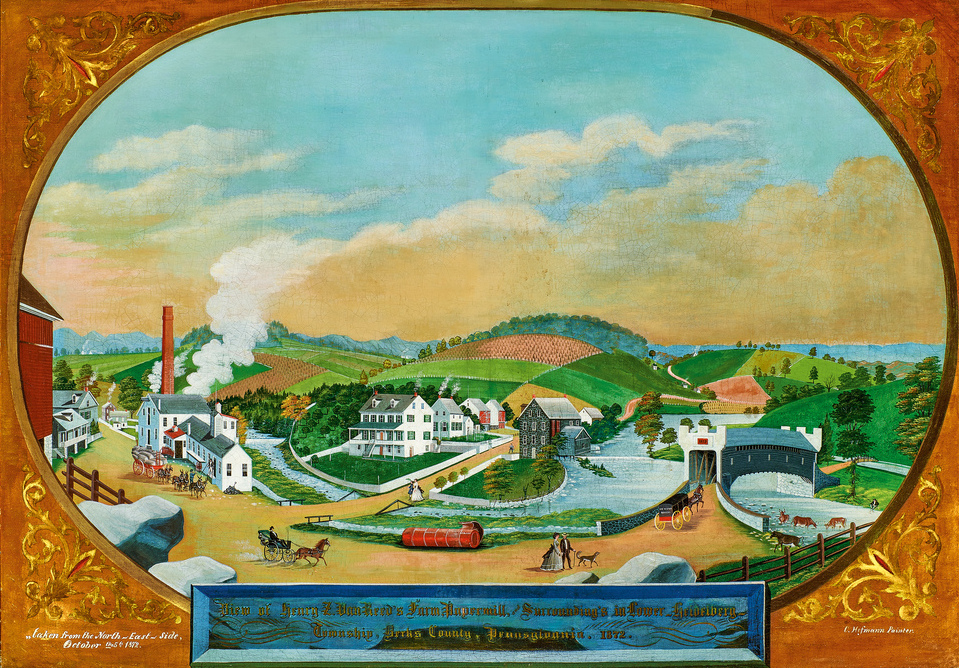
- View of Henry Z. van Reed’s Farm, Papermill, and Surrounding’s in Lower Heidelberg Township, Berks County, Pennsylvania, October 5, 1872, oil on canvas. Berks History Center, 54-21-14 [see fig. 17]56
- Daniel B. Lorah’s Farm, Berks County, 1872, oil on canvas. Private collection. Pook & Pook, May 21, 2001, lot 129
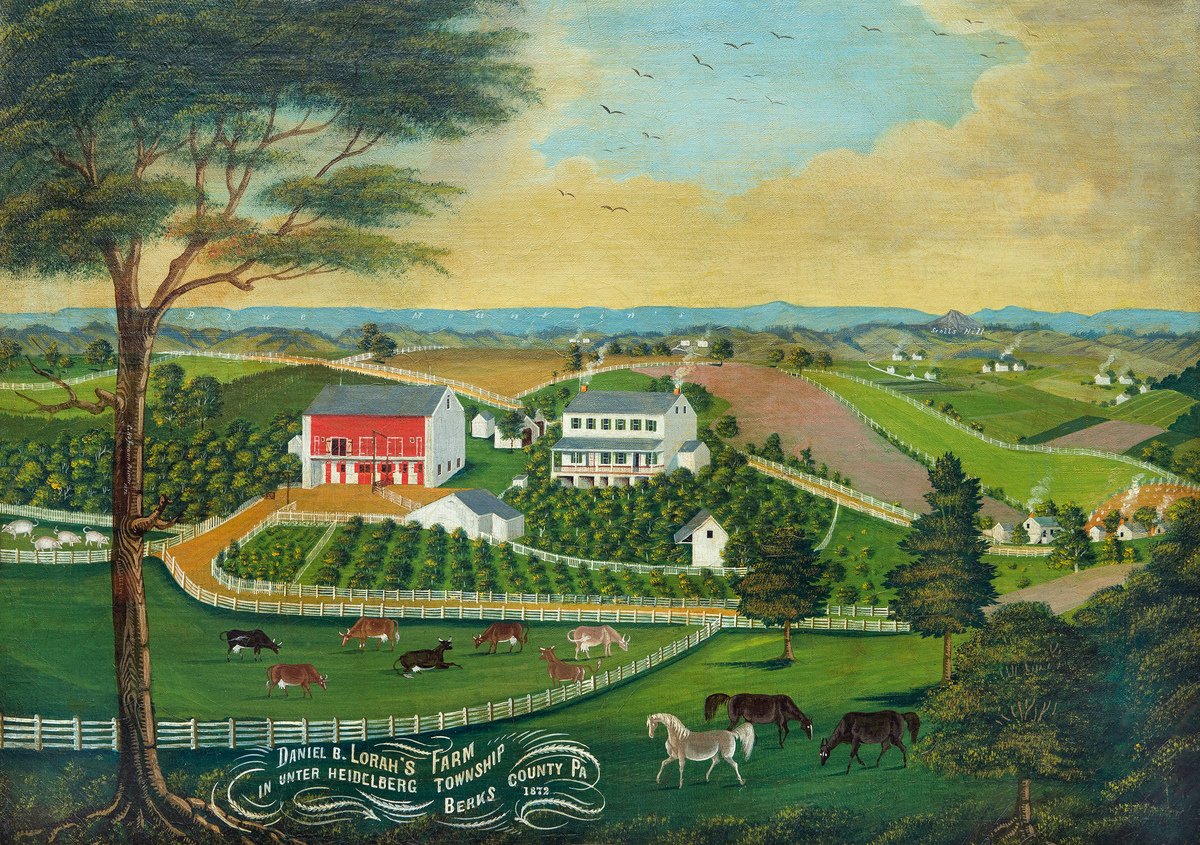
- Daniel B. Lorah’s Farm in Unter Heidelberg Township, Berks County, PA, 1872, oil on canvas. Private collection. Pook & Pook, April 28, 2018, lot 1102 [see fig. 18]
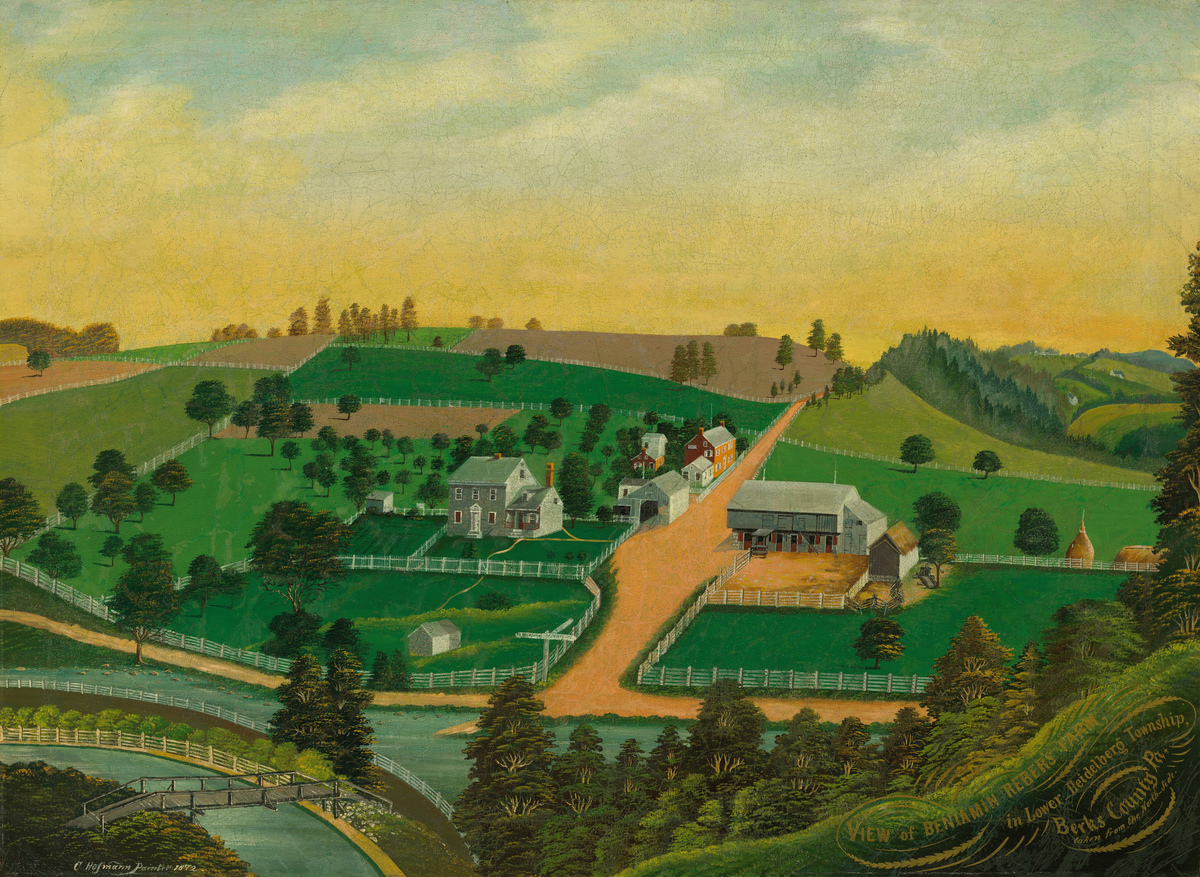
- View of Benjamin Reber’s Farm in Lower Heidelberg Township, Berks County Pa. taken from the North-Side, 1872, oil on canvas. National Gallery of Art, 1955.11.16 [see fig. 19]
- View of the Poorhouse & Hospital of Berks County, 1872, oil on canvas. Everhart Museum of Natural History, Science & Art, Scranton, PA, 46.38
- View of the Poorhouse & Hospital of Berks County, Pa., 1872, oil on canvas. Berks History Center, 67-2
- View of the Almshouse and Hospital, & Surrounding of Berks County, Pa., September 13, 1873, oil on canvas. Private collection. Sotheby’s, January 20, 2017, lot 4218 [see fig. 10]
- View of the Alms House, Hospital & Surroundings of Berks County, Pa., September 15, 1873, oil on canvas. Berks History Center, 49-24
- View of Montgomery County Almshouse, 1874–80. Carey Auctions, January 1, 2018
- Montgomery County Alms House, Penna, taken from the south west side, March 2, 1874, oil on canvas. Dietrich American Foundation, 6.4.1023 [see fig. 22]
- Montgomery County Alms-House, Pa, taken from south-west Side, March 12, 1874, oil on canvas. Historical Society of Montgomery County, 1960.10791.001 [see fig. 20]
- Horse-Drawn Carriage, April 22, 1874, oil on canvas. Historic Trappe, 2020.002.0013 [see fig. 24]
- Berks County Hospital and Alms House, 1874, oil on canvas. Yale University Art Gallery, 021.79.1
- View of the Schuylkill County Almshouse Property, Pa., 1875, oil on canvas. Private collection. Olde Hope Antiques, 2001 [see fig. 14]
- View of the Schuylkill County Almshouse Property, 1876, oil on canvas. Collection of the Schuylkill County Courthouse
- View of the Schuylkill County Almshouse Property: Pa., 1876, oil on canvas. The Metropolitan Museum of Art, 66.242.26 [see fig. 13]
- Die Wacht am Rhein [The Watch on the Rhine], August 25, 1877, oil on zinc. Greg K. Kramer Antiques [see fig. 25]
- Views of the Buildings & Surroundings of the Berks County Alms House, 1878, oil on zinc. Berks History Center, 69-16 [see fig. 1]
- Views of the Buildings & Surroundings of the Berks County Almshouse, 1878, oil on zinc. Private collection. Pook & Pook, October 11, 2013, lot 495
- View of the Montgomery County Almshouse Building’s, 1878, oil on canvas. Fred Giampietro
- View’s of the Buildings & Surroundings of the Berks County Alms House, July 12, 1879, oil on zinc. Private collection [see fig. 8]
- Views of the Buildings and Surroundings of the Berks County Almshouse, June 6, 1879, oil on zinc. Pook & Pook, 2012, lot 103
- “My Home” from the North Side, September 4, 1879, oil on zinc. Private collection. Pook & Pook, June 5, 1999, lot 274 [see fig. 27]
- Wernersville, Taken from the North-Side, September 4, 1879, oil on zinc. American Folk Art Museum, 2005.8.14 [see fig. 30]
- Hain’s Church, likely September 1879, oil on zinc. Private collection. Pook & Pook, June 5, 1999, lot 275 [see fig. 28]
- View of the Schuylkill County Almshouse Property, 1881, oil on canvas. Private collection. Christie’s, January 18, 2019, lot 1228
- View of the Schuylkill County Almshouse Property, 1881, oil on canvas. Private collection. Freeman’s, June 19, 2019, lot 98
1 The substrate for this paintings and all following works on metal is likely zinc but may also be another nonferrous metal.
2 See the inscription on fig. 6.
3 “German Americans in the Civil War Era,” Max Kade Institute for German-American Studies, University of Wisconsin-Madison, updated November 2019, wisc.edu.
4 Soldiers and Sailors Database, National Park Service, nps.gov.
5 Tom Armstrong, “God Bless the Home of the Poor,” Historical Review of Berks County 35 (1970): 88.
6 Mara Kaktins, “Almshouses (Poorhouses),” The Encyclopedia of Greater Philadelphia, philadelphiaencyclopedia.org.
7 Suzanne M. Spencer-Wood, “Introduction and Historical Context to the Archaeology of Seventeenth and Eighteenth Century Almshouses,” International Journal of Historical Archaeology 5 (2001): 115–22.
8 Monique Bourque, “Populating the Poorhouse: A Reassessment of Poor Relief in the Antebellum Delaware Valley,” Pennsylvania History: A Journal of Mid-Atlantic Studies 70, no. 4 (2003): 397–432.
9 Bourque, 403.
10 Priscilla Ferguson Clement, “The Philadelphia Welfare Crisis of the 1820s,” Pennsylvania Magazine of History and Biography 105, no. 2 (1981): 150.
11 Clement, “Philadelphia Welfare Crisis,” 151–52.
12 Bourque, “Populating the Poorhouse,” 404.
13 Bourque, 398.
14 Clement, “Philadelphia Welfare Crisis,” 153.
15 Borque, “Populating the Poorhouse,” 406.
16 Bourque, 416.
17 Bourque, 399.
18 “Gracedale’s History Dates to Indian Days,” May 15, 1997, Morning Call (Allentown, PA).
19 Armstrong, “God Bless,” 89.
20 Armstrong describes Hofmann’s paintings as revealing a “spotless world of sunshine and order” (p. 90).
21 Monique Bourque, “‘The Peculiar Characteristic of Christian Communities’: The County Almshouses of the Delaware Valley, 1790–1860,” Perspectives in Vernacular Architecture 6 (1997): 61.
22 Michelle Lynch, “Unassuming Wall Holds a Place in Berks history,” Reading (PA) Eagle, August 17, 2023.
23 Lynch, 397.
24 Bourque, “Populating the Poorhouse,” 405.
25 Bourque, “Peculiar Characteristic,” 67.
26 In the period, watercolor artists occasionally ground their own pigments from natural materials, but most purchased premade “cakes,” which had been invented in England by William Reeves in 1780. In 1846 Winsor and Newton introduced watercolor paints in metal tubes. See Elizabeth E. Barker, “Painting in Britain, 1750–1850,” October 2004, Heilbrunn Timeline of Art History, The Metropolitan Museum of Art, 2000–, metmuseum.org.
27 In 1951 the Berks County Almshouse was demolished, and residents were moved to a nursing facility in Bern Township called the Berks Heim Nursing Home. Only a stone wall remains from the original site. Many of the residents were buried in unmarked graves in the cemetery, now an open field with a simple gate marked “Potter’s Field.”
28 Dives, Pomery, & Stewart, History of the County of Schuylkill, in Honor of the County’s Centenary (Pottsville, PA, 1911), 9.
29 “Population of Pennsylvania by Counties and Minor Civil Divisions,” Twelfth Census of the United States, Census Bulletin, no. 44 (January 30, 1901), census.gov.
30 Bourque, “Populating the Poorhouse,” 402.
31 Bourque, “Peculiar Characteristic,” 11–13.
32 The Schuylkill County Almshouse eventually became a skilled nursing facility and changed its name to “Rest Haven” in the mid-twentieth century. The nursing home moved into a newer building, and several buildings were bought and renovated by Penn State University’s Schuylkill campus. Other buildings were demolished. Today, few remnants of the Schuylkill County Almshouse remain and little of the site can be recognized from Hofmann’s paintings.
33 Armstrong, “God Bless,” 88.
34 See John Bidwell, American Paper Mills, 1690–1832: A Directory of the Paper Trade with Notes on Products, Watermarks, Distribution Methods, and Manufacturing Techniques (Hanover, NH: Dartmouth College, 2013), 56–57.
35 Tobacco was an ideal crop for Pennsylvania farmers due to its 120-day growing period and preference for limestone soil, and farmers’ need for a new cash crop. After farmers in Lancaster first began growing tobacco at an industrial scale in 1828, cigar factories appeared in small towns throughout southeastern Pennsylvania. See Daniel B. Good, “The Localization of Tobacco Production in Lancaster County, Pennsylvania,” Pennsylvania History 49 (1982): 190–200.
36 “Daniel B. Lorah,” Reading (PA) Times, September 18, 1872, accessed April 15, 2024, berksnostalgia.com.
37 Several of Hofmann’s paintings incorporate gold-leaf-based pigments. See also number 13 in the “Known Works by Charles C. Hofmann (1821–1882)” included within this essay.
38 “John Reber,” DAR Pathways of the Patriots, Daughters of the American Revolution, accessed April 15, 2024, dar.org.
39 Nancy Sullivan, “The Montgomery County Almshouse,” Historical Society of Montgomery County, PA, December 7, 2017, accessed April 19, 2024, hsmcpa.org
40 Bright & Company was a wholesaler and retailer in hardware, sporting goods, and mine, mill, and plumbing supplies. The 1912 Bright & Company billhead was previously for sale at ebay.com, accessed April 19, 2024.
41 Today the towpaths along the now-defunct canal have become walking paths. Several of the Montgomery County Almshouse buildings remain intact, including the imposing stone residential building, which currently houses a skilled nursing facility. Several barns and outbuildings depicted by Hofmann have been preserved and are used by the Montgomery County Department of Parks and Recreation as an animal sanctuary. Though a great number of trees now grow along the riverbanks and block the view once painted by Hofmann, the site of the Montgomery County Almshouse is the only one of his landscapes that is still largely intact.
42 Pottstown was originally named Pottsgrove and even at the time was among the largest towns in Montgomery County.
43 Personal communication with Andrea Squeri, collections manager, The Long Island Museum, May 24, 2024. See also Tom Ryder, “The Evolution of the American Buggy,” Carriage Journal 18, no. 4 (Spring 1981): 184–88.
44 The title is also occasionally translated as “The Guard of the Rhine.”
45 Karen Painter, “Singing at Langemarck in the German Political Imaginary, 1914–1932,” Central European History 53, no. 4 (2020): 774; doi: doi.org.
46 Joep Leerssen, “German Influences: Choirs, Repertoires, Nationalities,” in Choral Societies and Nationalism in Europe, ed. Krisztina Lajosi and Andreas Stynen (Leiden: Brill, 2015), 26.
47 Leerssen, 26.
48 Pook & Pook Inc., Important Americana from the Personal Collection of the Late H. William Koch, June 5, 1999, auction cat., 52–55.
49 All three paintings were discovered decades later in the attic of the Knorr house. See Pook & Pook Inc., 52.
50 “History,” St. John’s Hain’s Church United Church of Christ, accessed May 3, 2024, stjhains.org.
51 Raymond J. Brunner, That Ingenious Business: Pennsylvania German Organ Builders (Birdsboro, PA: Pennsylvania German Society, 1990), 89.
52 Today the church is known as St. John’s (Hain’s) United Church of Christ. The view from the valley below to the church spire still resembles Hofmann’s painting for Knorr.
53 Pook & Pook Inc., Important Americana, 54.
54 “The Wernersville Resorts for Pleasure and Health,” South Heidelberg Township, 2015, accessed May 3, 2024, shtwp.org.
55 The paintings in which this distinctive figure appear are listed as numbers 9, 13, 17, 21, 23, 27, 32, and 34 in the “Known Works by Charles C. Hofmann (1821–1882)” included within this essay.
56 There are likely multiple extant copies of Hofmann’s painting of the Henry Z. van Reed farmstead. Armstrong notes seeing Hofmann’s painting of the site in December 1967 at the Abby Aldrich Rockefeller Folk Art Museum (AARFAM). According to the Smithsonian American Art Museum’s inventories, the painting was acquired by AARFAM in 1969, accession number 67.102.2, but no such painting is listed within their online catalog. According to an oral history recorded by Armstrong, the painting exhibited by AARFAM was purchased by James Pennypacker from C. Raymond van Reed. See Armstrong, “God Bless,” 87–88.