
The J. & G. Clapp Sign and Carriage Making in Auburn, New York
Eileen M. Smiles
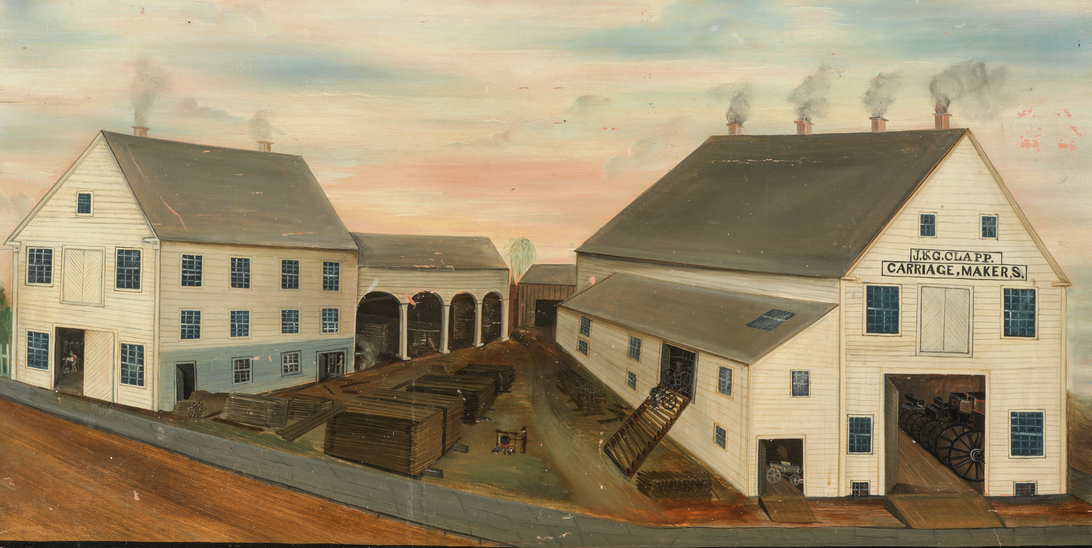
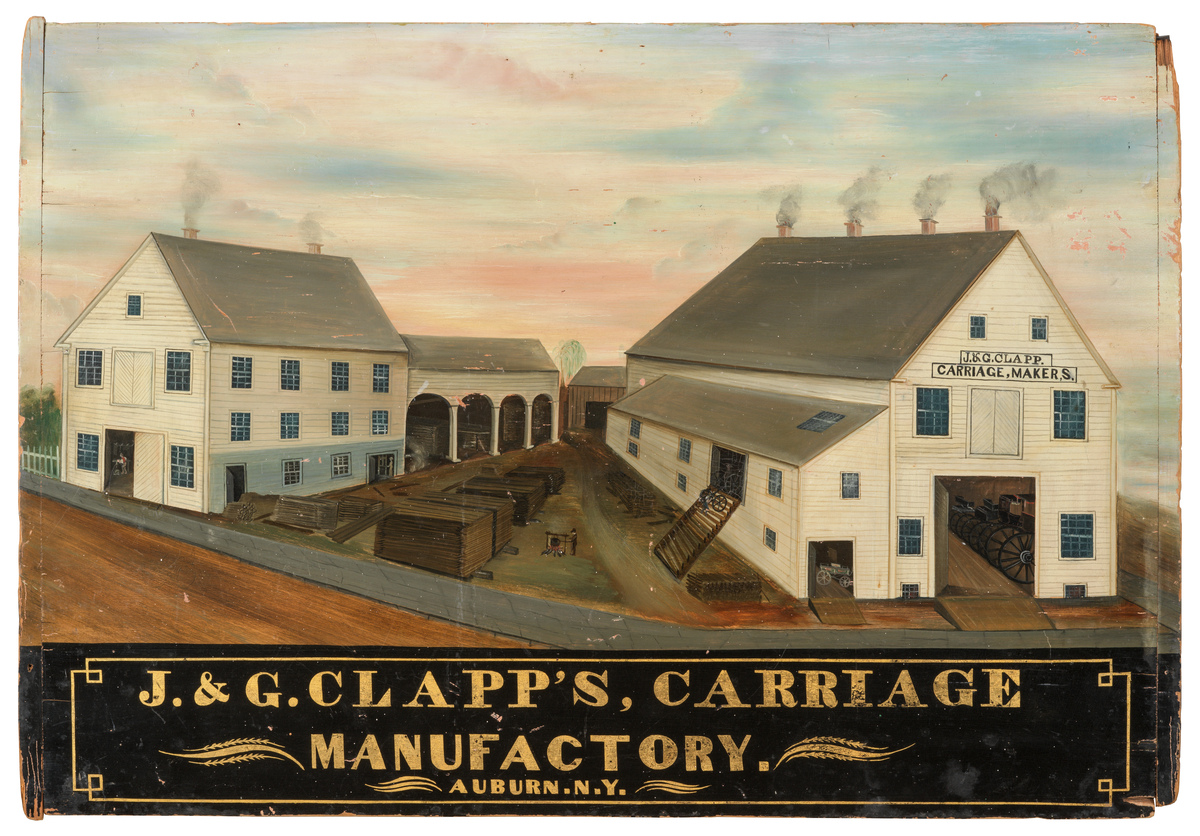
Auburn, New York, was a hub of artistic and entrepreneurial activity prior to the Civil War. Located in the Finger Lakes region, at the northern end of Owasco Lake, Auburn had long been a center for regional transportation and enterprise, and the small city grew rapidly following the opening of the Erie Canal in 1825.1 Between the canal’s opening and the Civil War, the city’s population quintupled to more than ten thousand individuals, and various manufactories flourished alongside this growing community.2 In this dynamic commercial environment, opportunities emerged for ornamental painters, especially those who worked for Auburn’s numerous carriage makers. The painted sign for the J. & G. Clapp Carriage Manufactory (act. 1834–c. 1879) reveals a web of ornamental painters competing for commissions from carriage manufactories in mid-nineteenth-century Auburn (fig. 1).
Brothers John Clapp (1806–1882) and George Clapp (1808–1899) were born in Wedmore, Sommerset, England, to George Clapp (b. 1772) and Sarah Pople (b. 1780).3 The brothers immigrated to New York in 1821 at the ages of twelve and fourteen, and by 1840 George was head of a household that included his wife, Eliza, and brother John.4 This domestic arrangement remained stable for several years as the 1855 census notes only the addition of a household servant, but by 1875 John was married, had a daughter, and was listed as head of his own household.5 The brothers were active in Auburn’s civic life—in 1841 they were paid $9.38 by Auburn for “work for the fire department,” and in 1843 they also provided supplies for the poorhouse in the amount of $8.14.6 Both were also members of the local Whig Party.7
On October 17, 1834, John and George Clapp announced their “New Establishment” in the Cayuga Patriot, offering “all kinds of carriages and sleighs which for elegance of workmanship and durability of materials cannot be surpassed,” in an advertisement that they ran for two years.8 The brothers sold carriages, wagons, and sleighs made to order and shipped throughout the United States, and they proudly announced: “Those wishing to see good and tasty work will please call and examine,” in an advertisement that ran in 1838 and 1839.9 While numerous other carriage manufactories operated in Auburn, the Clapp brothers evidently found success as, by 1835, they began hiring apprentices (fig. 2).10 The advertisement continued until 1837, indicating that the firm remained in need of workers.11 By 1856 the Clapps had a thriving business, producing more than one hundred carriages and forty to forty-five sleighs annually.12 The Clapp brothers remained listed as carriage makers in the Auburn City directory until 1879.
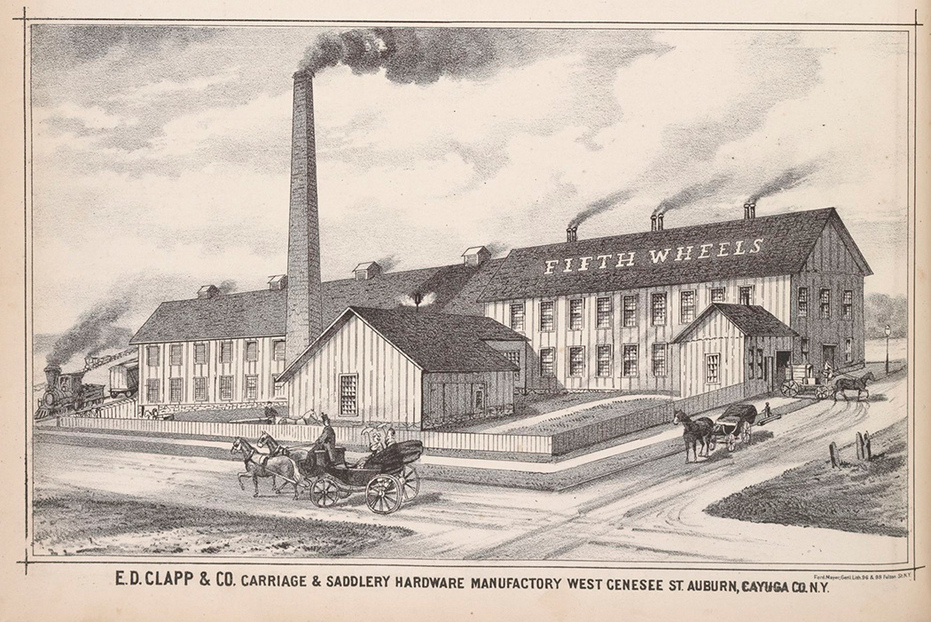
Figure 2 E. D. Clapp & Co. Carriage & Saddlery Hardware Manufactory, from Frederick W. Beers, County Atlas of Cayuga, New York (New York: Walker and Jewett, 1875), 25. New York Public Library, b14005156
The E. D. Clapp & Co. Carriage Manufactory, of no known relation to John and George Clapp, was among the brothers’ competitors in Auburn.
The Clapp brothers’ confident advertisements were evidently well founded as they received numerous accolades for their carriages.13 Local newspapers heaped praise on their work, with one review noting,
We yesterday caught a hasty glance of the new pedlar’s [sic] wagon . . . built by Mssrs. J. & G. Clapp, of State St. who have become not a little famous for turning off a goodly share of excellent work. Every portion of it—its box with numerous embellishments—its patent hubs and superb lamps,—may be taken as a specimen of good tasted skill in the art of carriage building. . . . May its voyages by land prove equally as successful as have those of its noted namesake upon the Atlantic.14
One of the handsomest and best finished pedlars [sic] wagons ever built in this place has just been completed by Mssrs. J. & G. Clapp . . . it is called the “Erie,” and very appropriately for the times, has a fine portrait of Harrison in front. The paintings, of which there are quite a number upon the several panels of the box,—are of a large size and reflect great credit upon the skill and taste of the painter, Mr. T. Kennedy.15
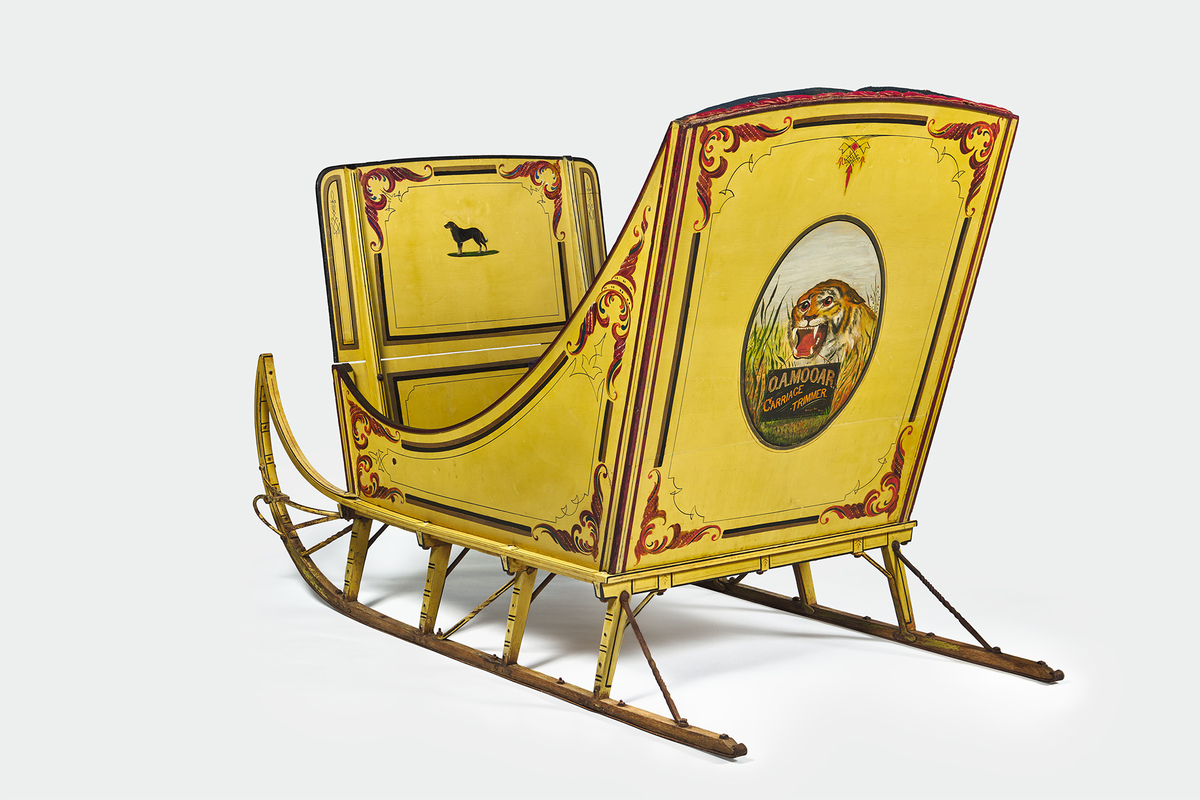
Figure 3 Sleigh, paint decorated by “Hodgkins,” c. 1865. Painted wood and iron, 48 × 40 × 70 in. Courtesy of Long Island Museum, 1995.002 (Photo: Michael E. Myers)
This c. 1865 sleigh and its sophisticated ornamental painting is similar to the products sold by J. & G. Clapp as described in contemporary newspapers.
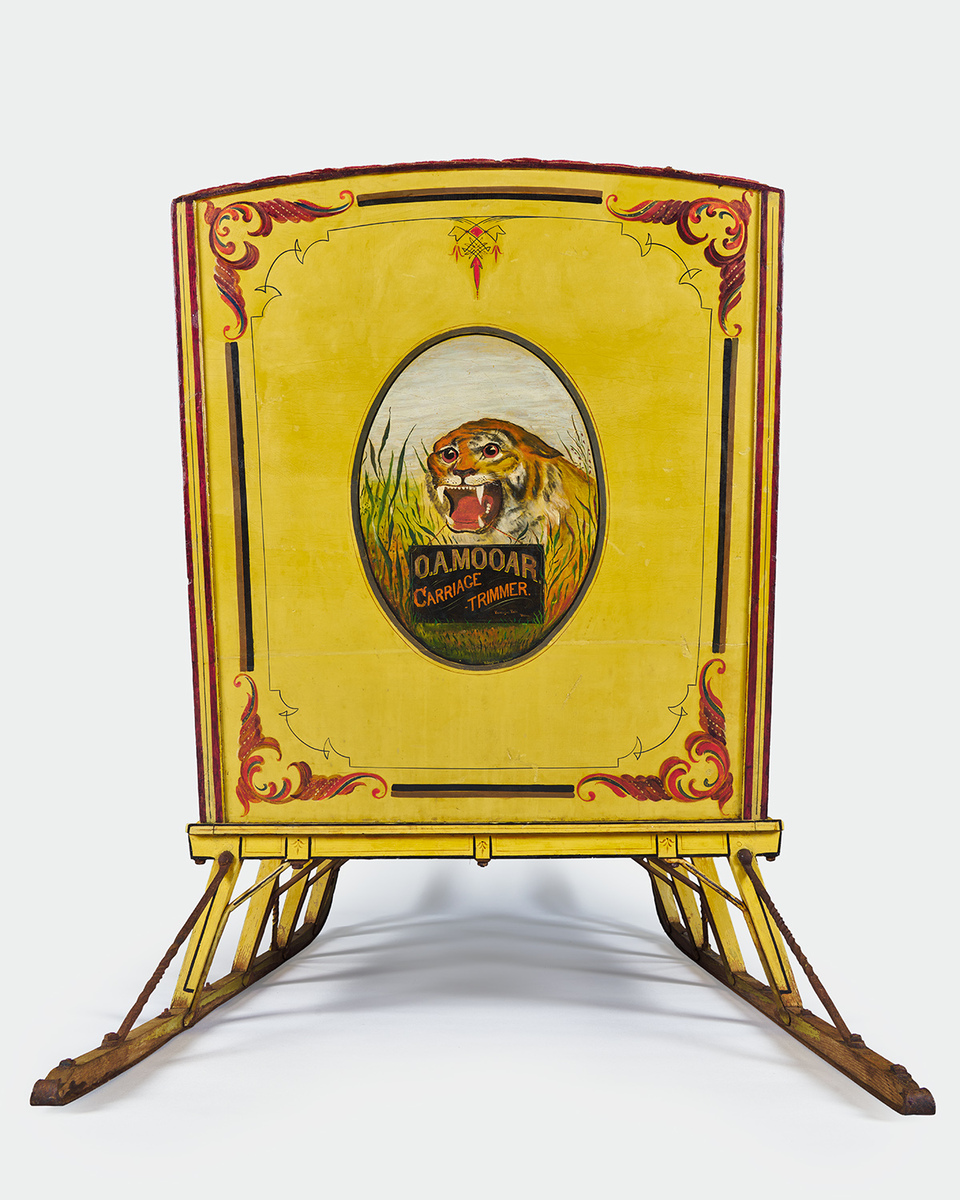
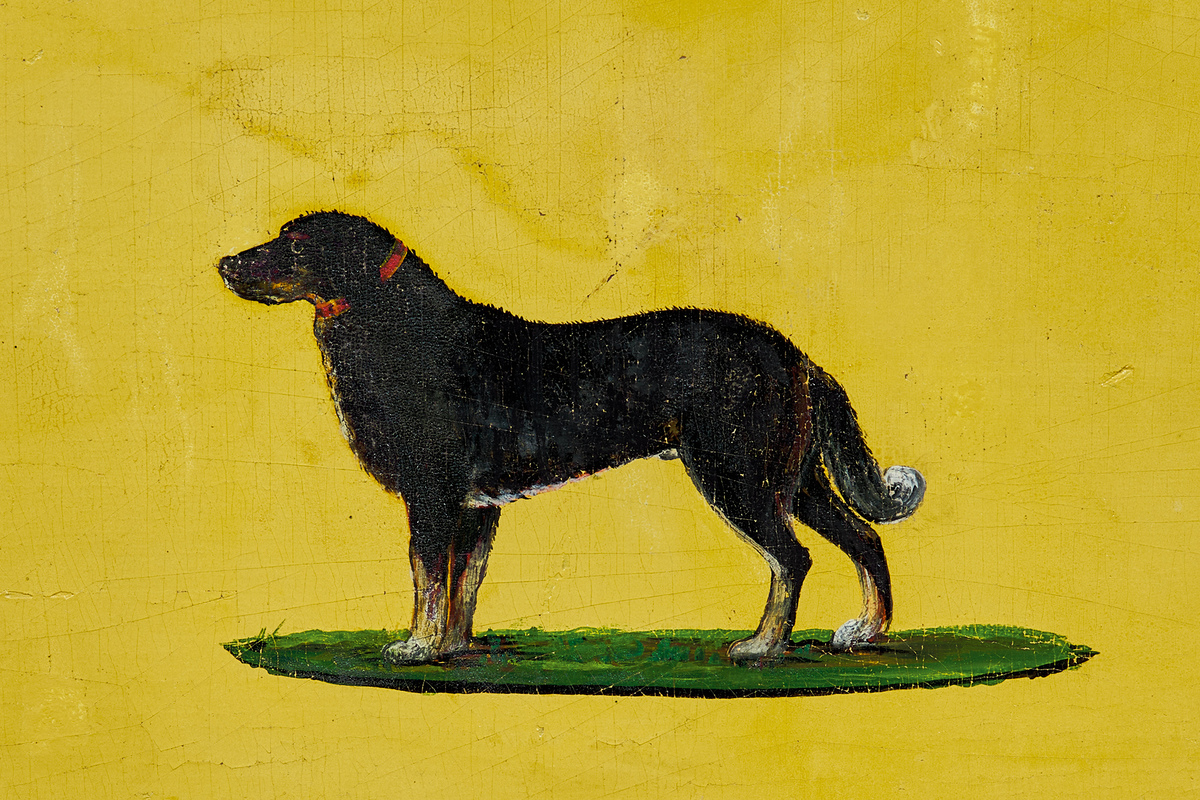
Terrence J. Kennedy (1820–1883) had arrived in Auburn in 1838 when he was eighteen years old, after completing a six-year apprenticeship in Troy, New York. He had also studied with landscape painter Thomas Grinnel and portrait painter Abel Buell Moore. Having begun his artistic training at the age of twelve, Kennedy would later become, according to William H. Gerdts, “an essential figure in the expansion of the arts” in upstate New York.16 Kennedy painted a Whig political banner in the collection of the Fenimore Museum, and he would later become a war hero, civic leader, merchant, and teacher (fig. 6).17 His artistic talents were discovered by John Milton Sherman (1793–1871), the owner of a stagecoach company and a respected real estate developer, who invited Kennedy to Auburn.18 Kennedy was also working for the Clapp brothers by 1840, so it is likely that he worked for Sherman briefly or on a part-time basis.19 It is possible that Kennedy painted the Clapp sign during his early years in Auburn before he had established himself as an independent painter and began signing his works. Comparing Kennedy’s later painted Whig banner with the Clapp sign suggests a shared sensitivity for rendering the sky in warmer pigments and the use of sharp diagonals—to form the roof lines in the Clapp sign and the dock astride the Erie Canal in the Whig painting (see figs. 1, 6). Yet the dearth of additional extant works by Kennedy makes it impossible to attribute the Clapp sign to his hand.
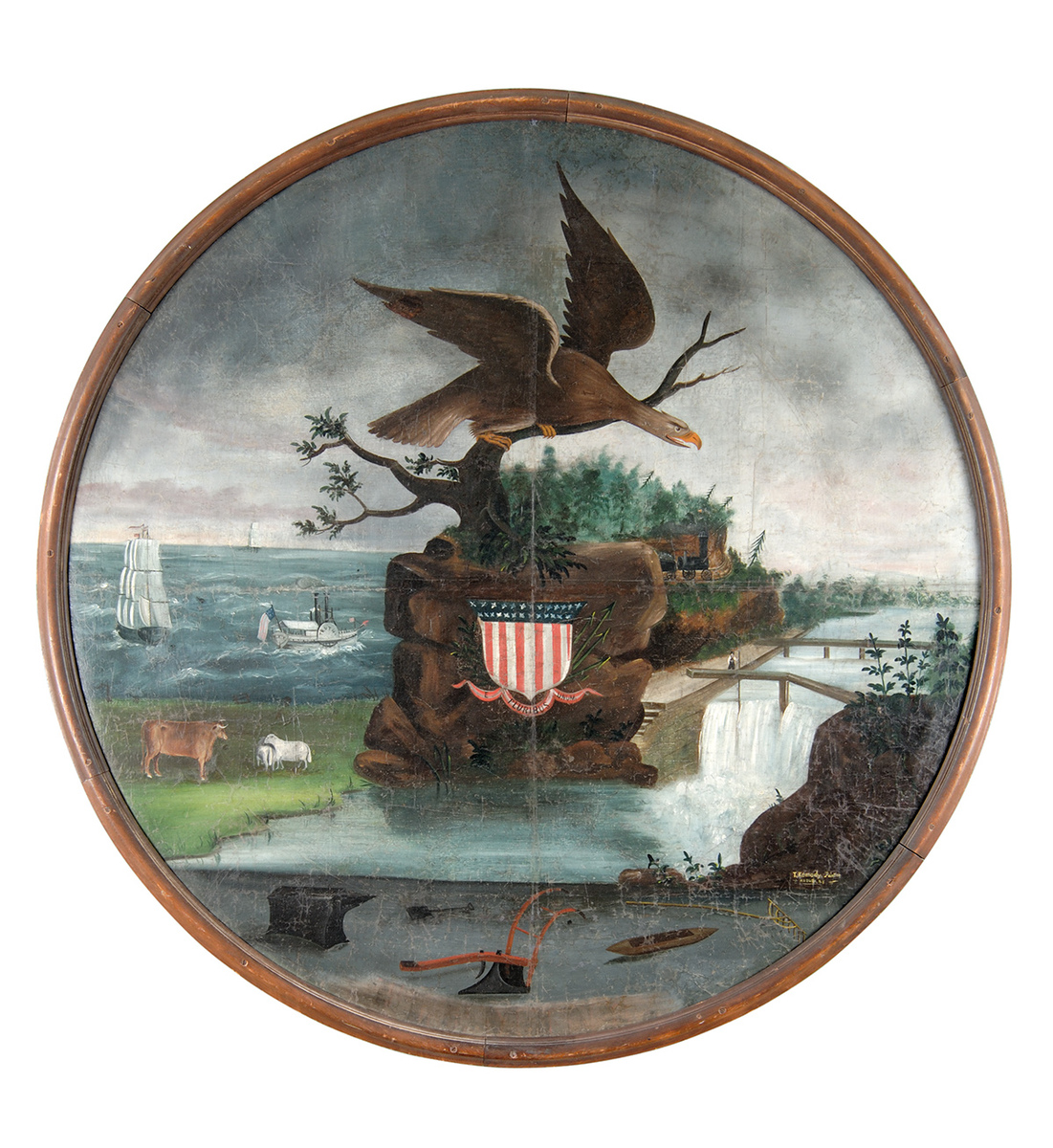
Figure 6 Terrance J. Kennedy, Whig political banner, c. 1836–44. Oil on canvas, diam. 66 in. Courtesy of the Fenimore Art Museum, N0537.1948
This political banner by Kennedy was likely displayed at Whig Party gatherings in Auburn. To the right of the eagle is a depiction of the Erie Canal, indicating Whig support for the development of national infrastructure.
By 1842 Kennedy began purchasing his own advertisements for carriage and coach painting.20 It is possible that Kennedy’s departure from the Clapp brothers’ manufactory was contentious, as he announced that he had: “Not Left Yet! As it seems to have been for the interest of some to report—but on the contrary I wish to inform the public that I have permanently established myself in the coach and carriage, sign and ornamental painting [business].”21 Kennedy long maintained this private painting business, which was located at the same address as that of his brother Martin H. Kennedy’s carriage manufacturing business “on North Street nearly opposite the Methodist church” (fig. 7).22
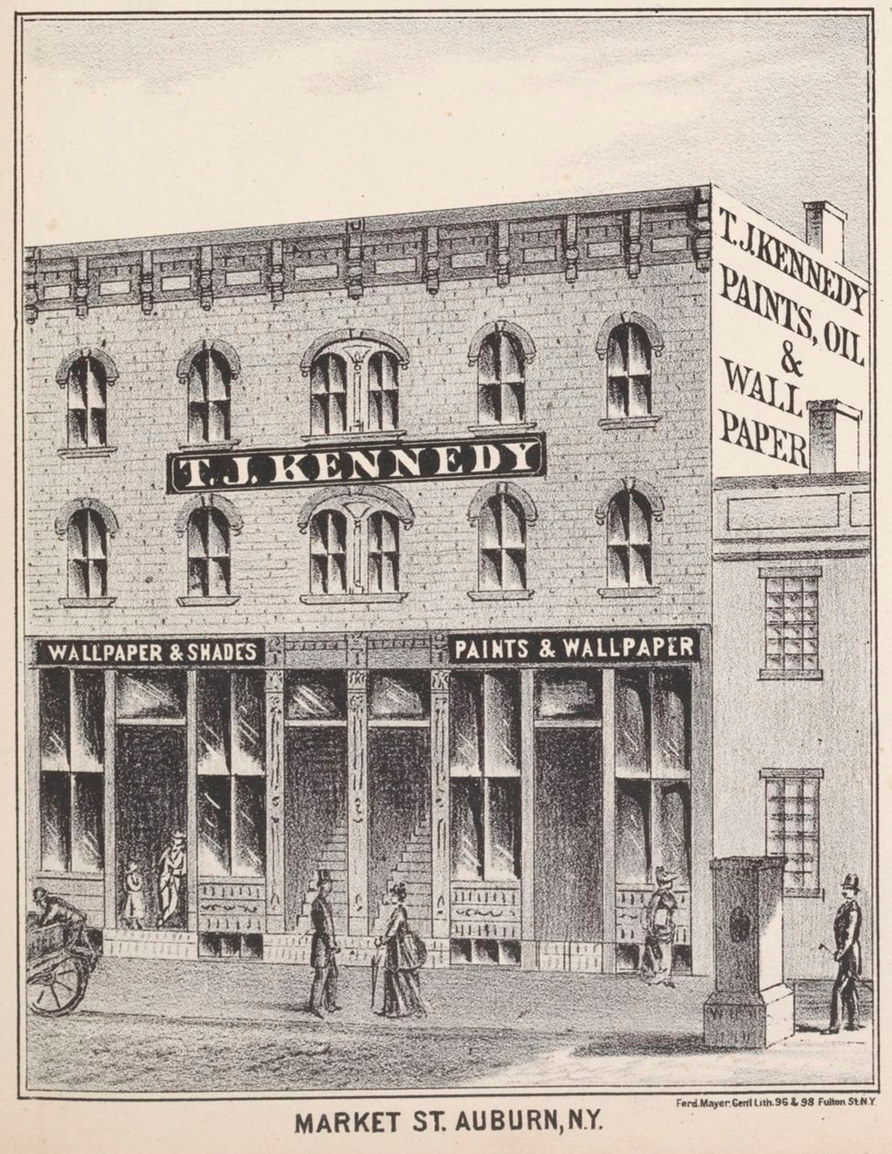
Figure 7 Market St. Auburn, N.Y., engraving, from Frederick W. Beers, County Atlas of Cayuga, New York (New York: Walker and Jewett, 1875), 21. Courtesy of the New York Public Library, b14005156
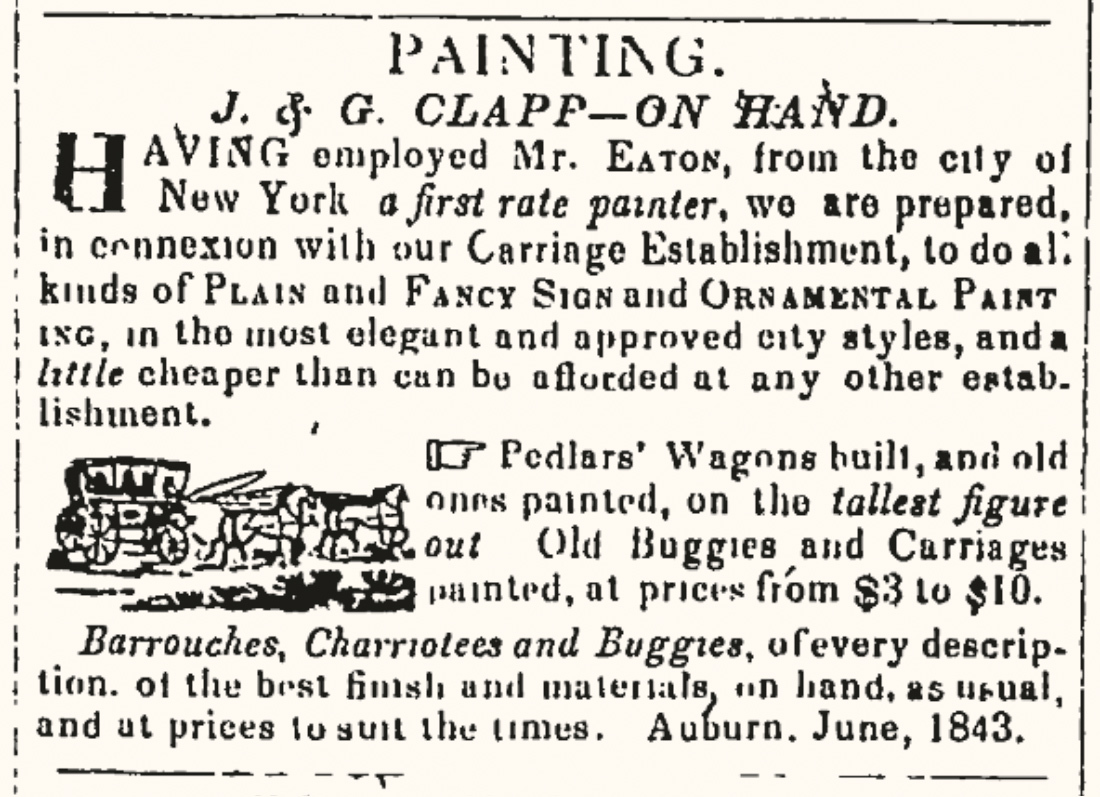
By the end of 1843, John and George Clapp had found a new painter, announcing that they had hired the “first rate painter” Mr. Eaton, recently of New York City (fig. 8).23 One possible identification for Mr. Eaton is Richardson A. Eaton (1812–1855), a painter who lived in nearby Geddes and whose son, Lewis W. Eaton (b. 1836), specialized in ornamental “bill posting” and “sign painting” after establishing his own business in Auburn.24 It is possible that Eaton painted the Clapp sign between 1843 and 1846 while he worked for the Clapp brothers. In 1846 the Clapp brothers ceased advertising their painting services but still declared that their “most fashionable carriages” were “Not To Be Beat!!”25
While Kennedy and Eaton are documented as having worked with the Clapp brothers, other carriage painters were also active in mid-nineteenth-century Auburn. The Briggs family advertised house, sign, and ornamental painting in Auburn beginning in May 1840 after J. P. Briggs established a retail shop and painting service.26 In August 1844, this business expanded when Briggs announced the “Auburn Paint Shop at Store no. 19 on the Bridge.”27 J. P. Briggs was also active in nearby Geneva, New York, with his relative, G. C. Briggs. In 1844 G. C. Briggs had acquired both the Auburn and Geneva shops, advertising that he “executes Painting, Graining, and Paper Hanging at the lowest prices.”28
Ichabod T. Marshall was another ornamental painter active in 1840s Auburn.29 On March 15, 1839, the town paid the firm of Marshall and Knapp $70.00 for painting its new fire engine.30 In March of 1842, he received $3.00 for painting parade caps and trumpets for the town, and an additional $3.00 for “work on engine.”31 His work was praised by the local press, who proclaimed: “There [sic] engine has lately been under the hands of our young artist Mr. Marshall, and it was no discredit to his name. We particularly admired the painting on the back piece.”32 Marshall must have been respected for his work, as he was invited to give a lecture about painting at the Auburn Literary Association in February 1843.33
Although the maker of the J. & G. Clapp Carriage Manufactory sign remains unknown, the sign itself is a testament to the importance of this long-lived family business and a tangible remnant of upstate New York’s early industrial history. Advertising signs were essentially popular portraits of successful businesses, reflecting pride in the industry of the antebellum rural United States and offering a glimpse into the lives and accomplishments of New York’s early entrepreneurs.

Acknowledgments
About the Author
1 Scott W. Anderson, Auburn, New York: The Entrepreneurs’ Frontier (Syracuse, NY: Syracuse University Press, 2015), 143.
2 US Census Bureau, Census for 1820 (Washington, DC: Gale & Seaton, 1821), 49; US Census Bureau, Population of the United States in 1860 (Washington, DC: Bureau of the Census Library, 1864), 330.
3 For biographical details on the birth and death years of the Clapp family members, see 1880 Census, Auburn, Cayuga, New York, roll 813, p. 245d, Ancestry.com; and Somerset Heritage Service, Taunton, Somerset, England, Somerset Parish Records, 1538–1914, Ancestry.com.
4 New York State Archives, Albany, NY, USA, Census of the State of New York, 1840, Ancestry.com.
5 New York State Archives, Albany, NY, USA, Census of the State of New York, 1855, Ancestry.com; New York State Archives, Albany, NY, USA, Census of the State of New York, 1875, Ancestry.com.
6 “A Statement of the Receipts and Expenditures,” Auburn Journal and Advertiser, March 24, 1841: 2; “Supplies for the Poor House,” Auburn Journal and Advertiser, December 20, 1843: 2.
7 “Whig County Meeting,” Auburn Journal and Advertiser, March 14, 1838: 2.
8 “New Establishment,” Cayuga Patriot, October 17, 1834: 3.
9 “Carriage Manufactory,” Auburn Journal and Advertiser, January 3, 1838: 1.
10 The Auburn directory of 1860 even includes numerous different listings of the name “Clapp” active in the carriage business. In addition to separate listings for John and George Clapp, their younger brother Ambrose Clapp (1818–1899) also worked as a carriage maker in Auburn. E. D. Clapp (1829–1889), a carriage maker who grew up in nearby Ira, New York, came to Auburn in 1856 to build a livery and carriage business. It is unknown whether E. D. Clapp was related to John, George, and Ambrose Clapp. The E. D. Clapp company manufactured carriage hardware into the twentieth century. See William H. Boyd, 1860 Boyd’s Auburn Directory (printed by the author, 1859), 39; D. Morris Kurtz, Auburn, N.Y., Its Facilities and Resources (Auburn, NY: printed by the author, 1884), 69–73.
11 “Two Apprentices Wanted,” Cayuga Patriot, August 14, 1836: 4; “Two Apprentices Wanted,” Cayuga Patriot, January 25, 1837: 4.
12 “Auburn Markets,” Auburn Weekly American, December 17, 1856: 3.
13 Including, for example, commendations for the carriages exhibited at the State Fair in Rochester in 1843. See “Cayuga County Agricultural Fair,” Auburn Journal and Advertiser, October 18, 1843: 2.
14 “The Great Western Ashore!,” Auburn Journal and Advertiser, May 22, 1839: 2.
15 “One of the Handsomest . . .,” Auburn Journal and Advertiser, May 13, 1840: 2.
16 William H. Gerdts, Art Across America: Two Centuries of Regional Painting, vol. 1, The East and the Mid-Atlantic (New York: Abbeville, 1990), 190.
17 See Deborah Harding, Stars and Stripes: Patriotic Motifs in American Folk Art (New York: Rizzoli, 2002), 55–56. See also Paul D’Ambrosio, “The Big Whig Banner,” American Folk Art at Cooperstown, posted January 1, 2010, accessed July 10, 2024, folkartcooperstown.blogspot.com.
18 This story is repeated in many sources, including Elliot G. Storke, The History of Cayuga County, New York (Syracuse, NY: D. Mason, 1879), 66–67. It originated from a letter that Kennedy wrote when he was assembling information about the history of art in Cayuga County.
19 See n. 15.
20 “T. Kennedy: Coach and Carriage, Sign, and Ornamental Painter,” Cayuga Patriot, August 17, 1842: 3; “T. Kennedy,” Auburn Journal and Advertiser, February 1, 1843: 3; Cayuga Patriot, December 12, 1843: 4.
21 “Not Left Yet!,” Auburn Journal and Advertiser, June 28, 1843: 1.
22 “Coach, Carriage Sign & Ornamental Painting,” Auburn Journal and Advertiser, May 13, 1846: 3.
23 “Painting. J. & G. Clapp—On Hand,” Cayuga Patriot, December 20, 1843: 4.
24 1850 Census, Geddes, Onondaga, New York, 568; p. 501a, Ancestry.com; William H. Boyd, 1865 Boyd’s Auburn Directory (printed by the author, 1865), 15.
25 “Not to be Beat!!,” Auburn Journal and Advertiser, August 12, 1846: 4.
26 “House, Sign, and Ornamental Painting,” Auburn Journal and Advertiser, July 22, 1840: 3.
27 “Auburn Paint Shop,” Auburn Journal and Advertiser, August 14, 1844: 3.
28 “Briggs,” Auburn Journal and Advertiser, April 17, 1844: 1.
29 “Only Necessary to Say!,” Auburn Journal and Advertiser, August 24, 1842: 3.
30 “A Statement of the Receipts and Expenditures,” Auburn Journal and Advertiser, March 20, 1839: 2.
31 “A Statement of the Receipts and Expenditures,” Auburn Journal and Advertiser, March 23, 1842: 2.
32 “National Anniversary,” Auburn Journal and Advertiser, July 8, 1840: 2.
33 “Congressional,” Auburn Journal and Advertiser, February 1, 1843: 3.